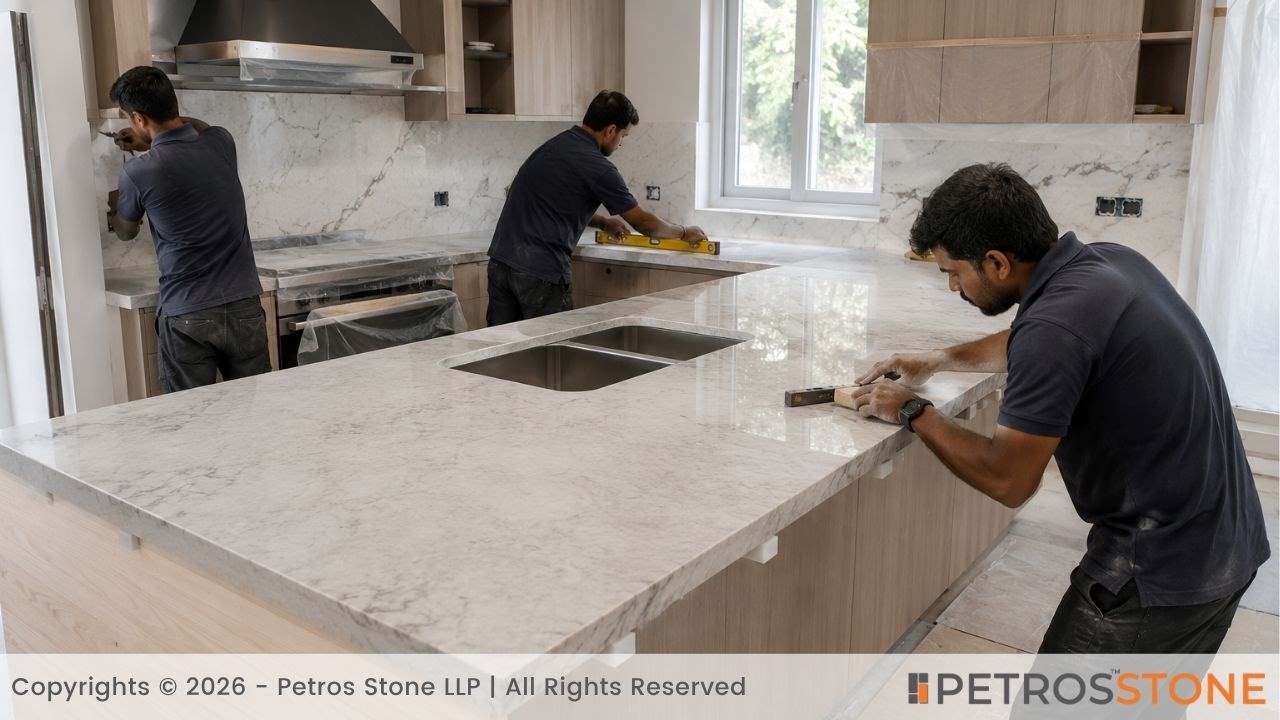
Calacatta marble installation follows six stages: slab selection, cabinet preparation, templating, layout approval, fabrication (often 1–3 weeks), and installation (usually one day). Use an experienced stone fabricator, plan seams and cutouts before cutting, and approve the actual slab in writing. This guide covers each step, kitchen and bathroom preparation, typical costs, and mistakes to avoid.
- What Should You Know Before Installing Calacatta Marble?
- How Is Calacatta Marble Installed?
- Who Should Install Calacatta Marble?
- How Should You Prepare Your Kitchen or Bathroom?
- How Should Calacatta Marble Seams Be Planned?
- Which Adhesives and Supports Are Suitable?
- What Can Go Wrong During Installation?
- What Should You Check After Installation?
- How Long Does Installation Take, and What Does It Cost?
- FAQs
- Key Takeaways
What Should You Know Before Installing Calacatta Marble?
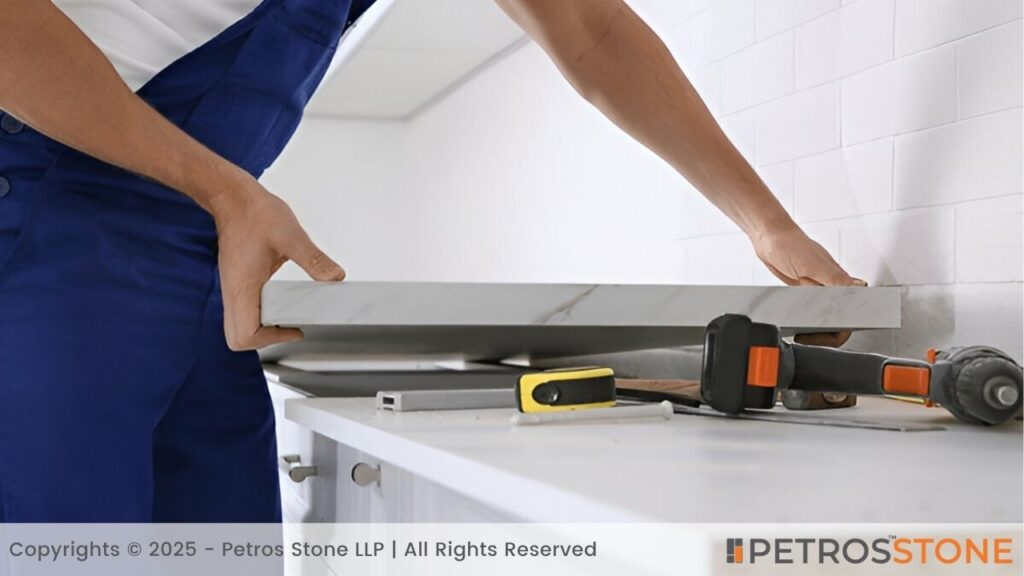
Hire an experienced stone fabricator and installer. Calacatta marble is relatively soft, can contain natural fissures, and may crack if mishandled or inadequately supported.
Five Things to Know Before Installing Calacatta Marble
- Weight: A 2 cm slab weighs about 11 lb per sq. ft.; a 3 cm slab weighs 16–17 lb. Actual weight varies by stone density.
- Cutouts: Sink and cooktop openings need careful fabrication to reduce cracking risks. Learn about cutouts.
- Acid sensitivity: Marble can etch on contact with acids; sealing does not prevent etching. Learn about sealing.
- Natural veining: Vein direction affects seam placement and visual continuity. Learn about seams.
- Planning: Finalise cabinets, fixtures, edge profiles, and seam locations before templating. See the installation process.
How Is Calacatta Marble Installed?

The installation process generally follows six stages.
Calacatta Marble Countertop Installation – Stages and Typical Timeline
| Stage | What happens | Typical timing |
|---|---|---|
| Slab selection | Inspect and approve the actual slabs | Before ordering |
| Cabinet preparation | Check level, stability, and support | Before templating |
| Templating | Measure cabinets, walls, and cutouts | Usually one visit |
| Layout approval | Review seams and veining on the selected slab | Several days, depending on the project |
| Fabrication | Cut, reinforce, shape, and polish the stone | Often 1–3 weeks |
| Installation | Dry-fit, support, bond, join, and inspect | Often one day |
These are indicative timings. Slab availability, workshop schedules, project complexity, and rework can extend the process.
How Does Templating Work?
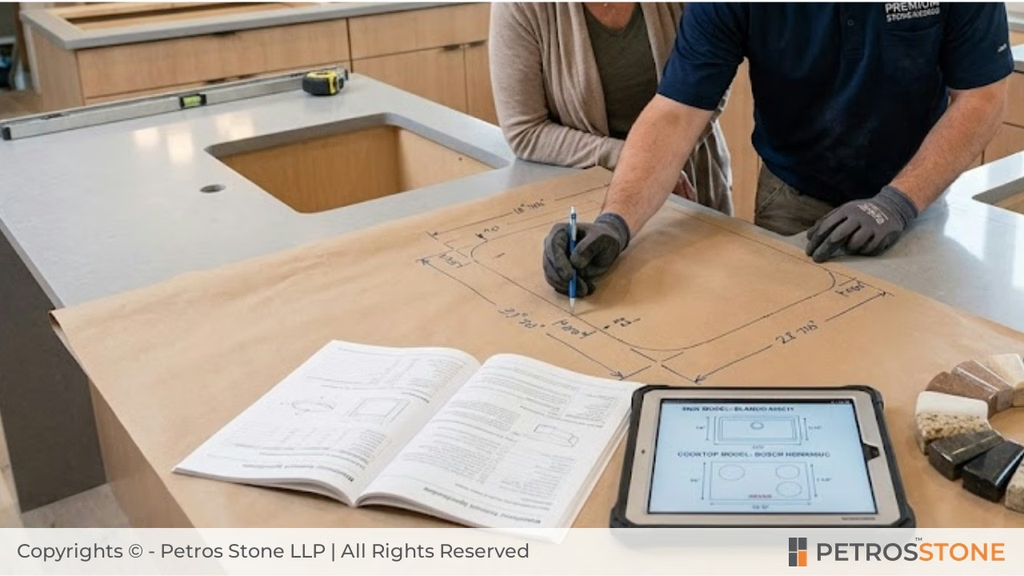
Templating records countertop dimensions, backsplash height, and sink and appliance openings so the fabricator can cut the stone accurately. Before approving the template, confirm all fixtures, faucet holes, edge profiles, and overhangs, and review seam planning before cutting.
What Happens During Fabrication?

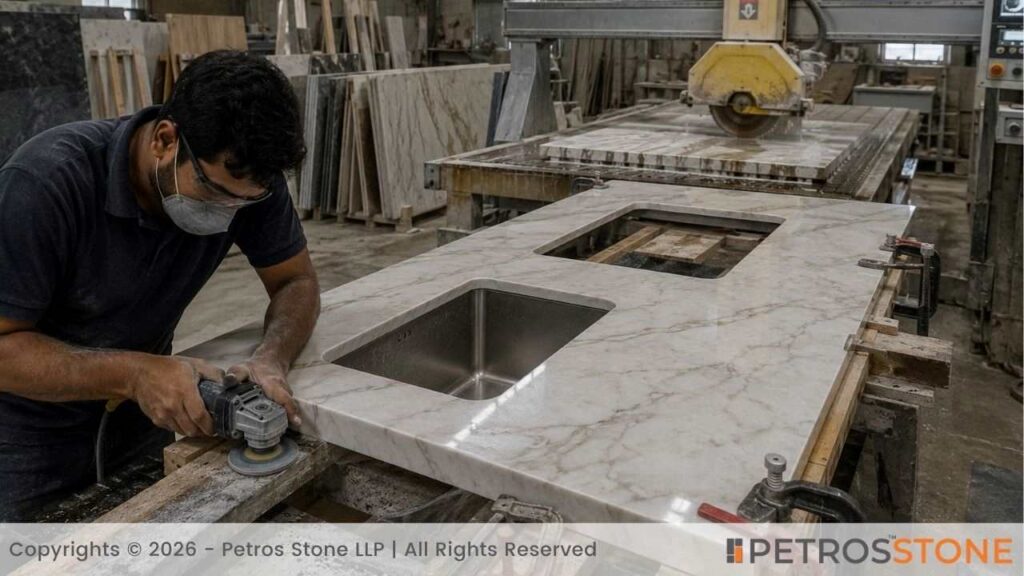
The workshop positions the approved layout over the actual slab, taking the veining and natural fissures into account. The stone is then cut, the edges are shaped and polished, and the required openings are made.
Internal cutout corners should be appropriately rounded to reduce stress concentration. Where necessary, the fabricator may reinforce vulnerable areas using a method suitable for the slab and application.
Important: Ask to review the cutout and seam layout before fabrication begins, especially for expensive or strongly veined Calacatta varieties.
What Happens on Installation Day?
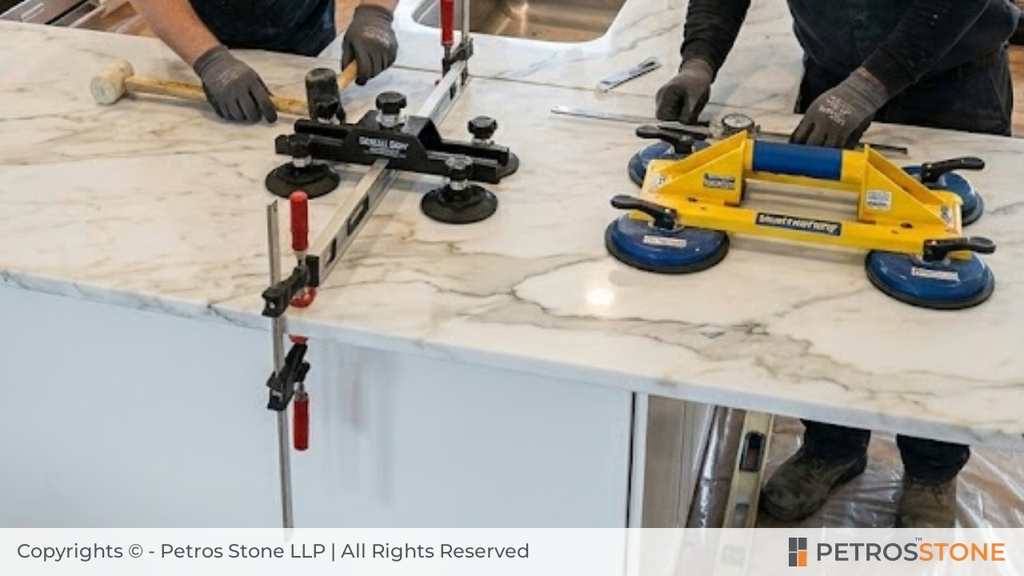
The crew checks the cabinets, carries the pieces using suitable slab-handling equipment, dry-fits them, adjusts the support, and joins the sections using compatible adhesives.
Before the crew leaves, inspect the seams, edges, cutouts, surface finish, and agreed support details. Photograph any defects and record them in writing.
Who Should Install Calacatta Marble?
Choose a fabricator experienced in both working with white marble and installing the finished pieces. Ideally, one company should take responsibility for fabrication and installation.
How Do You Choose a Reliable Fabricator?
Questions to ask and what the quote must include:
- Photographs of completed Calacatta or other white-marble projects, including close-ups of seams.
- References from recent customers.
- Details of the templating, cutout, and reinforcement methods.
- A clear explanation of how breakage, defects, and replacement costs are handled.
- Relevant credentials or industry affiliations, where applicable.
Membership of the Natural Stone Institute (NSI) can be a useful credibility signal, but it does not guarantee workmanship.
How Should You Prepare Your Kitchen or Bathroom?

Check Cabinet Level and Support
Cabinets must be installed, secured, and adequately supported before templating. Their tops should be level, stable, and sufficiently flat for the specified stone installation.
Shims can correct minor variations, but they cannot fix a weak, twisted, or sagging cabinet. Pay particular attention to gaps around dishwashers and other appliances, where additional support may be necessary.
The required support depends on slab thickness, cabinet construction, spans, and the fabricator’s specifications.
Finalise Sinks, Faucets and Appliances
Confirm the exact sink, faucet, cooktop, and accessory models before templating. Their installation specifications determine the required cutout dimensions and clearances.
Late changes can mean re-templating or recutting, adding cost and delay.
Prepare for Installation Day
Empty the cabinets, clear the access route, and ensure someone authorised to make decisions is available. Arrange plumbing or appliance disconnection in advance if it is included in the project plan.
How Should Calacatta Marble Seams Be Planned?
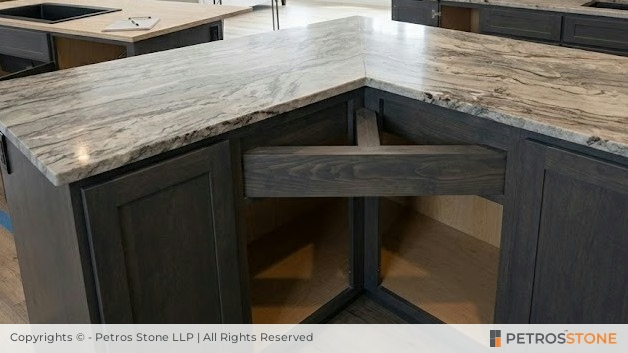
Seams are sometimes unavoidable, particularly on long countertops, L-shaped runs, and large islands. The goal is to place them where they are structurally appropriate and visually discreet.
Where Should Seams Go?
The best position depends on the cabinet layout, slab dimensions, and cutouts. Seams should have suitable support underneath and should not compromise narrow sections around sink or cooktop openings.
Avoid placing seams across unsupported gaps or close to vulnerable cutout corners unless the fabricator has designed an appropriate solution.
How Do You Match the Veining?

Vein matching means planning adjoining pieces so their natural patterns flow as consistently as possible across a seam.
Book-matching uses consecutive slabs arranged as mirror images. It can create a striking effect on backsplashes and waterfall islands, but increases material selection and fabrication requirements.
A well-made seam should be aligned, flush, and filled with a compatible, colour-matched adhesive. It may still be visible on close inspection.
Ask the fabricator to mark the proposed cuts and seams on a photograph of your actual slab. Approve the layout before cutting, not after installation.
Which Adhesives and Supports Are Suitable?
Why Do Setting Materials Matter?
White marble can be translucent, and unsuitable adhesives or setting materials may cause discolouration or visible marks.
- Use adhesives and setting products specifically suitable for the stone and application.
- Select seam adhesives with an appropriate colour and compatibility.
- For cement-based setting materials, confirm that the product is suitable for natural stone and use a white formulation where required.
- Avoid organic mastics where the applicable natural-stone installation guidance prohibits them.
- Test potentially discolouring products on an offcut when appropriate.
The fabricator or installer should identify the products being used and follow their technical data sheets.
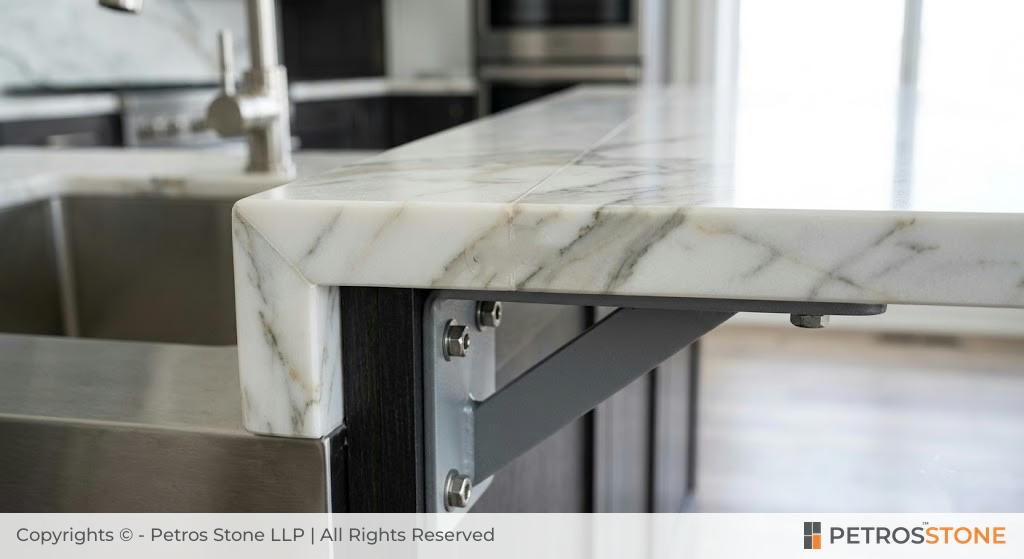
Do Overhangs Need Additional Support?
Yes, when the dimensions and loading exceed what the stone and substrate can safely support.
Is Plywood Required Under Calacatta Marble?
Not in every installation. The answer depends on slab thickness, cabinet construction, support conditions, and the selected installation system.
What Can Go Wrong During Installation?
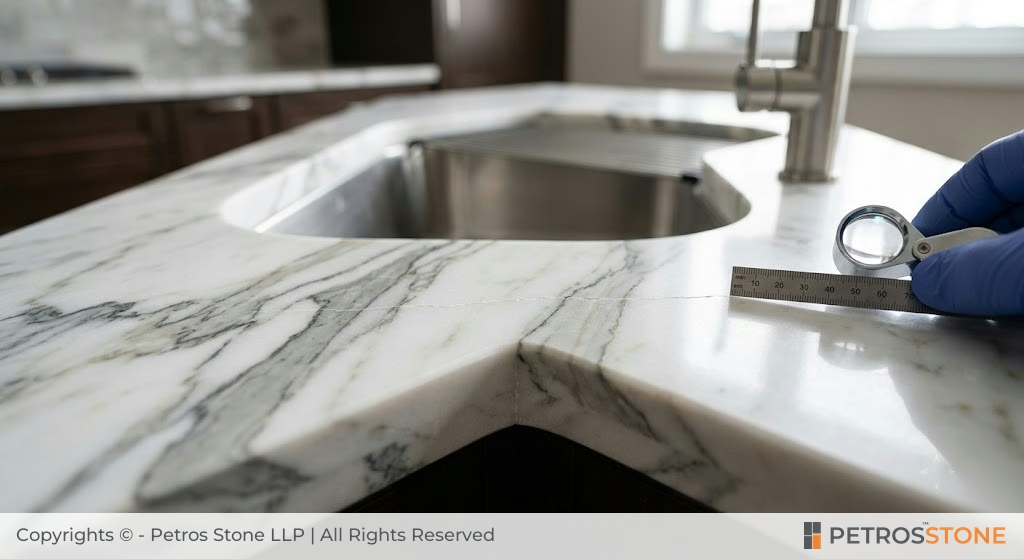
Cracking During Handling or Installation
Common contributing factors include poor handling, natural fissures, inadequate support, uneven cabinets, vulnerable cutouts, and excessive unsupported spans.
Prevention: Inspect the slab before cutting, plan the cutouts carefully, provide suitable reinforcement, and use trained personnel with appropriate handling equipment.
Staining or Discoloration
Incompatible adhesives, setting materials, or moisture conditions can leave marks beneath or around the stone.
Prevention: Specify stone-compatible products, confirm their suitability for white marble, and test on an offcut when necessary.
Chipping Around Edges and Cutouts
Thin edges and sharp internal corners can be vulnerable to impact and stress.
Prevention: Use an appropriate edge profile, carefully finished cutouts, and the support specified for the installation. Document any damage immediately.
What Should You Check After Installation?

When Can You Use the Countertop?
Follow the fabricator’s instructions for adhesive curing and safe use. Avoid heavy loads or pressure on seams and overhangs until the specified curing period has passed.
Use trivets and cutting boards from the beginning.
When Should You Seal the Marble?
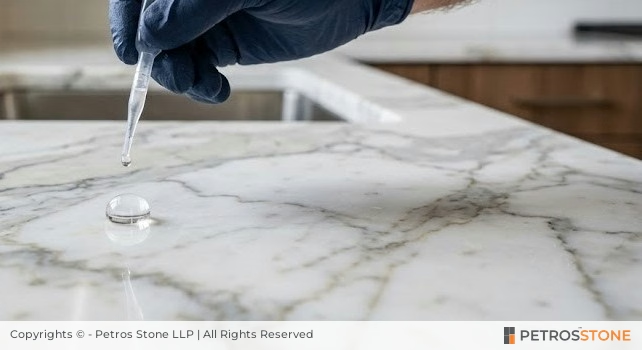
Use a penetrating sealer formulated for natural marble if the stone and application require it. Sealing can reduce liquid absorption, but it does not make marble waterproof or prevent acid etching.
A water-drop test can help assess whether the stone is absorbing moisture, although results depend on the stone’s finish and condition. Follow the sealer manufacturer’s instructions for application, drying, and curing.
Resealing frequency varies with use, exposure, and product. Test the stone periodically rather than relying on a fixed calendar alone.
Final Inspection Checklist
Before signing off, check:
- Seams are aligned, flush, and neatly finished.
- No visible chips, cracks, adhesive haze, or unexpected discolouration are present.
- Cutout edges are properly finished.
- The countertop is stable and does not rock.
- Brackets and other specified supports are installed.
- The surface has been cleaned and any agreed sealing work completed.
Inspect under good lighting and record any issues before the installation team leaves.
How Long Does Installation Take, and What Does It Cost?

What delays installation?
Delays can arise from unfinished cabinets, unavailable slabs, changes to appliances, late seam approvals, fabrication damage, or revised measurements.
What Does Installed Calacatta Marble Cost?
Installed Calacatta marble countertops in the US typically cost about 80 –150 per sq. ft. Confirm the range with sales first. Rare varieties and elaborate projects can cost substantially more.
The final price depends on the slab grade, thickness, fabrication complexity, edge profile, number of cutouts, seam matching, and local labour rates.
Factors That Affect Calacatta Marble Countertop Cost
| Cost Factor | Why It Changes the Price |
|---|---|
| Slab Grade | Premium Calacatta marble slabs with a brighter white background, distinctive veining, and fewer visible defects generally cost more than commercial-grade slabs. |
| Thickness | Thicker slabs, such as 3 cm compared with 2 cm, require more stone and may increase material, handling, and installation costs. |
| Edge Profile | Simple straight edges cost less to fabricate, while decorative profiles, rounded edges, and built-up edges require additional labour and finishing. |
| Cutouts | Cutouts for sinks, cooktops, taps, and other fixtures require precise cutting and finishing. Complex cutouts may increase fabrication costs and the risk of breakage. |
| Book-Matching and Waterfall | Book-matched slabs must be selected and aligned to create continuous veining. Waterfall edges require additional material, careful vein alignment, and precise fabrication. |
| Demolition and Reconnection | Removing existing countertops, disposing of debris, and reconnecting plumbing, sinks, cooktops, or electrical fixtures add costs beyond the new marble and its installation. |
Potential additional costs include:
- Demolition and removal of the existing countertop.
- Sink, cooktop, and faucet cutouts.
- Special edge profiles and laminated edges.
- Book-matching, waterfall panels, and full-height backsplashes.
- Brackets, substrates, and cabinet repairs.
- Plumbing or appliance disconnection and reconnection.
Buyer tip: Compare written quotations with the same scope of work. A low material price may not include fabrication, delivery, installation, or structural support.
FAQs
Can I install Calacatta marble myself?
We strongly recommend professional installation because the slabs are heavy, vulnerable to damage, and expensive to replace. Cutouts, lifting, and support also require appropriate equipment and experience.
Should I choose 2 cm or 3 cm Calacatta marble?
Neither is always better. A 2 cm slab weighs about 11 lb per sq. ft. and a 3 cm slab about 16–17 lb; choose based on cabinet support, look, and your fabricator’s system.
Will the seams be visible?
Often slightly, but good planning makes them much less noticeable: accurate cutting, vein matching, and colour-matched adhesive.
How much overhang is safe without support?
No universal limit applies to every Calacatta slab. Thickness, stone condition, support, and loading determine the safe design. Obtain written guidance from the fabricator.
Is honed or polished Calacatta marble better?
Neither is universally better: polished shows etching more clearly; honed may disguise surface dulling.
How much does Calacatta marble installation cost?
About 80–150 per sq. ft. installed in the US (budgeting estimate); rare varieties and complex projects cost more. Compare written quotes with the same scope.
How long does installation take?
Fabrication usually takes 1–3 weeks after templating; installation is often one day. Delays come from unfinished cabinets, slab availability, appliance changes, or late seam approval.
Does Calacatta marble need sealing?
Often. Use a penetrating sealer made for natural marble if the stone and use require it. Sealing does not stop acid etching, so use trivets and pH-neutral cleaners.
How should I clean Calacatta marble?
Use a pH-neutral natural-stone cleaner and a soft cloth. Avoid acidic products such as vinegar and lemon juice, which can etch the surface.
Key Takeaways
- Choose an experienced fabricator and approve the actual slab before cutting.
- Finalise cabinets, sinks, appliances and seam positions before templating.
- Review the cutout, veining and reinforcement plan before fabrication.
- Confirm suitable adhesives, substrates and structural supports.
- Put breakage responsibility, costs, inclusions and lead times in writing.
- Inspect the installation before sign-off and follow product-specific sealing and curing instructions.
- Treat all cost and support figures as preliminary until confirmed for your project.

Tapas Koul leads editorial direction and content strategy at Petros® Stone, bringing over 15 years of combined experience in e-commerce, publishing, and digital communication. His work spans research, strategy, and communication, with a focus on natural stone, its technical properties, processing, and architectural applications. Collaborating with Petros® Stone’s production team, laboratory experts, and specialists, he translates industry knowledge into clear, engaging content and communication for diverse audiences.
Feel free to get in touch for a free consultation, quote, and get a detailed understanding from our experts here at Petros®. Visit www.petrosstone.com or call +91-8446360361 or WhatsApp

Brown Granite

White Galaxy Granite

Blue Bahia Granite

Silver Cloud Granite

Black Pearl Granite

Dallas White Granite