Why Is Travertine Mostly Used for Exterior Applications?
Travertine’s porous, pitted texture drives its outdoor use. It provides slip resistance, natural drainage and heat reflectivity, staying cool underfoot unlike concrete. It resists cracking and fading from rain, UV and freeze-thaw, and costs less than marble or granite. But remember one caveat: it requires regular sealing to prevent staining and moisture damage over time. And this is why it is very highly sought after for exterior applications.
To understand more about Travertine and its types, Rishabh Jain, Director – International Business at Petros® Stone, spoke with Mehdi Eslamibidgoli, Quarry & Factory Owner, STONEMAN, Iran, about the characteristics, colour variations, and commercial distinctions found across travertine. Mr. Mehdi, whose operation includes twelve quarries, a central processing factory, stockyards, and a showroom, explained how changes in quarry location can influence the appearance and quality of materials such as White, Silver, Titanium, and Red Travertine.
Mehdi Eslamibidgoli (Quarry & Factory Owner, STONEMAN, Iran)
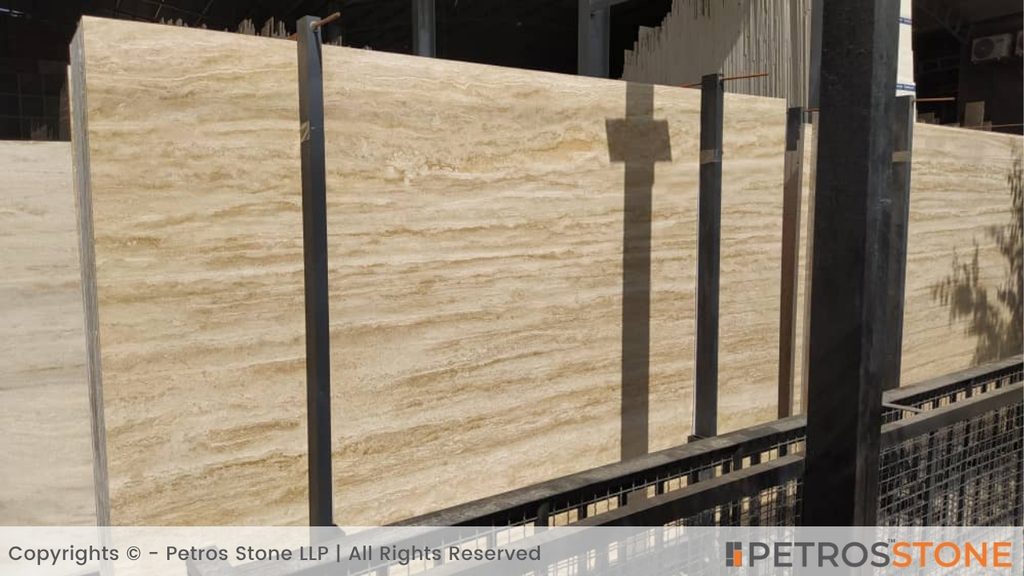
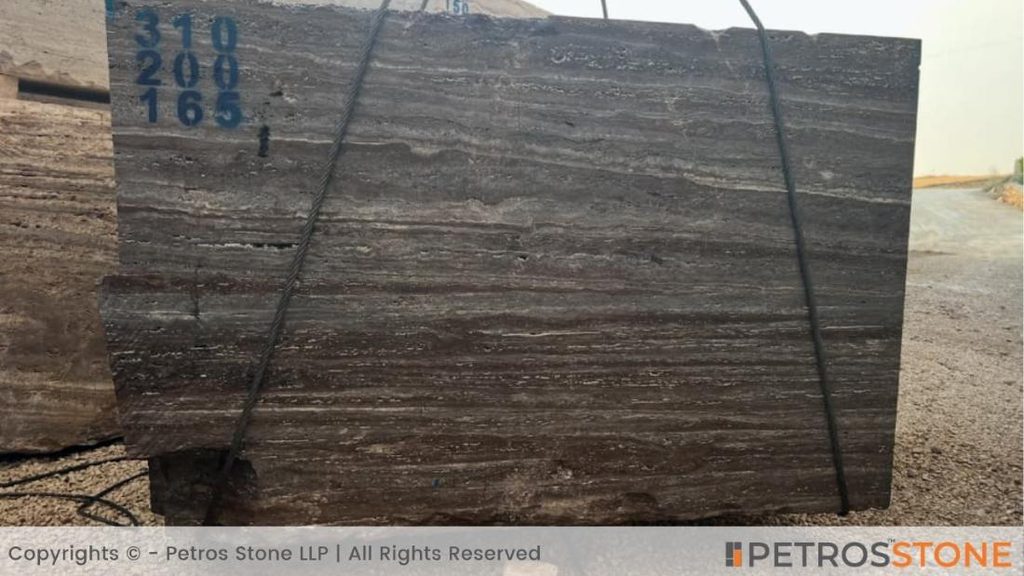
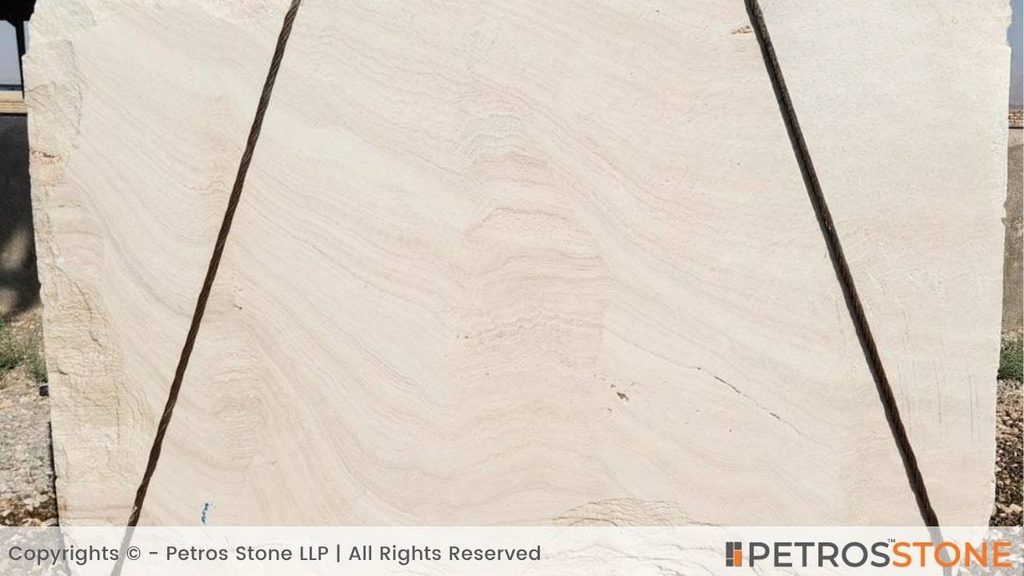
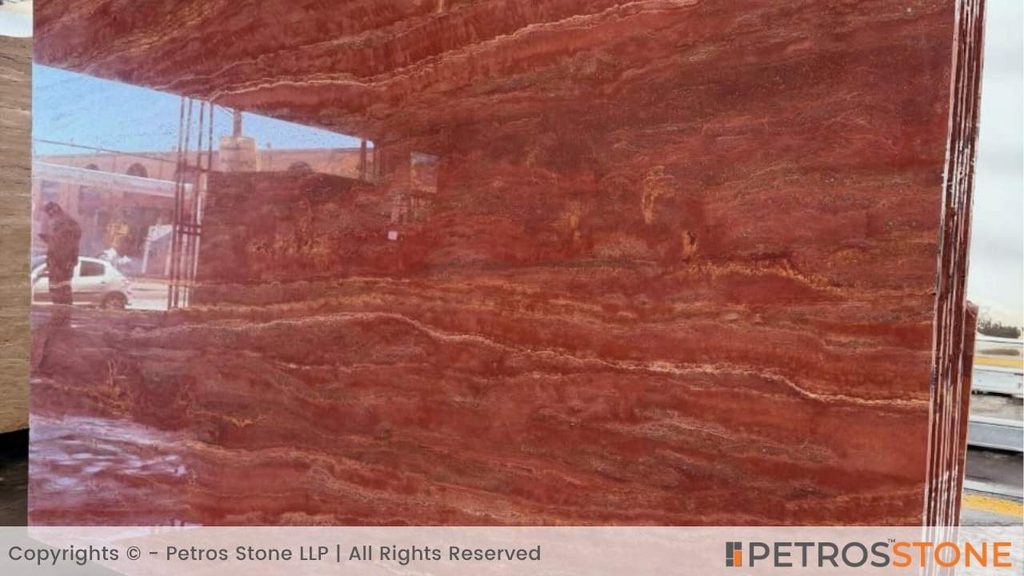
“White travertine can vary considerably in quality and appearance. Some blocks move toward ivory or light cream, while premium-quality blocks can be genuinely white. There is also another special type of white travertine where the veins appear in different colours. Silver travertine is similarly variable because there are many quarries across different parts of Iran, each producing its own colour variation. When the veins become narrower, the material is often commercially called Titanium. Red travertine is different again — it is more compact and dense, with fewer pores than many other travertine types. Another distinctive variety is Canyon Blue Travertine, which has a beige or ivory base with contrasting blue veins.”
Some Audio Excerpts from our Conversation with Yasaman Gholampoor from YG Luxury Manufacturing Group, Iran, and Mehdi Eslamibidgoli from Stoneman, Iran, Owners of a Travertine Quarry
In this article, we explain why travertine is widely used for exterior applications, from pool decks and patios to facades and walkways. We look at its porosity, heat performance, finishes, durability, maintenance, and the factors buyers should consider before choosing it for outdoor projects.
Why Porosity Is Travertine’s Greatest Strength Outdoors
Almost everything good about travertine outdoors comes from its holes. Travertine forms when spring water rich in calcium carbonate reaches the surface and loses carbon dioxide gas. Calcium carbonate then settles out in layers. The escaping gas leaves tiny voids, and leaves or moss trapped in the deposit leave more when they rot away. That is why you see layered banding and a pitted surface.
How porous is it? Natural travertine is generally about 5–15% porous, and water absorption usually falls between 0.4% and 8% by weight, depending on the fill. The range is wide because every quarry and every block is different.
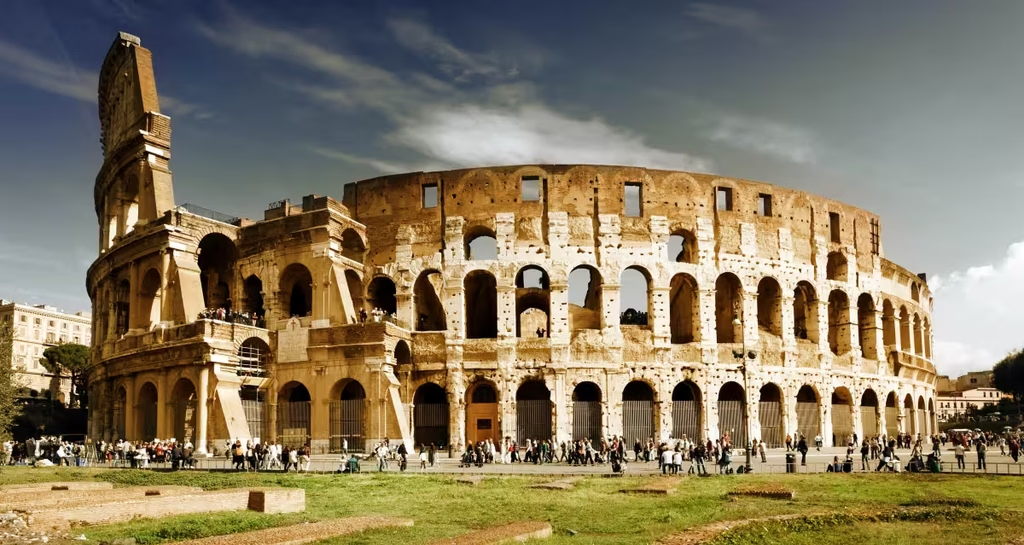
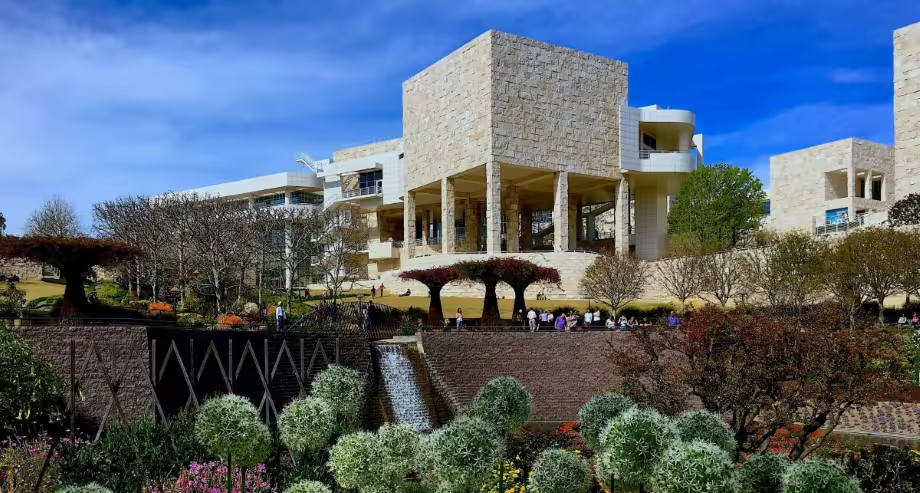
Those pores are also why the stone has been trusted for so long. The Romans used it heavily, including for the pillars, floors, and outer facade of the Colosseum. More recently, the Getty Center in Los Angeles is clad in about 1.2 million square feet of it, roughly 16,000 tons.
The Colosseum, Rome
Rome’s most iconic and enduring monuments were built from travertine, and the city’s largest amphitheater, the Colosseum, is a prime example — constructed entirely from this natural stone quarried in Tivoli and transported into the city along the Aniene and Tiber rivers. Romans favored travertine partly for its proximity to the capital, but mainly for its natural strength under heavy loads and its resistance to weathering.
Getty Center is a famous cultural and art campus in Los Angeles, California.
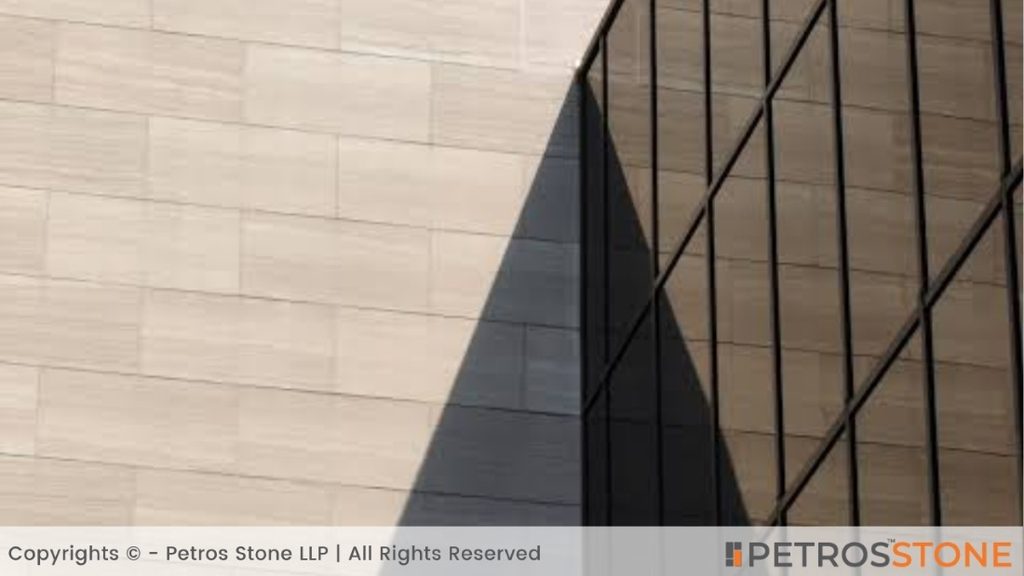
The Getty Center in Los Angeles is one of the most striking modern uses of travertine, with architect Richard Meier cladding the entire complex in roughly 16,000 tons of the stone, imported from Bagni di Tivoli — the same Italian region that supplied ancient Rome. Meier chose travertine both to echo classical architecture and for its warmth, texture, and proven resistance to weathering. The blocks were split rather than polished, leaving the natural fossils and grain exposed. Hence, the museum’s walls carry the same raw, enduring quality that has defined travertine architecture for over two thousand years.
Which Travertine Color Works Best for a Facade?
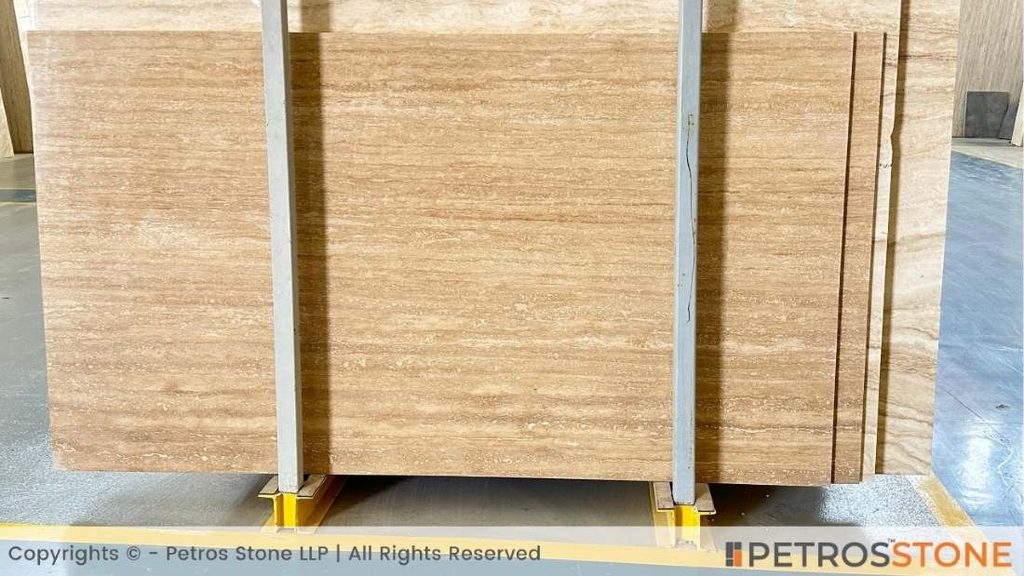
Color comes from trace minerals. Iron and organic compounds give travertine its ivory, beige, gold, walnut, and russet tones. Titanium Travertine and Red Travertine are among the best options for demanding applications because of their higher density, strength, and durability. Here are the four that come up most for facades.
This is the classic. Classic beige travertine appears in Rome’s best-known buildings. It suits nearly any architecture, hides dust and light staining well, and is easy to match if you need extra stone later.
It is mostly quarried in Iran and Turkey, and runs from dark grey, sometimes brownish, to a light tone. It gives a modern look, and one supplier says it suits contemporary spaces with steel and concrete. Dark stone also absorbs more heat and shows dirt less. It works well on vertical facades, but think twice before using it on sunny floors.
Iranian super white is a known example. One supplier describes it as having a bright white colour, low porosity, and high density, with smooth thin veins. That is a supplier claim, so ask for test reports. White gives a clean, high-end look. It also reflects the most sunlight and will show dirt and algae sooner in humid places.
It is mostly quarried in Iran and Turkey, and runs from dark grey, sometimes brownish, to a light tone. It gives a modern look, and one supplier says it suits contemporary spaces with steel and concrete. Dark stone also absorbs more heat and shows dirt less. It works well on vertical facades, but think twice before using it on sunny floors.
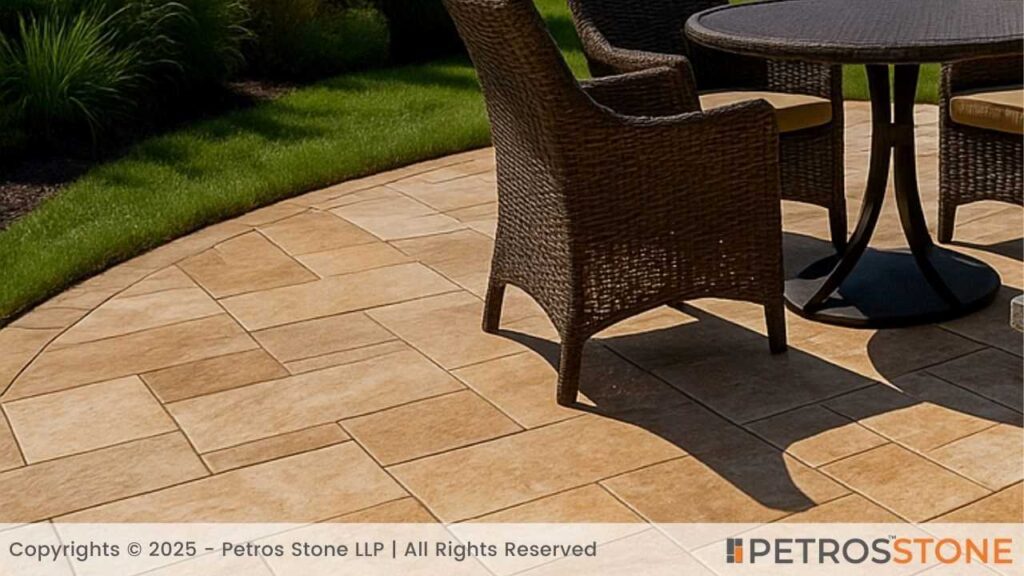
Travertine is a good outdoor choice for pool decks, patios and paving, but how well it performs depends on the finish, colour, filling and the drainage beneath it. The sections below cover the five things that matter most outdoors: slip resistance, heat, drainage, weather durability and cost.
Slip resistance
The pitted surface grips even when wet. Polished stone aside, other finishes such as tumbled and honed are noticeably more slip resistant. This is why it is a pool deck favourite. For a real project, ask the supplier for wet slip-test data on your exact finish.
Heat
Travertine does get warm, but light-colored varieties generally remain more comfortable under direct sun. Field readings and controlled research both suggest that color, reflectance, porosity, and thermal properties influence surface temperature.
Field observations: Contractors have reported lower surface temperatures for light-colored travertine than concrete under direct summer sun. For example, one Phoenix installer reports 115°F (46°C) for neutral travertine at 108°F (42°C) air temperature, compared with 138–140°F (59–60°C) for concrete. These are field readings, not controlled laboratory tests.
Research evidence: A study published in Energy and Buildings compared travertine and concrete under direct sunlight and found that Katsuren travertine had more favorable thermal performance, associated with its reflectance and thermal properties
Color matters a lot. Cream and pale beige stay noticeably cooler than deep walnut or espresso tones. Light porcelain can also perform well, so travertine’s advantage is real but not unique.
Drainage (with a caveat)
The pits break up sheets of water on the surface, but the stone is not a drain. Unfilled travertine absorbs about 1–5% by weight. Proper drainage still needs a sloped base. Skimping there is a common cause of failure.
Weather durability
Compressive strength is often 30–100 MPa, with many commercial types in the 35–70 MPa range. That is fine for cladding and paving. It is softer than granite, though, at 3–4 on the Mohs scale. Freeze-thaw resistance depends on sealing. Sealers can significantly reduce water entry and the damage that follows. Filled stone also tends to do better. Filled slabs handle freeze-thaw better than open-pore brushed finishes. Open pores give more grip and filled stone gives more frost protection, so pick based on your climate.
Cost
Travertine is not as strong or impermeable as granite, but it is easier to work and more available, so it costs less. That matters when you are covering hundreds of square metres.
Where Does Travertine Actually Get Used Outdoors?
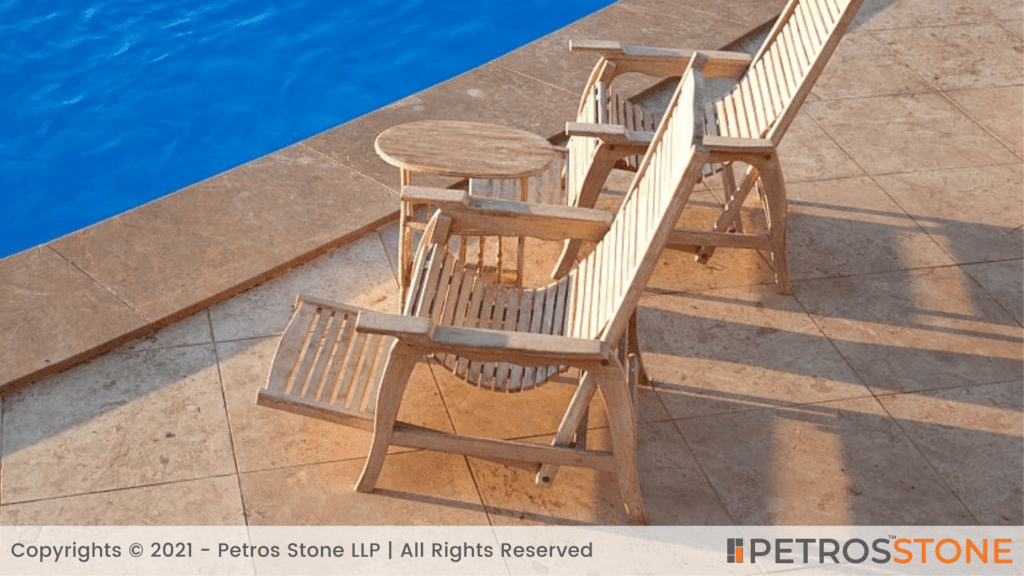
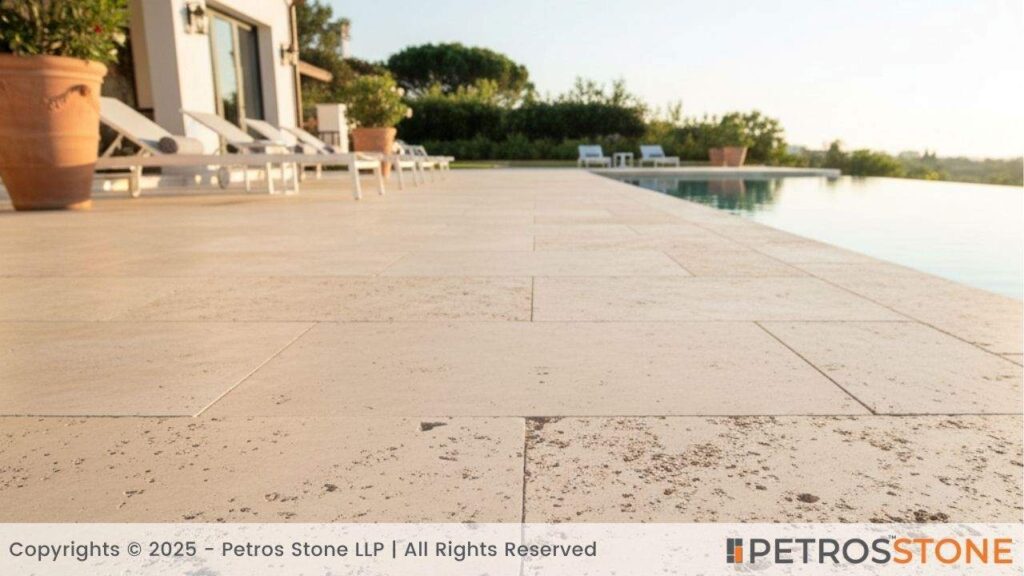
Cool Travertine Pool Deck
Pool decks and coping
Best because the textured surface grips wet feet and light colors stay cool. Use 2-inch (about 5 cm) stone for coping.
Patios and terraces
Best because they are big, open, sunny areas where comfort underfoot matters. 1¼ inch (about 3 cm) pavers are the usual choice for patios.
Garden paths and walkways
Tumbled stone gives a natural, aged look and a good grip.
Driveways
Yes, but use 2-inch stone and invest in the base, since thinner pavers crack under vehicle loads.
Wall cladding and feature walls
Best for warmth and texture. Facade work uses thin natural stone of roughly ¾ to 1¼ inch, fixed mechanically to a subframe.
Outdoor kitchens and BBQ surrounds
Good-looking, but acidic spills such as lemon juice or vinegar can stain it, so seal well and wipe spills fast.
Which Travertine Finish Should You Use Outdoors?
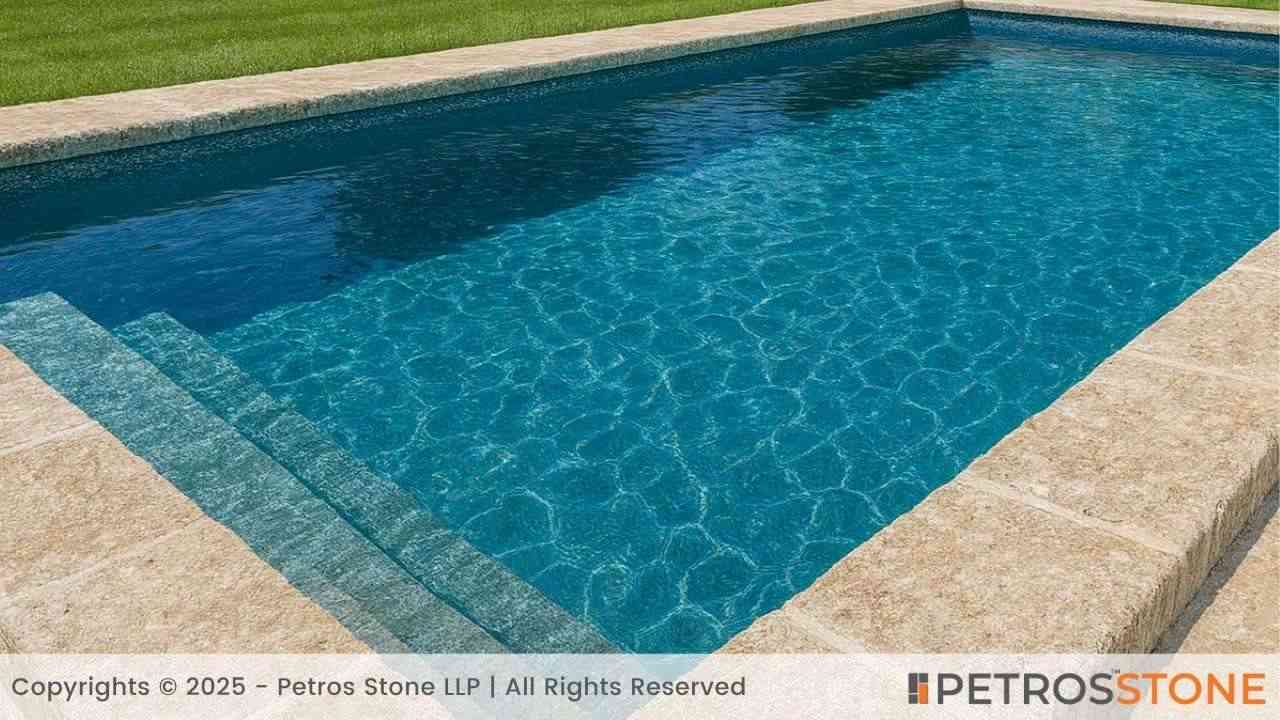
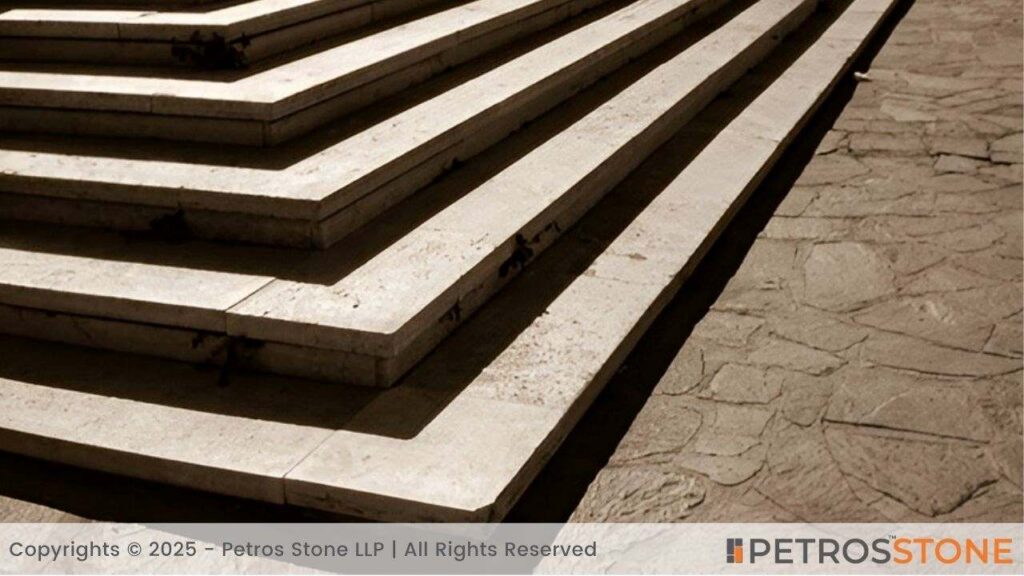
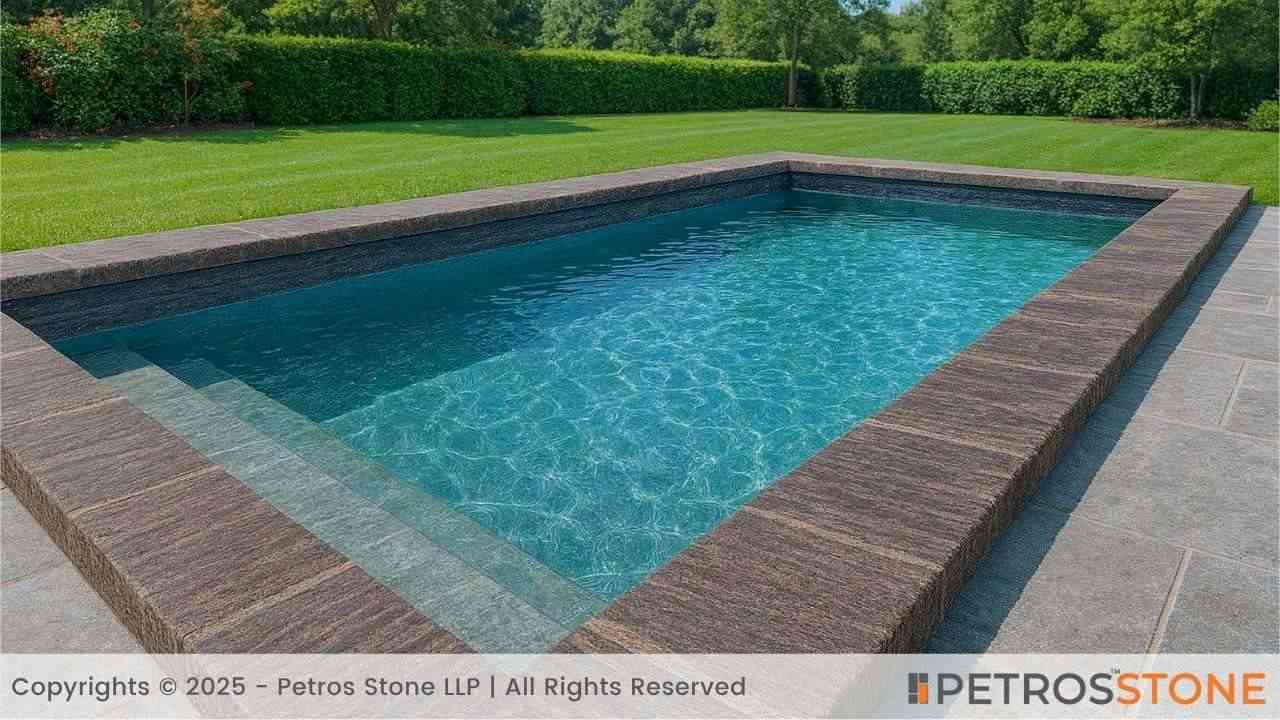
Tumbled Finish – Travertine Pool CopingHoned Finish – Travertine Stone StairsBrushed Finish – Travertine Pool Coping
Travertine Finish for Outdoors
Finish
Look and feel
Tumbled
Rounded edges, aged, rustic
Honed
Smooth, matte
Brushed
Textured, light sheen
Rule of thumb: the wetter the area, the rougher the finish.
The Actual Cost of a Travertine Facade (approx.)
Travertine Facade
This is a worked example to help you estimate. Every number is an assumption. Replace them with local quotes.
Assumptions: 30 mm beige or titanium slabs from Iran or Turkey, a ventilated dry-hung facade on a steel subframe, stainless steel anchors, cost in USD per sqm.
Market inputs behind the assumptions:
Listed export prices are around US$28–30 per m² for Iranian off-white and US$37–51 per m² for Turkish Roman, ex-port, with 100 m² minimums. Thickness isn’t stated in the listings, so treat these as a starting point only.
Dry-hung systems use stainless steel (316/A4) anchors and subframes with a 40–100 mm ventilated air gap.
Travertine Facade Cost Estimation
Item
Estimated Low Cost / m²
Material (slab, ~10% wastage, freight, duty)
$55
Fabrication (cutting, anchor holes, finish)
$10
Steel dry-cladding structure
$35
Installation
$25
Estimated finished facade cost
$125/m²
Estimated starting cost: ~$125/m². This is a basic estimate, not a fixed market rate; the final cost can be considerably higher depending on travertine selection and quality, thickness, finish, fabrication requirements, cladding system, project location, and site conditions.
What moves the price most: stone origin and grade, slab thickness, facade height (scaffolding and hoisting), and the number of corners and openings.
Origin can also be misrepresented. Yasaman Gholampoor, a stone exporter, emphasizes..
Yasaman Gholampoor (Iranian Stone Exporter)
“A buyer should verify the country, quarry, block or lot, selection, thickness, finish, test report, and actual material photographs rather than relying on a trade name.”
Is Travertine Right for Every Outdoor Space?
Not always. Three honest limits:
It needssealing. Unsealed stone absorbs stains, water, and chemicals.
It doesn’t like acid. Acids dissolve the calcium in the stone and leave a permanent rough mark, and sealers cannot prevent this. Be careful near pool acid splash zones and with acidic cleaners.
It needs upkeep. Plan for it from day one.
How to Maintain Travertine Outdoors
Sweep or blow off debris regularly.
Clean with pH-neutral stone cleaner only. Avoid vinegar and acidic cleaners.
Reseal on a schedule. One source suggests every 1–2 years for busy pool decks and saltwater pools, and every 2–3 years for covered or lightly used areas. Do a water-drop test: if water soaks in fast, it is time to reseal.
Treat stains early. Oil stains can often be drawn out with a baking soda poultice, though stubborn ones need a stone specialist. This is standard stone-care advice, so check the method for your stone first.
Keep water moving. Slope and joints should carry water away. Standing water is what starts frost damage and algae.
Why Travertine’s ‘Flaws’ Are Its Greatest Strength
Travertine forms as mineral-rich water flows through underground springs, and as CO₂ escapes from that water, calcium carbonate precipitates rapidly — trapping gas bubbles, plant debris, and other organic material in the process. Those trapped pockets are what create the characteristic pits and holes once the stone is quarried and cut. In indoor applications, fabricators often fill those holes with resin or grout for a smoother, more formal look. Outdoors, leaving them open (or lightly filled) is usually the better call, for a few concrete reasons:
Slip resistance: the pitted surface breaks up water flow and adds micro-texture underfoot — exactly what you want around a pool deck or exterior walkway, where a polished stone would become dangerously slick when wet.
Thermal comfort: the porous structure means travertine doesn’t retain heat the way denser polished stones (like granite or polished marble) do, so it stays walkable barefoot even in direct summer sun — a big reason it’s the default choice for pool surrounds in hot climates.
Drainage and freeze-thaw resilience: the open pores let water move through rather than pool on the surface, which reduces surface cracking in freeze-thaw cycles compared to sealed, non-porous stone.
Visual character: that same texture is what gives travertine its rustic, sun-baked look — the material reads as quarried stone rather than a manufactured surface, which is part of its enduring appeal in Mediterranean and desert-style landscaping.
FAQs
Does travertine get hot in the sun? It warms up, but light-coloured stone stays clearly cooler than concrete. Dark colors run hotter.
Is travertine slippery when wet? Tumbled, brushed, and unfilled surfaces grip well. Polished travertine is slippery and should stay indoors.
Does travertine need sealing for outdoor use? Yes. Seal at installation and reseal every 1–3 years depending on exposure.
Can travertine be used for driveways? Yes, with 2-inch stone on a strong base.
How does travertine compare to marble outdoors? Both are calcium-based and react to acids. Travertine costs less, and its texture grips better when wet. Polished marble is slippery outside.
Key Takeaways
The pitted, porous surface gives grip, comfort, and character.
Choose lighter colors where feet will be, and darker ones for vertical facades.
Use tumbled or brushed finishes outdoors. Keep polished indoors.
Match thickness to use: about 3 cm for patios, 5 cm for driveways and coping.
Seal it, keep it away from acids, and give it proper drainage.
Budget for a full facade system, not just the stone.
Feel free toget in touch for a free consultation, quote, and get a detailed understanding from our experts here at Petros®. Visit www.petrosstone.com or call +91-8446360361 orWhatsApp
To provide the best experiences, we use technologies like cookies to store and/or access device information. Consenting to these technologies will allow us to process data such as browsing behavior or unique IDs on this site. Not consenting or withdrawing consent, may adversely affect certain features and functions.
Functional
Always active
The technical storage or access is strictly necessary for the legitimate purpose of enabling the use of a specific service explicitly requested by the subscriber or user, or for the sole purpose of carrying out the transmission of a communication over an electronic communications network.
Preferences
The technical storage or access is necessary for the legitimate purpose of storing preferences that are not requested by the subscriber or user.
Statistics
The technical storage or access that is used exclusively for statistical purposes.The technical storage or access that is used exclusively for anonymous statistical purposes. Without a subpoena, voluntary compliance on the part of your Internet Service Provider, or additional records from a third party, information stored or retrieved for this purpose alone cannot usually be used to identify you.
Marketing
The technical storage or access is required to create user profiles to send advertising, or to track the user on a website or across several websites for similar marketing purposes.