To clarify how Calacatta Viola differs by origin and natural variation, Rishabh Jain, Director – International Business at Petros® Stone, spoke with Mr. Roberto Baratta, Owner of Manfredi Import Export, Italy. Drawing on his experience working with Viola from multiple regions, Baratta explained what buyers should look for to distinguish authentic Italian material from visually similar alternatives.
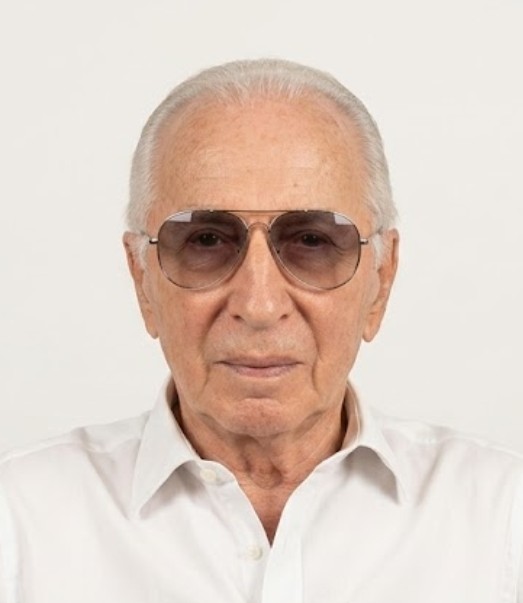
“Authentic Calacatta Viola is quarried in Italy, with Turkey also producing a genuine violet-veined marble of its own under the same name. Spain, Portugal, and Iran, by contrast, mostly supply look-alike material, stone with a broadly similar white-background, purple-veined appearance sold commercially as ‘Calacatta Viola’ without coming from a verified Calacatta-type quarry. Italian material commands the highest prices (roughly €700 per tonne ex-quarry) because of its rarity and selection; Turkish material is the next closest in genuine character, while Spanish, Portuguese, and Iranian alternatives are priced lower and should be treated as stylistic substitutes rather than the same material under a different flag. The right choice depends less on the country of origin alone and more on the specific quarry, the block’s verified natural range, and how much variation your project can accept.”
— Roberto Baratta, Owner, Manfredi Import Export, Italy
Calacatta Viola by Origin – Authentic Sources, Look-Alikes and Price Position
| Origin | Block Price per Tonne | Approximate Finished Slab Prices — 2 cm Thickness (USD/m²) |
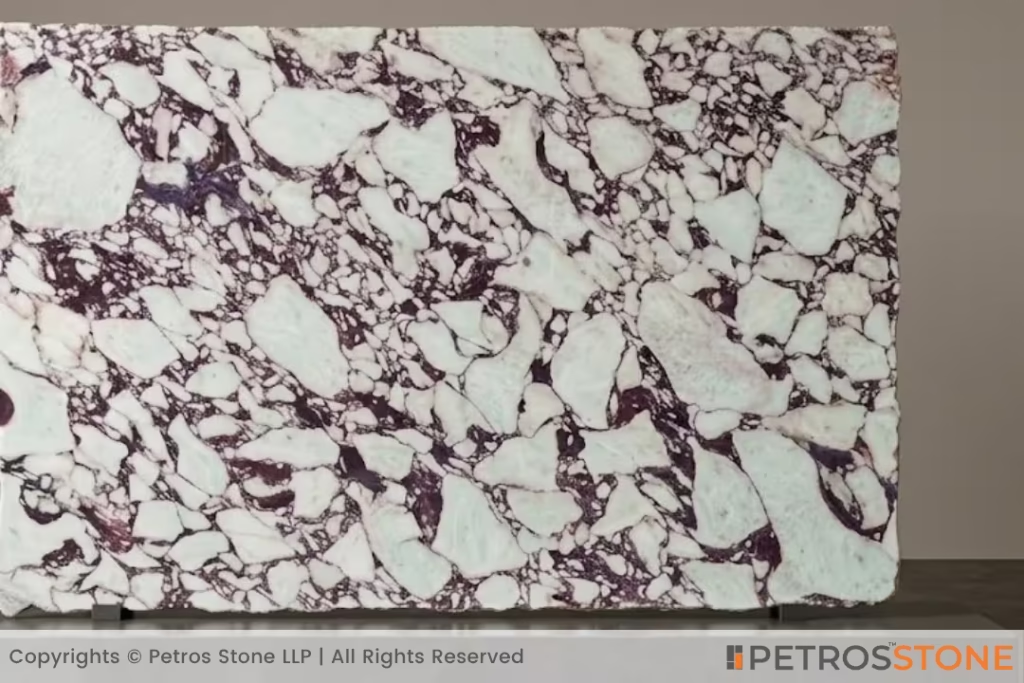 Calacatta Viola – Italy Calacatta Viola – Italy | €700–2,000 | $220 |
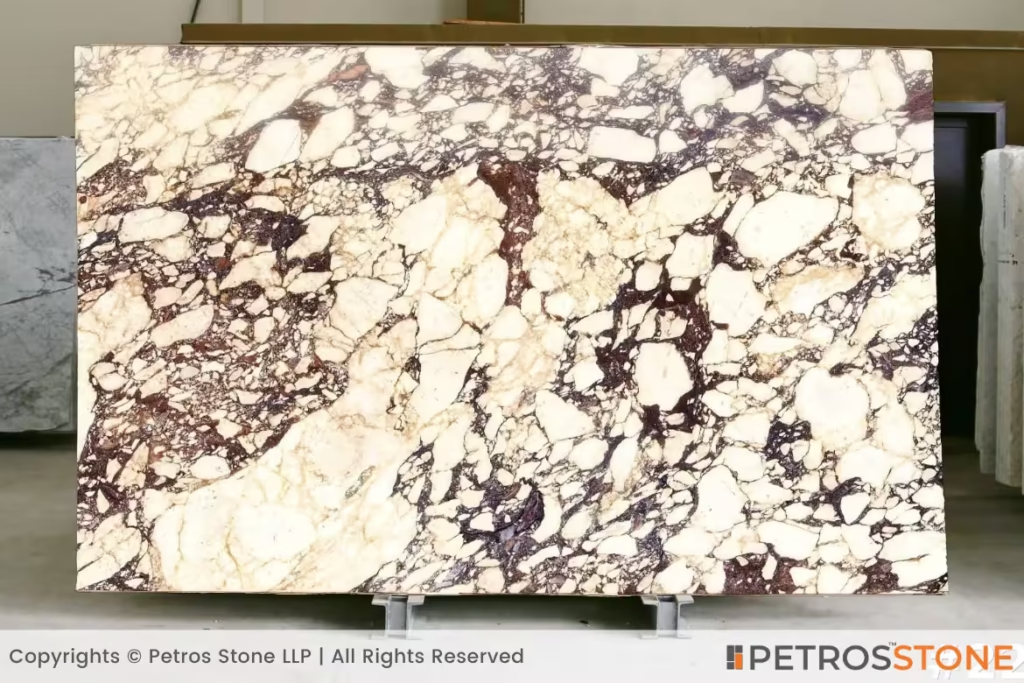 Calacatta Viola – Turkey Calacatta Viola – Turkey | $150–350 | $65 |
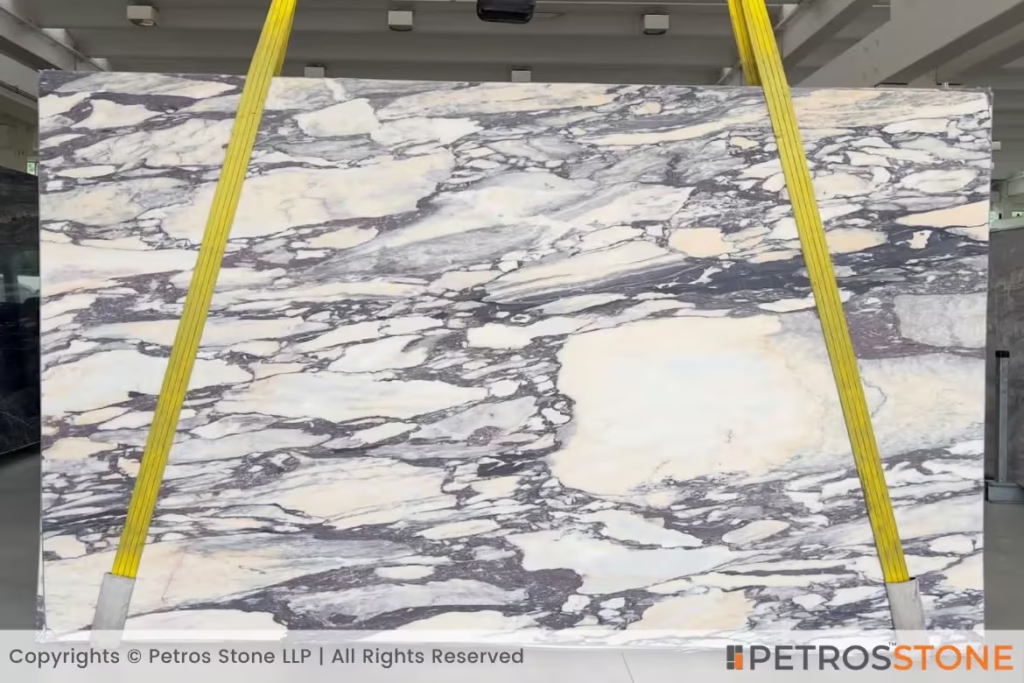 Calacatta Viola – Spain Calacatta Viola – Spain | $300–600 | $90 |
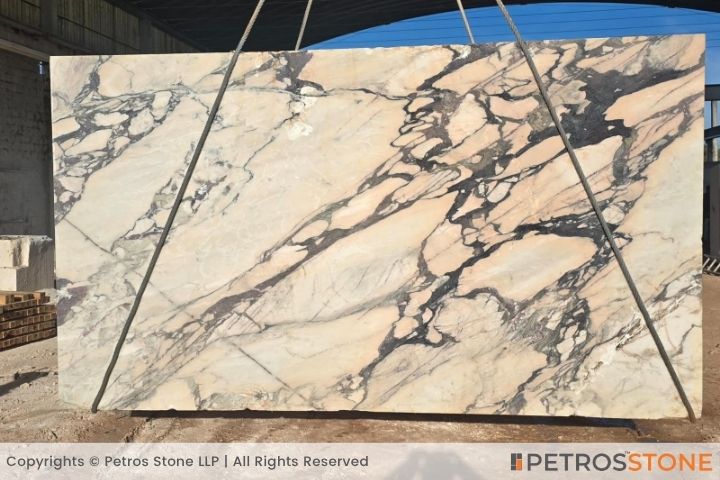 Calacatta Viola -Portugal Calacatta Viola -Portugal | $250–500 | $80 |
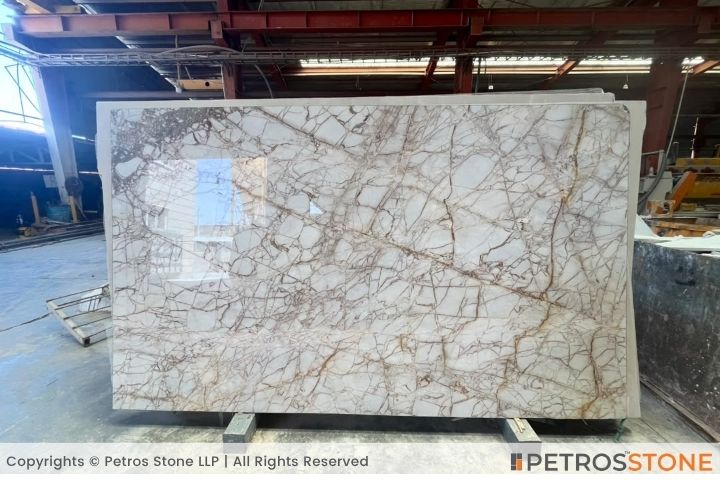 Calacatta Viola – Iran | $80–150 | $45 |
Note: Because marble is a natural product, these price bands are indicative only. Actual pricing depends on the specific quarry, block selection, thickness, and shipping terms (FOB/CIF), and should always be confirmed directly with the supplier for large or high-value projects. “Look-alike” here means the material is commercially sold under the Calacatta Viola name and shares its general appearance, not that it is inferior — only that its origin and geological pedigree differ from the authentic Italian (and Turkish) material.
Some Audio Excerpts from our Conversation with Roberto Baratta
- Some Audio Excerpts from our Conversation with Roberto Baratta
- What Exactly Is Calacatta Viola?
- What Are the Different Types of Calacatta Viola?
- Calacatta Viola (Authentic Italian Origin)
- Calacatta Viola (Turkish Origin – Lookalike)
- Calacatta Viola (Portugal Origin – Lookalike)
- Spanish Viola (Lookalike)
- Iranian Viola (Lookalike)
- Why Can Viola Look So Different From One Block to Another?
- Which Calacatta Viola Is Considered the Best?
- How Important Is Quarry Origin When Buying Viola?
- Why Does Calacatta Viola Cost So Much?
- How Should Buyers Compare Different Viola Offers?
- Can Calacatta Viola Be Used for Large Projects?
- Where Does Calacatta Viola Work Best?
- What Should Buyers Know Before Ordering Viola?
- What Should You Really Look for in Viola?
- FAQs
- Looking for the Right Calacatta Viola for Your Project?
What Exactly Is Calacatta Viola?
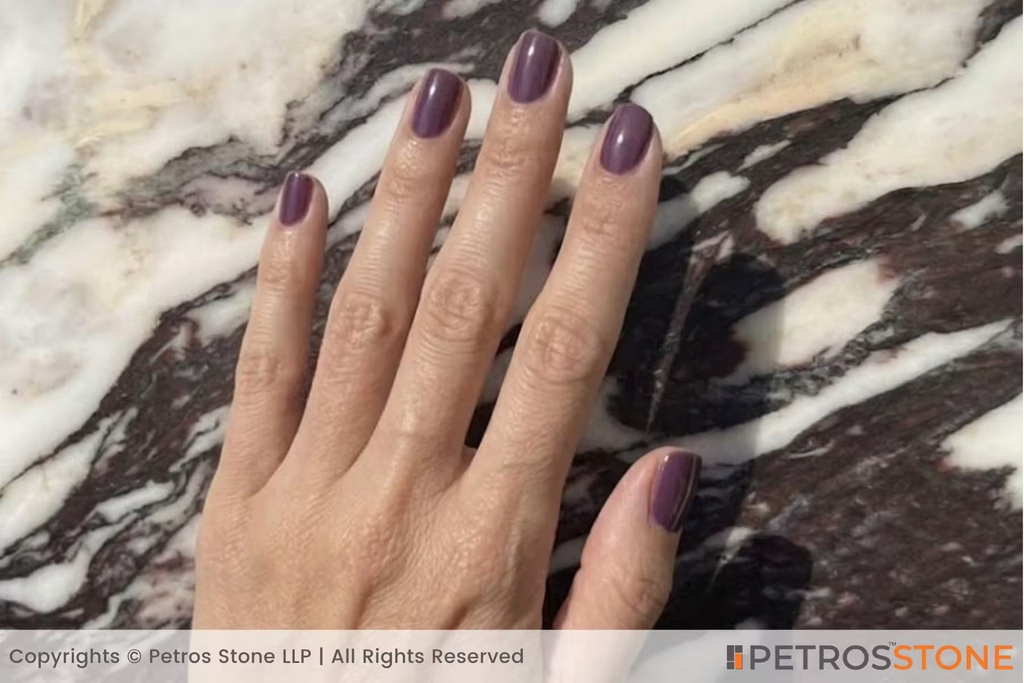
Calacatta Viola belongs to the broader Calacatta family of marbles, prized historically for their bright backgrounds and dramatic veining. What sets the “Viola” variant apart is its distinctive purple or burgundy-toned veining running through a white, cream, or occasionally yellow-tinted background — a look that has made it a favorite for feature walls, vanities, and other high-visibility surfaces in luxury interiors.
When sourcing high-end Calacatta Viola, success lies in understanding the natural material before purchasing. Know its quarry origin, evaluate its full tonal range, and inspect the actual slabs firsthand. Ensure your supplier can deliver both the precise quantity and quality your spec requires — because variation in natural stone is not a flaw; it is its defining feature.
This single idea explains most of the confusion buyers run into: the same commercial name can cover a wide spread of appearances, and that spread is normal, not a red flag.
What Are the Different Types of Calacatta Viola?
There are two separate questions buyers often blur together: is this a different variety of marble, or is this simply natural variation within the same material?
According to the expert:
“Natural variation happens constantly within a single quarry, and even within a single material. Some blocks come out with larger spots or veins, others with smaller, more delicate patterning — and which one you get can depend entirely on which section of the quarry the block was cut from.”
— Roberto Baratta, Owner, Manfredi Import Export, Italy
So before assuming that two very different-looking slabs must be two different products, it’s worth asking where each one actually came from. Often, the honest answer is: the same quarry, just a different part of it.
Calacatta Viola (Authentic Italian Origin)
Origin and Quarrying
Quarried almost exclusively from the Vagli area in the Apuan Alps of Tuscany, part of the same broader marble district that has supplied Carrara-region stone since Roman times. Extraction here is selective — Calacatta Viola is a relatively rare seam even within these quarries, which is part of why genuine material commands a premium.
Background and Veining
A bright white to creamy background provides the canvas for dense, dramatic veining that runs from deep burgundy through to violet and wine tones. The veining is bold and irregular, frequently forming breccia-like clusters — patches where the stone appears to have fractured and re-cemented naturally — rather than simple parallel lines. No two slabs repeat the same pattern.
Texture and Finish
A fine, tight crystal structure is what gives authentic Calacatta Viola its signature silky, almost luminous polish. Light sits differently on this stone than on coarser lookalikes — the surface has real depth rather than a flat shine.
How to Tell it’s Genuine
Hold it next to genuine Vagli material in the same light: the veining will look more blurred at the edges, and the overall contrast between background and vein color will feel gentler rather than dramatic.
Positioning
This is the benchmark. Every regional lookalike — Turkish, Portuguese, Spanish, Iranian — is ultimately being compared back to this material, whether the buyer realizes it or not. It commands the highest price point in the Calacatta Viola category for that reason.
Calacatta Viola (Turkish Origin – Lookalike)
Origin and Quarrying
Turkey has an extensive and well-developed marble export industry, and a version marketed as “Calacatta Viola” is quarried and cut there at scale, largely aimed at buyers looking for the Calacatta Viola look at a lower price point than the Italian original.
Background and Veining
The base tends to run slightly warmer or greyer than the crisp white of Vagli material. Veining is typically softer and more diffuse — it spreads rather than cuts sharply through the stone and reads as less densely packed than the Italian version.
Texture and Finish
Under close inspection, the crystal structure is generally coarser, which can make the polished surface look slightly less silky or reflective than true Calacatta Viola.
How to Tell it’s Genuine
Hold it next to genuine Vagli material in the same light: the veining will look more blurred at the edges, and the overall contrast between background and vein color will feel gentler rather than dramatic.
Positioning
Commonly sold and marketed explicitly as a “budget alternative” — the industry is generally upfront that this is a Turkish-origin stone, not a rebranding of the Italian one.
Calacatta Viola (Portugal Origin – Lookalike)
Origin and Quarrying
Portugal has a long-established marble belt centered around the Estremoz–Borba–Vila Viçosa region in the Alentejo, historically known for pink- and cream-toned marbles. Stones marketed under the Calacatta Viola name from this region draw on that same geological belt.
Background and Veining
The background can carry a pinkish or beige undertone rather than the cooler, purer white of Italian material. Violet veining is present but tends to read as more muted, sitting closer in tone to the background rather than snapping into sharp contrast.
Texture and Finish
Portuguese marbles from this belt are generally known for a fine, even grain, which can give the stone a soft, uniform look — pleasant, but visually calmer than the dramatic movement of Vagli Calacatta Viola.
How to Tell it’s Genuine
Look at the undertone in natural daylight — a warm pink or beige cast in the white field is the clearest giveaway that it’s not Italian Vagli stone.
Positioning
Often selected by buyers who want the Calacatta Viola color story but prefer a softer, less high-contrast finished look.
Spanish Viola (Lookalike)
Origin and Quarrying
Spain’s marble-producing regions (including areas such as Almería/Macael in the south) supply a version marketed under the Calacatta Viola name, generally positioned as a mid-range option in the wider Calacatta-style category.
Background and Veining
The base typically runs cooler and greyer than the Italian original. Veining tends to be thinner and more linear — running in straighter, more parallel lines — rather than the bold, irregular, breccia-like movement characteristic of true Vagli Calacatta Viola.
Texture and Finish
The overall visual rhythm reads as more restrained and repetitive, which can be an advantage for buyers wanting a more uniform, less “busy” pattern across multiple slabs.
How to Tell it’s Genuine
Step back and look at the vein pattern as a whole: if it looks more like straight brushstrokes than dramatic, branching rivers, it’s likely the Spanish-origin version rather than Italian.
Positioning
Frequently chosen for large-format installations where visual consistency across many slabs matters more than the one-of-a-kind drama of Italian material.
Iranian Viola (Lookalike)
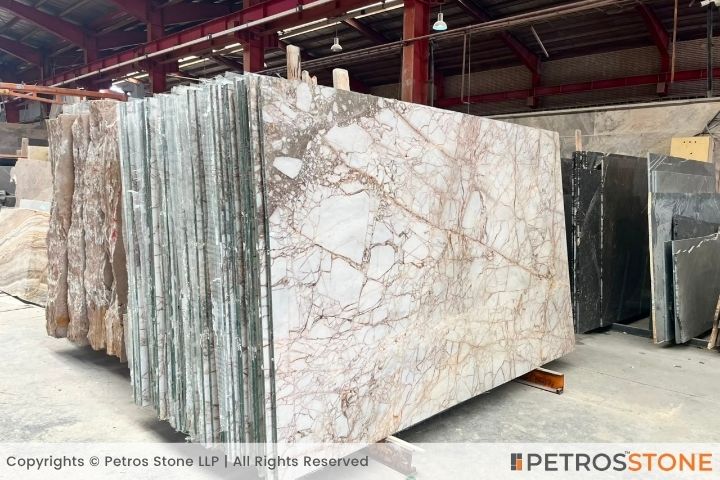
Origin and Quarrying
Iran has significant marble reserves and an active quarrying industry, and a Calacatta Viola-style stone is produced from Iranian sources for both domestic and export markets.
Background and Veining
The white field tends to be denser and can appear slightly chalkier or flatter than the luminous white of Italian Vagli marble. Veining is more scattered and less continuous — appearing in shorter, broken segments rather than flowing unbroken across the slab.
Texture and Finish
The stone can still take a striking polish, but the crystal structure generally produces a slightly less translucent, more opaque surface compared to genuine Calacatta Viola.
How to Tell it’s Genuine
Trace a single vein with your eye from one edge of the slab to the other — if it breaks and restarts rather than flowing continuously, that’s a strong indicator of Iranian-origin material rather than Italian.
Positioning
Visually bold and distinctive in its own right, but structurally and aesthetically distinct enough from Italian Calacatta Viola that it should be sold and understood as its own product, not a substitute.
Knowing which is which isn’t about ranking one as ‘better’ — it’s about buying what you think you’re buying.
Why Can Viola Look So Different From One Block to Another?
Several factors drive this visual range within a single origin:
- Background color — white, cream, yellow-tinted, or a mix of tones
- Veining color and intensity — from subtle purple threads to bold burgundy movement
- Spot size — some blocks show fine, small spotting; others show large, distinctive spots
- Quarry location within the deposit — different sections of the same quarry can produce noticeably different material
Background and veining differences are simply part of the natural selection process. Some material has a cleaner background, while other pieces carry more color or pattern, and understanding the quarry’s overall range matters more than expecting uniformity. Specifically regarding veining and spotting, the scale of the pattern can shift significantly from block to block, largely depending on where in the quarry the block was taken.
Which Calacatta Viola Is Considered the Best?
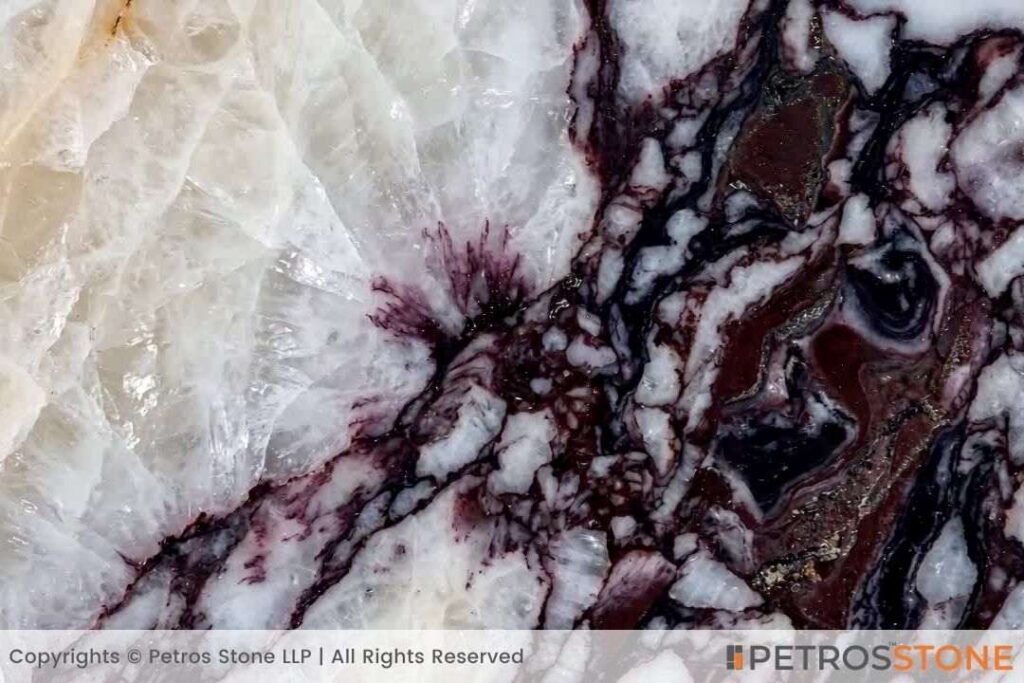
There’s no single “best” Viola — only the selection that best fits a given project. A premium selection typically means a cleaner background, more balanced veining, and fewer natural fissures, but a project aiming for a bolder, more dramatic look might specifically want a stronger-patterned, less “clean” block.
This is why quality is best framed in terms of range rather than a fixed grade: when sourcing from a quarry, the goal is to understand what the best material looks like, what the lower selections look like, and what can realistically be supplied at each level — because no natural quarry produces uniform blocks throughout.
How Important Is Quarry Origin When Buying Viola?
Origin matters, but it isn’t the whole story. Different selections can come from the very same origin, so buyers still need to look at the actual material on offer, not just the country it’s labeled with.
According to the expert:
“Different selections can come from the very same origin, so origin alone doesn’t guarantee a particular appearance. Buyers still need to look at the actual material on offer, not just the country it’s labeled with.”
— Roberto Baratta, Owner, Manfredi Import Export, Italy
Practically, this means asking suppliers to name the specific quarry — not just the country — and requesting to see the realistic range of what that quarry can produce, rather than relying on the reputation of the origin alone.
Why Does Calacatta Viola Cost So Much?
Pricing is driven by a combination of factors rather than any single one:
- Rarity and recovery rate — how much usable, high-quality material a quarry can actually extract
- Block selection — larger, cleaner blocks with fewer fissures command higher prices
- Origin — Italian quarries in particular carry a price premium
- Processing and logistics — cutting, finishing, and transport add to landed cost
On Italian material specifically, it can be very expensive, and buyers are sometimes purchasing a large lot containing a mix of block sizes, qualities, shapes, and selections all under one price. Prices for Italian material have reportedly been offered anywhere between €700 and €2000 per tonne ex-quarry, a wide enough spread that buyers need to understand precisely what is included in that price before comparing it to another offer.
For current landed pricing in your market — including thickness-specific and FOB/CIF quotes — this should be confirmed directly with suppliers, as global marble pricing shifts with quarry output, currency movement, and shipping costs.
How Should Buyers Compare Different Viola Offers?
One of the most common mistakes buyers make is assuming that one photograph represents the entire material. Natural stone varies, and a single hero image — however striking — can’t tell you what the rest of a shipment will look like.
Instead, when comparing multiple Viola offers, it’s worth gathering:
- Origin and specific quarry
- Available range (best selection through lower selection)
- Quantity the quarry can actually supply
- Quality and expected natural variation
- Direct confirmation from the quarry for anything beyond a modest quantity
A higher price tag on one offer doesn’t automatically mean every block in that lot will be superior — it simply reflects a different selection, origin, or mix. The only way to know for sure is to look at the actual material and its documented range, not just the number on the invoice.
Can Calacatta Viola Be Used for Large Projects?
Yes, but large projects raise the stakes on everything discussed above. For a medium quantity, careful selection from available stock is usually enough. But once a project moves into very large territory — 5,000 square meters is a useful reference point — the right approach shifts: speaking directly with the quarry to confirm both the suitability of the material and whether that quantity can realistically be supplied becomes essential.
Long-term availability becomes just as important as appearance at this scale. For large, ongoing requirements, buyers need confidence that the quarry can consistently deliver the necessary volume, while still accepting that natural variation will always be part of the material. This means working closely with the quarry to understand exactly what range they can reliably supply over time — not just for the first shipment.
Where Does Calacatta Viola Work Best?
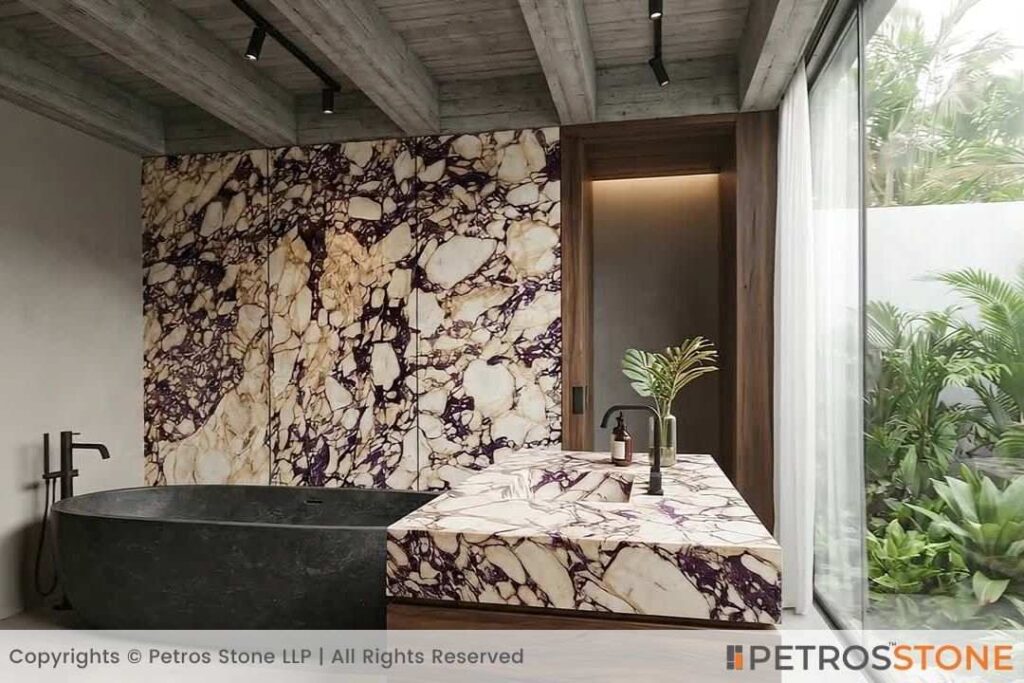
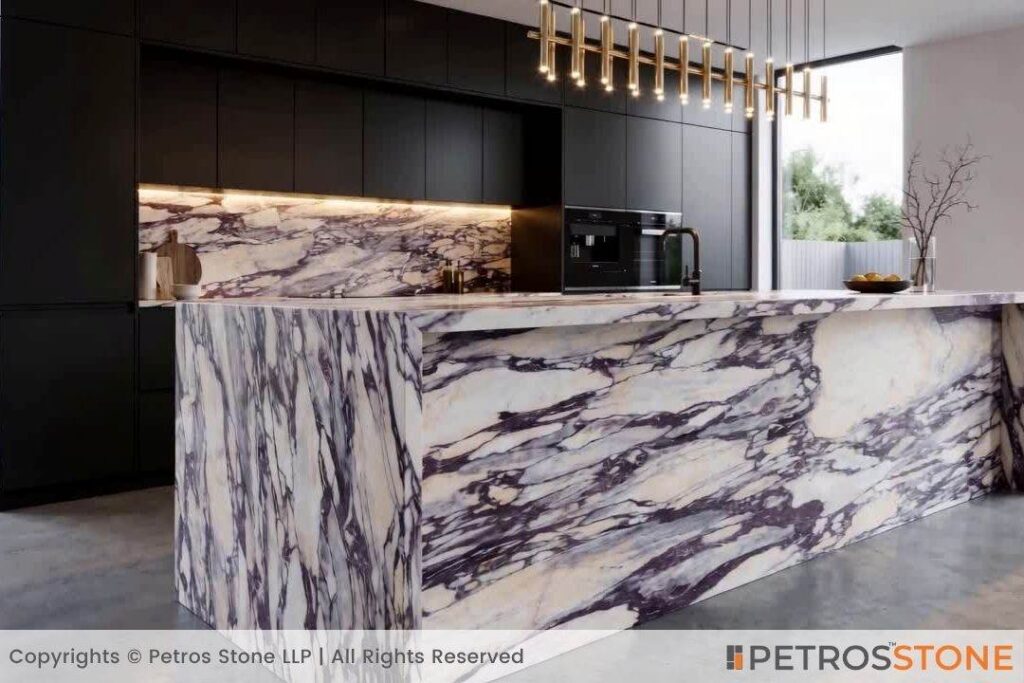
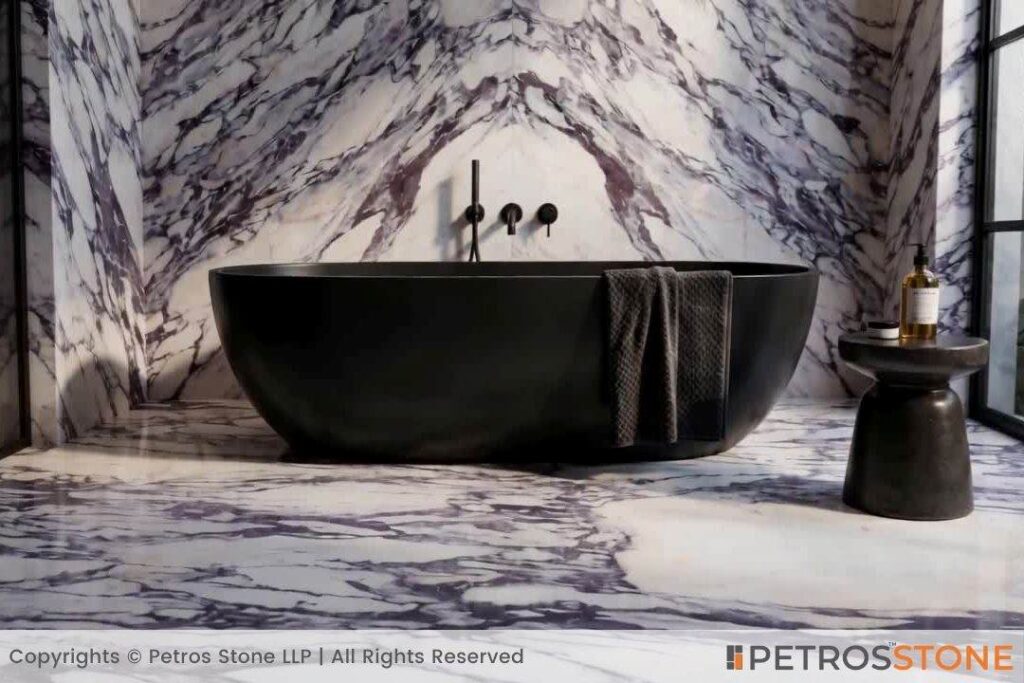
Given its dramatic veining and premium positioning, Viola is most commonly specified for:
- Feature walls and statement backdrops
- Vanities and bathroom surrounds
- Kitchen islands and waterfall countertops
- Flooring in lower-traffic, high-visibility areas
- Furniture and custom joinery accents
- Hospitality and luxury retail environments
Bookmatched installations — where adjacent slabs are mirrored to create a symmetrical pattern — are especially popular with Viola because of its strong veining, though both polished and honed finishes are used depending on the desired effect.
What Should Buyers Know Before Ordering Viola?
Beyond selecting the right origin and quarry, a few practical points reduce risk before material arrives on site:
- Natural fissures are common in Calacatta-type marbles and should be discussed with the fabricator ahead of time, especially for large-format or structural applications
- Resin treatment is frequently used to stabilize fissures and enhance durability
- Slab selection should happen in person or via detailed photos/video of the actual slabs — not the marketing photo
- Calibration and consistent thickness matter for large installations
- Installation and sealing should follow the fabricator’s recommendations for a natural stone with this level of veining
The underlying risk to guard against is the same one raised throughout this discussion: letting a single, well-lit “hero” photograph stand in for the real range of material you’ll actually receive.
What Should You Really Look for in Viola?
Asked for one piece of closing advice for someone buying Calacatta Viola for a high-end project, the closing advice ties the whole conversation together:
According to the expert:
“Different selections can come from the very same origin, so origin alone doesn’t guarantee a particular appearance. Buyers still need to look at the actual material on offer, not just the country it’s labeled with.”
— Roberto Baratta, Owner, Manfredi Import Export, Italy
Asked for one piece of closing advice for someone buying Calacatta Viola for a high-end project, the message is simple: understand the natural material before you buy it. Know the quarry, understand its range, look at the actual selection, and make sure the supplier can provide both the quantity and quality the project requires — because variation is not a flaw in natural stone; it’s simply part of working with it.
FAQs
What are the different types of Calacatta Viola?
Rather than fixed “types,” Viola varies by origin (Italy, Spain, Portugal, Turkey, Iran) and by natural selection within each quarry — differences in background tone, vein color, and spot size that can occur even within a single block of stone.
Why does Calacatta Viola vary so much?
Because it’s a natural material. Appearance depends on which part of the quarry a block is cut from, and no quarry produces perfectly uniform stone throughout its deposit.
Which Calacatta Viola is the best?
There’s no universal “best” — the right selection depends on the project. A cleaner background with balanced veining suits a refined look, while bolder, larger-veined material suits a more dramatic statement piece.
Why is Italian Viola more expensive?
Italian quarries are more limited in output and carry a premium reputation, with ex-quarry pricing reported between roughly €700 per tonne depending on block quality and selection.
Is Calacatta Viola available from countries other than Italy?
Yes. Spain, Portugal, Turkey, and Iran all produce Viola-type marble with their own natural ranges, typically at more accessible price points than Italian material.
Is Calacatta Viola suitable for kitchen countertops?
Yes, though buyers should discuss natural fissures, resin treatment, and finish (polished vs. honed) with their fabricator, since kitchen surfaces see heavier daily use than feature walls.
How can buyers verify the quality and origin of Viola?
Ask suppliers to name the specific quarry (not just the country), request to see the actual range of available material rather than a single photo, and — for large projects — confirm availability and suitability directly with the quarry itself.
Looking for the Right Calacatta Viola for Your Project?
Calacatta Viola is a marble where origin, veining, colour variation, and individual slab character can make a significant difference to the final result. Whether you’re an architect, interior designer, stone importer, or private client, our team can help you identify material that matches your project’s aesthetic and performance requirements.
Explore our Calacatta Viola Marble collection and discover available slabs, finishes, sizes, and selection options. We can also provide high-resolution slab images and videos, technical documentation, availability details, and project-specific quotations to help you make a more informed decision.
Planning a project with Calacatta Viola? Talk to Petros Stone today to discuss your requirements, review available material, and find the right stone for your application.

Tapas Koul leads editorial direction and content strategy at Petros® Stone. His work spans research, content development, and brand communication, with a focus on architecture, natural stone, and design. He is interested in the stories behind materials, projects, and industry developments, bringing together useful insights and information to help readers understand the subject beyond the surface.

Brown Granite

White Galaxy Granite

Blue Bahia Granite

Silver Cloud Granite

Black Pearl Granite

Dallas White Granite