All three marbles come from the Apuan Alps above Carrara, Italy, but they differ in background whiteness, veining, rarity, and price. Carrara has a soft grey-white base with fine, feathery veins and costs roughly $4.65–$13.93/sq. ft. By contrast, Statuario has a bright white base with bold grey veins and costs about $23.22–$65.03 USD/sq. ft. Calacatta has a white base with thick, dramatic veins, often gold or brown, at about $18.58–$55.74 USD/sq. ft., with premium Calacatta Oro exceeding $65.03–$92.90+USD/sq. ft. To identify them, compare background whiteness first, then vein thickness, and contrast. Keep in mind that these are indicative slab prices and vary by grade, thickness, and supplier.
Here is a table summarizing the differences between Statuario, Carrara, and Calacatta:
| Statuario | Carrara | Calacatta | |
|---|---|---|---|
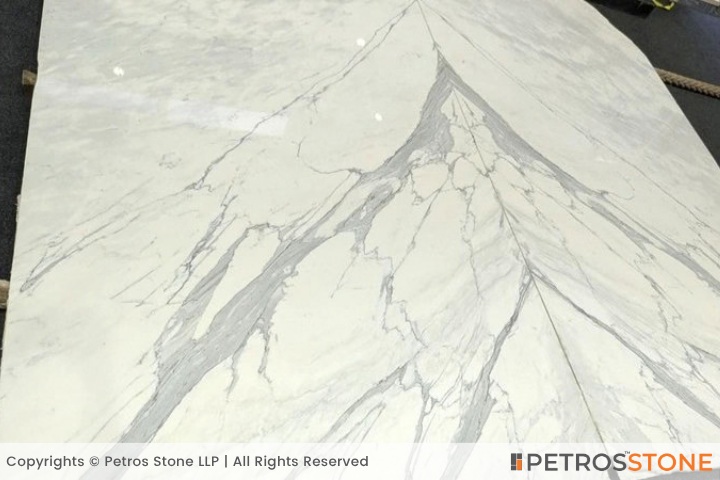 | 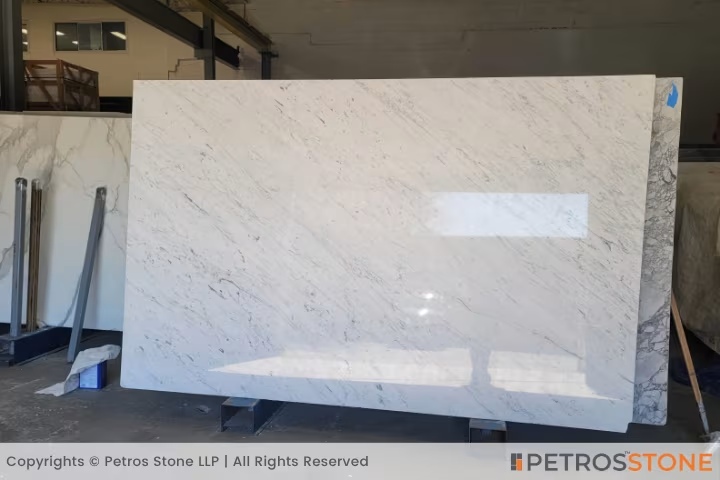 | 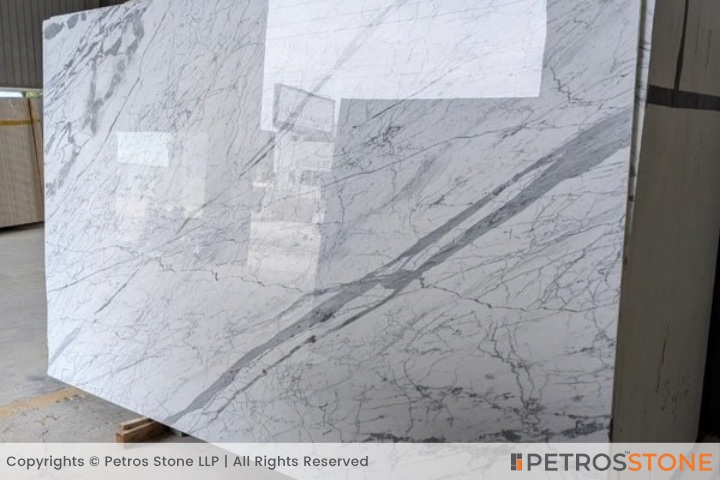 | |
| Rarity/quarry source | Rare; small-volume blocks from selected Carrara quarries | Most abundant; quarried in Torano, Miseglia, and Colonnata basins | Rarest premium family; limited blocks from the Calacatta and Colonnata areas (Vagli is a separate variant) |
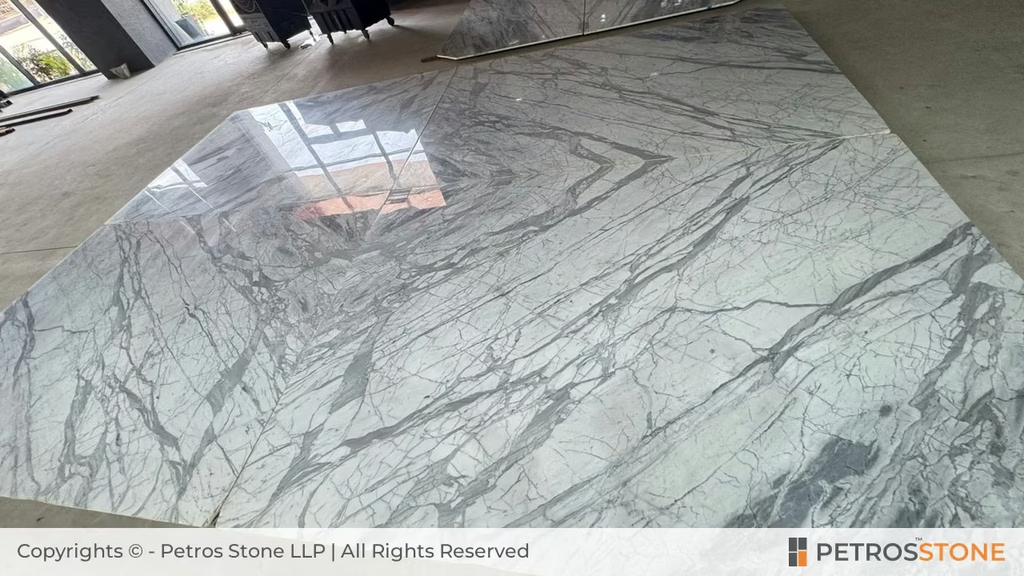
| Appearance | Bright white base, bold grey veins with defined contrast | Soft white-grey base, fine feathery veins | Very white base, thick, dramatic veins that are sparse and often gold, brown, or grey |
| Key distinguishing factor | Grey veining that is dramatic but usually directional | Cloudy grey background, low contrast | Wide veins on an unusually clean white background |
| Typical price range (USD/sq. ft., slab) | USD 23.22– 65.03 /sq.ft. | ~ USD 4.65– 13.93 /sq.ft. | ~ USD 65.03– 92.90 /sq.ft; Calacatta Oro/Borghini ~ USD 92.90+ |
Note: Prices move with block quality, slab selection, finish, and market demand.
In this article, we compare Statuario, Carrara, and Calacatta marble by origin, appearance, veining, rarity, grades, and price. We also explain how to identify each marble, verify authenticity, and choose the right stone, with insights from Italian quarry owners.
- How to Identify Statuario, Carrara, and Calacatta (DIY Step-by-Step Guide)
- What Is Statuario Marble?
- What Is Carrara Marble?
- What Is Calacatta Marble?
- How Do Quarry Owners Distinguish 'True' Statuario or Calacatta from Look-alikes?
- Which Marble Should You Choose Based on Design Intent?
- Which Marble Offers the Best Value for the Price?
- FAQs
- Key Takeaways
How to Identify Statuario, Carrara, and Calacatta (DIY Step-by-Step Guide)
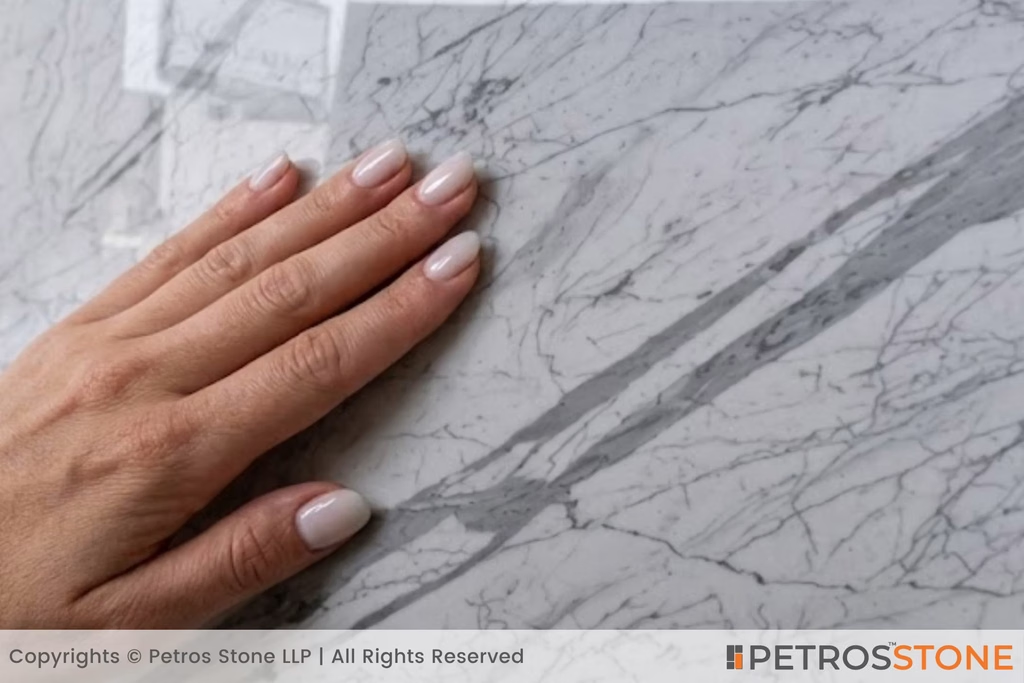
Step 1 – View the slab in natural or neutral daylight.
Warm showroom lighting makes Carrara look whiter and hides grey undertones.
Step 2 – Judge the background colour.
Carrara has a grey, slightly cloudy base. Statuario and Calacatta have a much cleaner white.
Step 3 – Look at vein thickness.
Thin, feathery, soft-edged veins point to Carrara. Meanwhile, thick, bold, high-contrast veins point to Statuario or Calacatta.
Step 4 – Check the vein spacing.
Carrara has many small veins spread evenly. Calacatta has fewer veins with large white areas between them.
Step 5 – Check the vein colour.
Grey-charcoal veins suggest Statuario. Gold, beige, or brown veins suggest Calacatta, and Calacatta Oro has the strongest gold.
Step 6 – Compare several slabs.
Natural stone varies, so never judge from a single sample. Request the full slab or bookmatched pairs.
Step 7 – Ask for paperwork.
Ask for the quarry name, block number, and grade. Genuine suppliers can usually trace a slab back to its block.
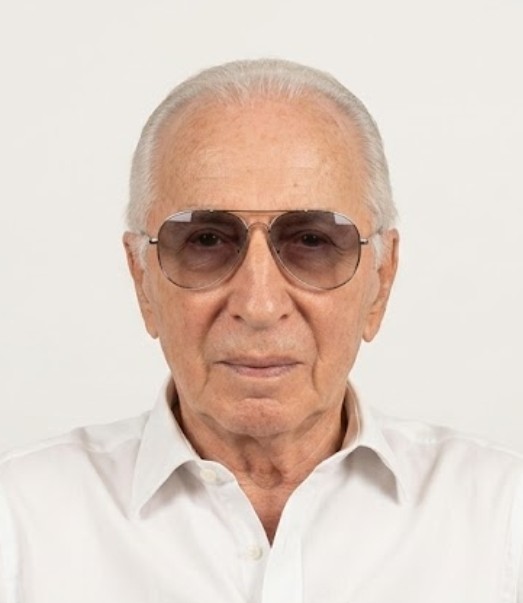
(Quarry Owner, Italy)
According to the expert:
“Different selections can come from the very same origin, so origin alone doesn’t guarantee a particular appearance. Buyers still need to look at the actual material on offer, not just the country it’s labeled with.”
— Roberto Baratta, Owner, Manfredi Import Export, Italy
What Is Statuario Marble?
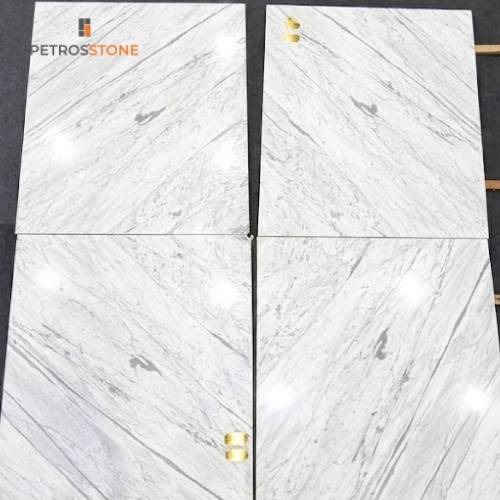
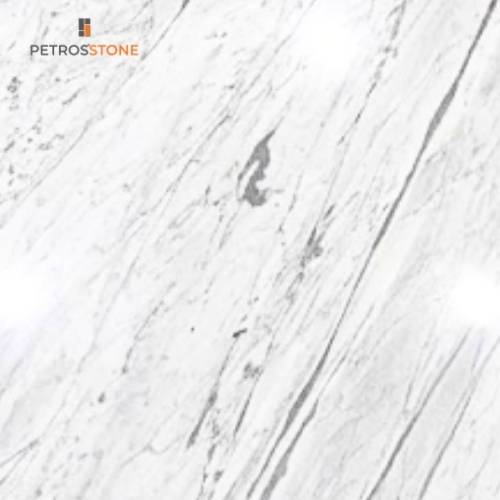
Statuario is known for its brilliant white base and confident grey veining, with a slightly translucent, luminous quality. Historically, it was the marble of sculptors, hence the name, which comes from statua. It is quarried in small quantities, and only some blocks reach top quality. Variants include Statuario Venato (more veining) and Statuario Altissimo (whiter and rarer). Statuario tends to have more consistent, linear veining than Calacatta.
What Is Carrara Marble?

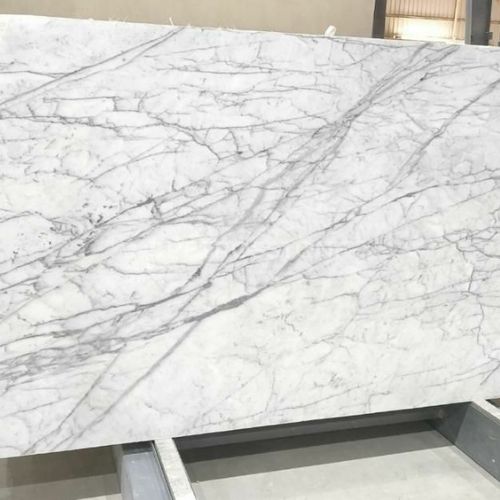
Carrara is the most widely quarried marble of the region and the benchmark for white marble. It has a soft white-to-grey base with delicate, feathery veining. Common commercial grades include Bianco Carrara C, CD, and the whiter Bianco Gioia. It is the most affordable of the three, which makes it popular for floors, bathrooms, and large-volume projects. Its subtle, calm character suits classic and minimalist interiors.
What Is Calacatta Marble?
Calacatta is prized for its bold, sparse veining against a very white background. It is not a single stone but a family, and the variants differ noticeably:
- Calacatta Oro: warm gold-toned veins on a bright white base
- Calacatta Borghini: thick, dramatic grey-gold veins with high contrast
- Calacatta Extra: very white with minimal, refined veining
- Calacatta Macchia Vecchia: a cream-toned base with a heavier, more antique look
- Calacatta Vagli: from the Vagli quarries in the Garfagnana area, with bolder, more irregular veining
- Calacatta Viola: distinctive purple-toned veining

(Quarry Owner, Italy)
According to the expert:
“The Carrara region is home to several distinct Calacatta quarries. To understand a Calacatta slab’s authenticity and structural characteristics, you must always trace it back to its exact origin.”
“When a slab shows both a white ground and strong, wide veining, it is Calacatta territory, and the specific variety depends on vein color, clustering, and quarry.”— Riccardo Tedeschi
Owner of TMC – Tecnica Marmo Carrara in Massa Carrara, Italy
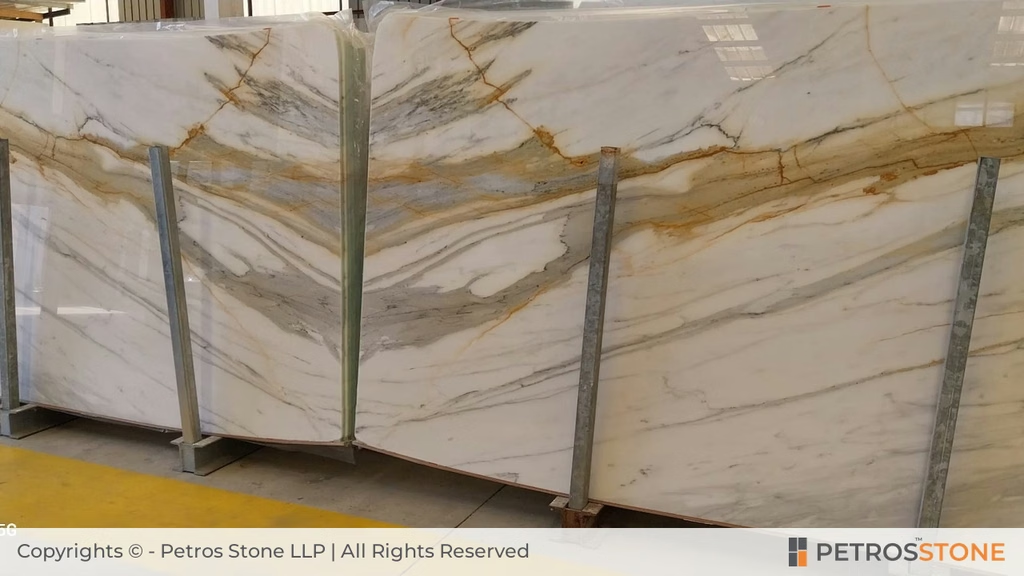
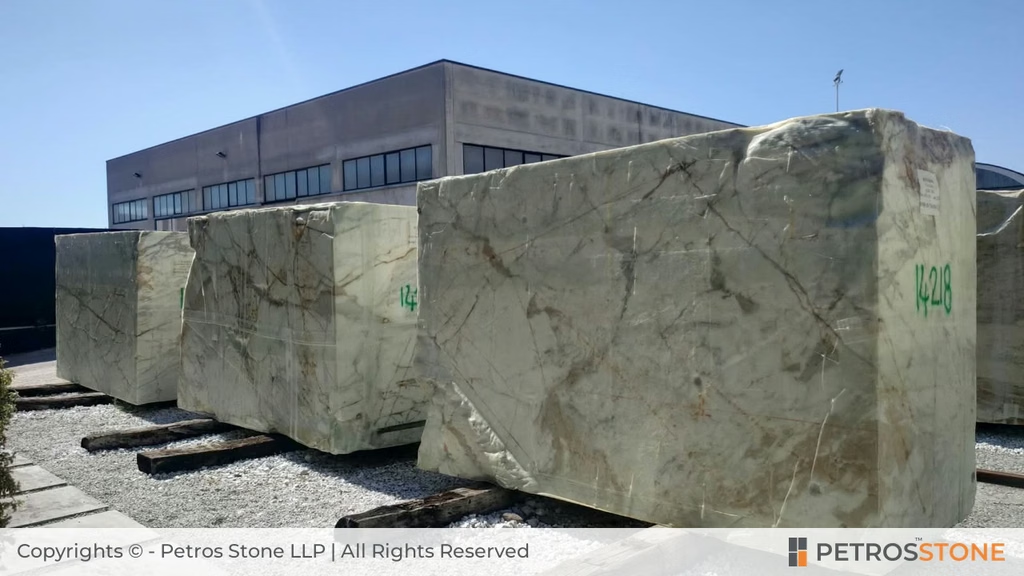
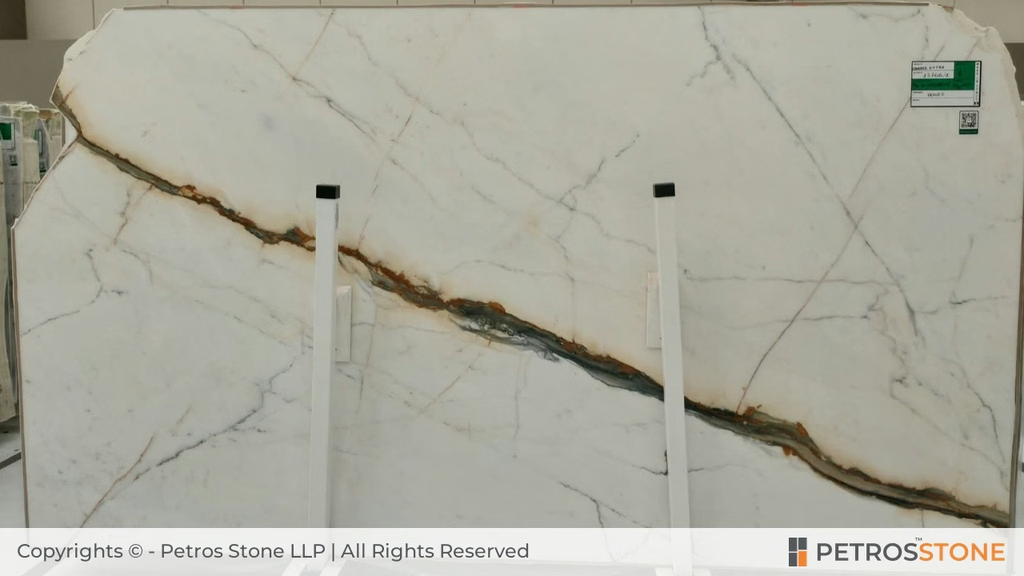
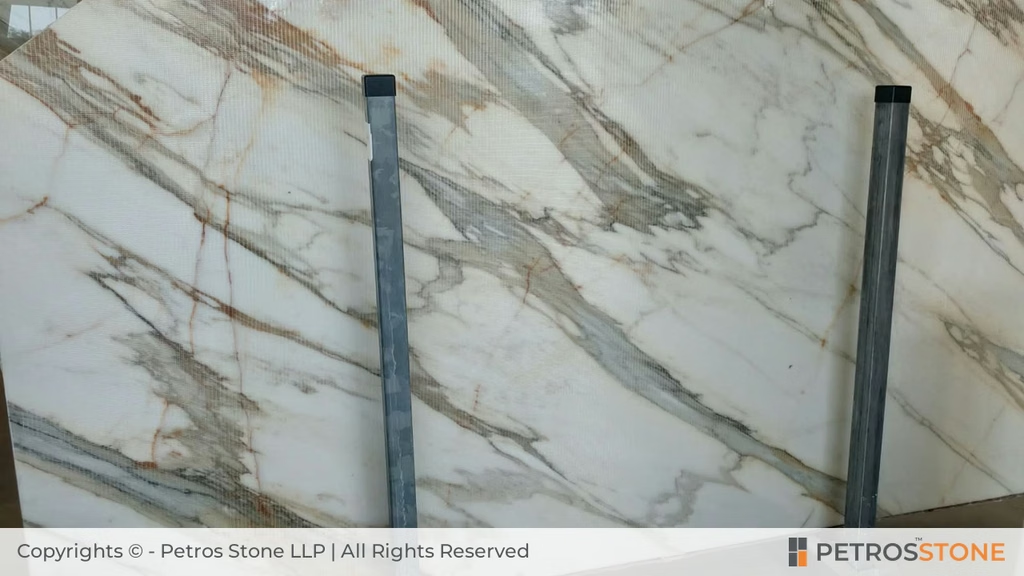
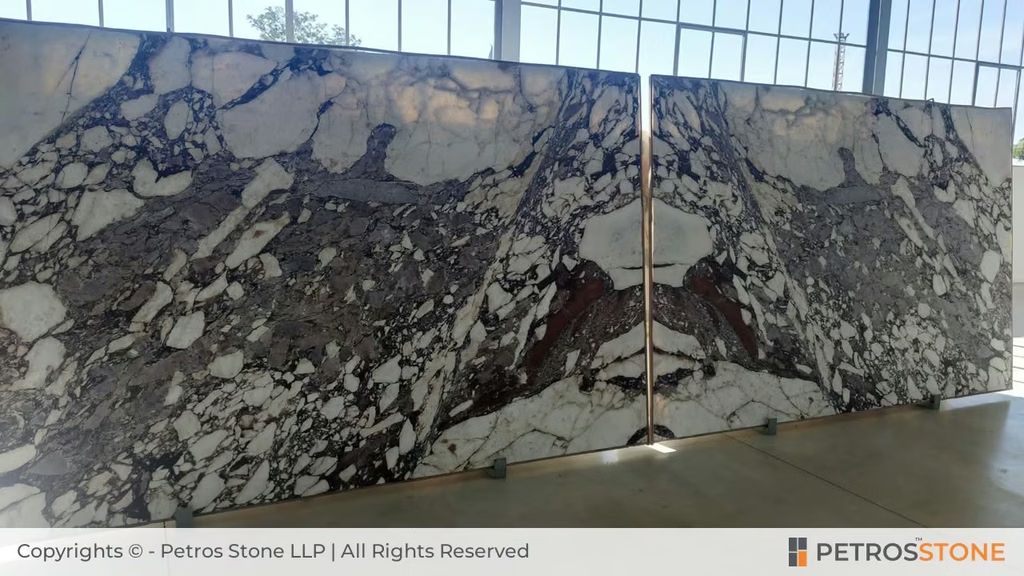
Limited block yield and strong global demand for statement veining keep Calacatta pricing high.
Audio Excerpts from Petros® Stone Director – International Business Rishabh Jain’s conversation with Roberto Baratta, Quarry Owner (Manfredi Import Export), Italy
How Do Quarry Owners Distinguish ‘True’ Statuario or Calacatta from Look-alikes?
The look-alikes are common, and most are cheaper marbles or quartzite sold under a premium name. Quarry owners typically check:
- Origin and block traceability: genuine stone can be traced to a quarry and block
- Background purity: true Statuario and Calacatta have a clean white base without a cloudy grey cast
- Vein character: natural veins vary in width and direction, while repeated identical patterns suggest an engineered product
- Translucency: good Statuario has a subtle luminous depth
- Consistency across the lot: unusually uniform slabs at a low price are a red flag
- Price reality check: a ‘Calacatta’ quoted at Carrara prices is almost certainly not Calacatta
Audio Excerpts from Petros® Stone Director – International Business Rishabh Jain’s Discussion with TMC Quarry Owner Riccardo Tedeschi, Italy
Which Marble Should You Choose Based on Design Intent?
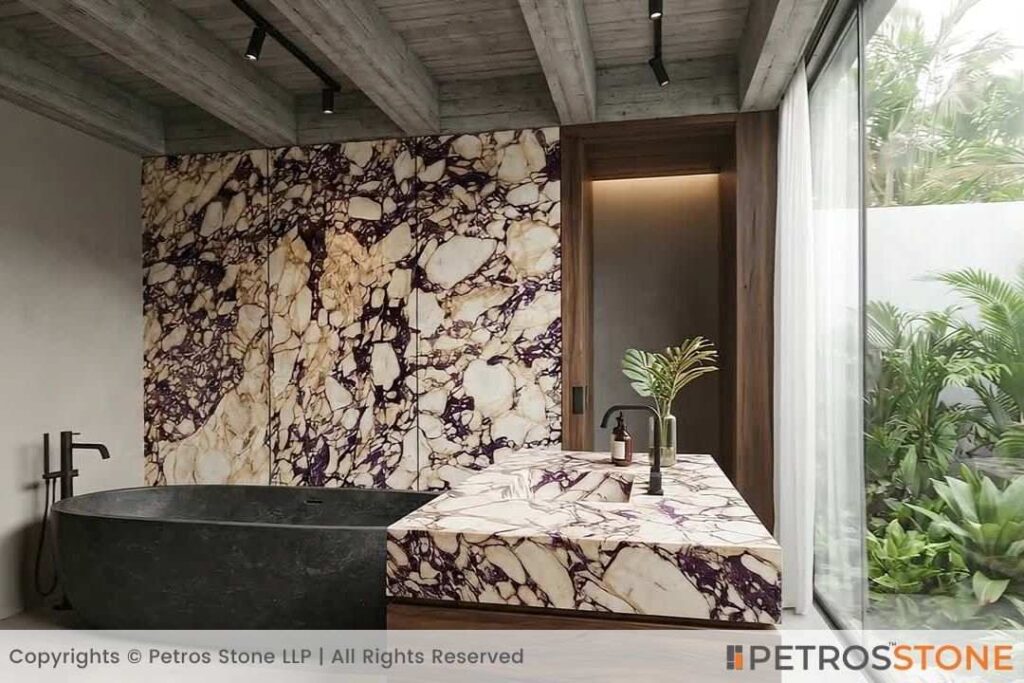
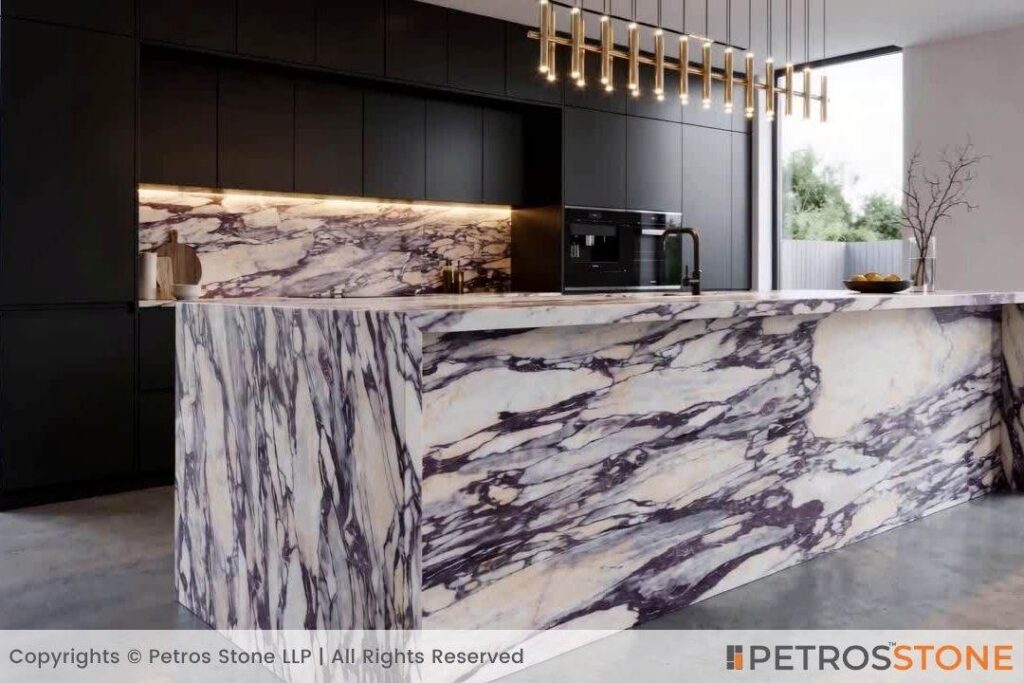
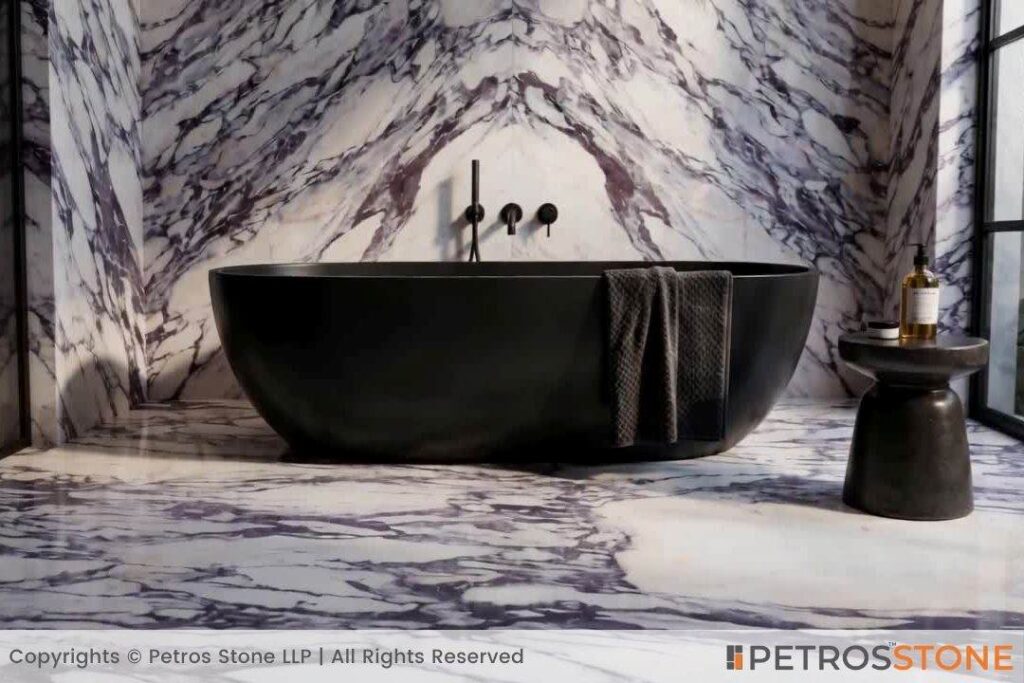
- Classic, calm, understated: Carrara
- Sculptural, luminous, high-contrast elegance: Statuario
- Dramatic statement surfaces: Calacatta (Oro for warmth, Borghini for boldness)
- Large floors on a budget: Carrara
- Feature walls, islands, and bookmatched installs: Calacatta or Statuario
Which Marble Offers the Best Value for the Price?

Carrara offers the best cost-to-coverage value, since it looks elegant and costs a fraction of the others. Statuario delivers strong visual impact for a mid-to-high premium. Calacatta is best reserved for focal surfaces, such as an island, a vanity, or a feature wall, where its rarity is visible. Using a premium marble on a small feature and Carrara elsewhere is a common way to balance budget and impact.
Why Are Carrara, Calacatta, and Statuario All Quarried in the Same Region but Priced So Differently?
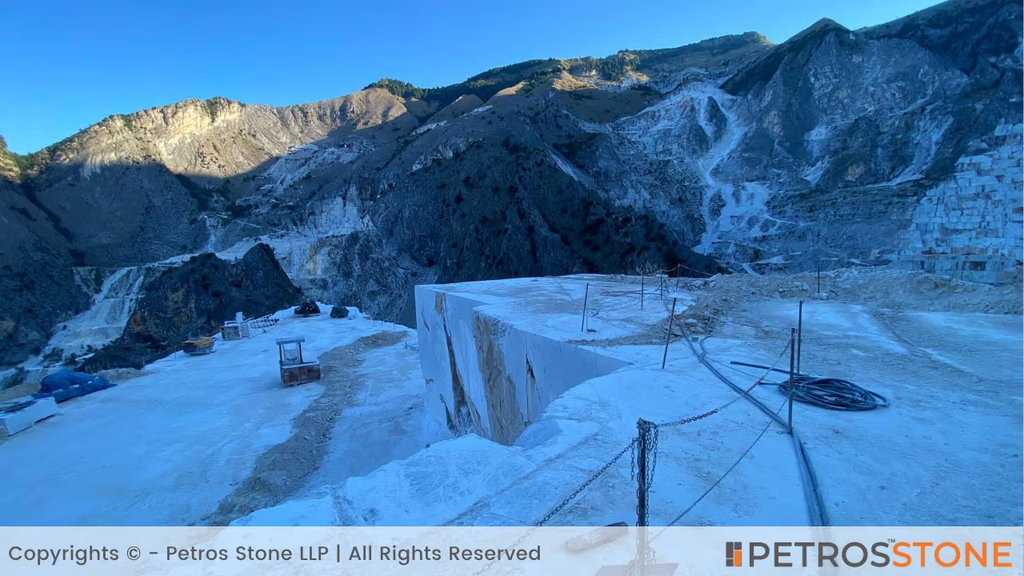
- Supply: Carrara blocks are abundant, while high-quality Statuario and Calacatta blocks are limited. Only a small percentage of extracted marble meets top-grade standards.
- Yield and waste: Premium blocks often need careful cutting and selection, and many slabs are rejected for flaws.
- Appearance and demand: Bold veining and a very white base are the most sought-after in luxury design, which pushes prices up.
- Selection and matching: Bookmatched, consistent slabs cost more.
- Global trends: Interior design trends and luxury demand strongly influence Calacatta pricing.
Common Myths About Statuario, Carrara, and Calacatta Marble
Myth 1: They’re soft and unusable. Marble is a calcite-based stone (around 3 on the Mohs scale). It is softer than granite but perfectly suitable for interiors when sealed and maintained.
Myth 2: They’re all the same. They differ in background whiteness, veining, rarity, and price.
Myth 3: They’re all expensive. Carrara is often affordable, and price depends heavily on grade.
Myth 4: The most expensive is the highest quality. Price reflects rarity and aesthetics, not necessarily durability. All three share the same basic physical properties.
Myth 5: Any ‘Calacatta’ label is genuine. Names are often used loosely in the market, so always verify origin.
Myth 6: Marble stains permanently. Sealing and prompt cleanup prevent most staining, though acids can etch the surface.
FAQs
Is Statuario more expensive than Calacatta?
Not always. Statuario generally costs more than standard Carrara, but premium Calacatta variants such as Oro or Borghini can cost more than Statuario. Grade matters more than name.
Why are Carrara, Calacatta, and Statuario all quarried in the same region but priced so differently?
Because of differences in rarity, block yield, and visual appeal. Carrara is abundant, while premium Statuario and Calacatta blocks are scarce and highly sought-after.
How can I verify if a slab labeled “Statuario” is genuine?
Check for a clean white background, bold grey veining, and translucency. Ask the supplier for the quarry origin and block details, inspect several slabs in natural light, and be suspicious of prices near Carrara levels.
Can you use Carrara, Calacatta, and Statuario together in one project?
Yes, but keep undertones consistent. Cool grey Carrara and Statuario pair easily, while warm-veined Calacatta Oro may clash with cool tones, so view samples together first.
Which of the three is best for high-traffic flooring?
All three have similar hardness, so choose based on look and budget. Carrara is the most practical option because its subtle veining hides wear better and it costs less to replace. Use a honed finish and proper sealing in any high-traffic area.
Do quarry owners still consider Statuario the rarest of the three today?
Opinions vary by block quality. Top-grade Calacatta variants and Statuario Altissimo are both very scarce.
Key Takeaways
- All three marbles come from the same Carrara region but differ in background, veining, rarity, and price.
- Identify by background whiteness first, then vein thickness, colour, and spacing.
- Verify authenticity through quarry origin, block details, and realistic pricing.
- Price reflects rarity and demand, not durability.
- All three need sealing and care.
Feel free to get in touch for a free consultation, quote, and get a detailed understanding from our experts here at Petros®. Visit www.petrosstone.com or call +91-8446360361 or WhatsApp

Brown Granite

White Galaxy Granite

Blue Bahia Granite

Silver Cloud Granite

Black Pearl Granite

Dallas White Granite