Granite looks permanent when you see it installed in a lobby, kitchen, staircase, or façade. What most buyers do not see is how much manufacturing sits behind that finished surface. A granite slab is not simply ‘cut from a mountain.’ It moves through a long chain of quarry planning, block extraction, transport, sawing, resin treatment, polishing, fabrication, testing, packing, and export handling before it becomes a usable product.
That manufacturing chain matters because two slabs of the ‘same granite’ can perform very differently depending on how they were quarried and processed. Cracks, polish depth, thickness tolerance, resin quality, and packing standards are all manufacturing decisions, not geological accidents. ASTM C615, the core material specification for granite dimension stone, makes that clear by linking stone selection not only to appearance but to physical requirements, sampling, soundness, freedom from open defects, and resistance to objectionable staining minerals.
The Indian Bureau of Mines describes granite processing in practical terms: raw blocks are sawed or cut into slabs or tiles of the required size and thickness, and then the sawn surfaces are polished. Edge cutting, milling, boring, and contouring add further value.
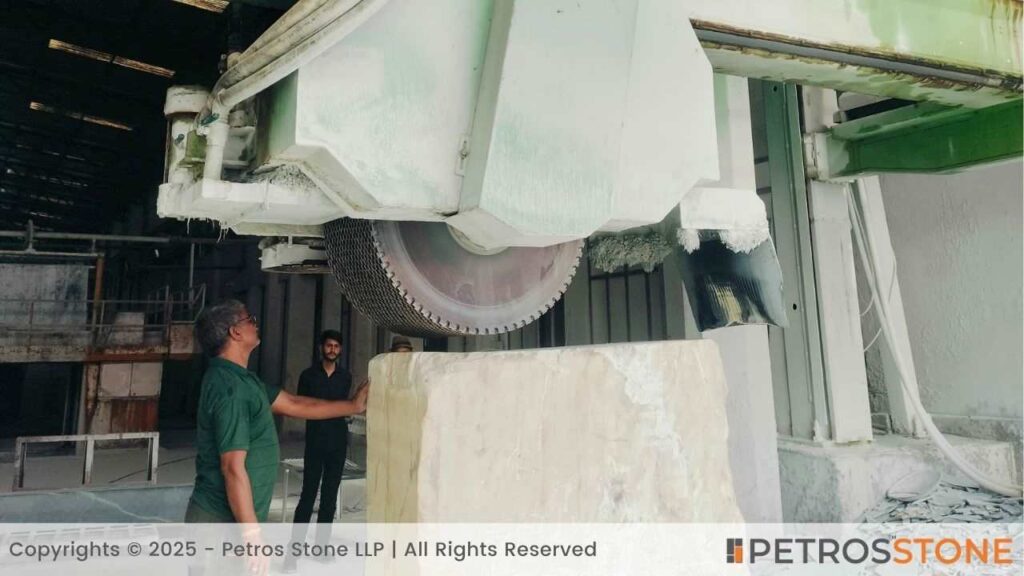
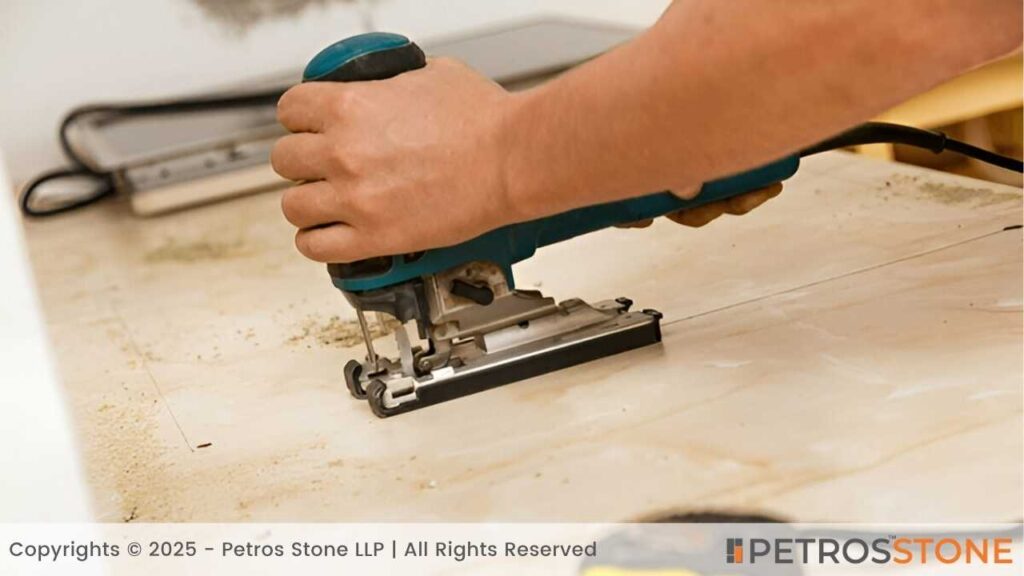
In this article, we explain the complete granite manufacturing process, from quarrying to finished slabs, and how each stage affects quality and durability. We also highlight key standards from ASTM International and practical factors that influence pricing and buyer decisions.
- What Granite actually is, and where Manufacturing begins
- Quarrying and Block Extraction
- Transport from the Quarry to the Factory
- Primary Processing from Block to Slab
- Drying, Resin Treatment, and Reinforcement
- Polishing & Surface Finishes
- Calibration, Trimming, & Cut-to-Size Fabrication
- Quality Control and Technical Testing
- Waste, Water, & Worker Safety
- Packing, Container Loading, and Export Readiness
- Granite Price Range (approx.)
- Why Processing Directly Impacts Granite Price
- Common Buyer Risks in Granite
- Key Takeaways
What Granite actually is, and where Manufacturing begins
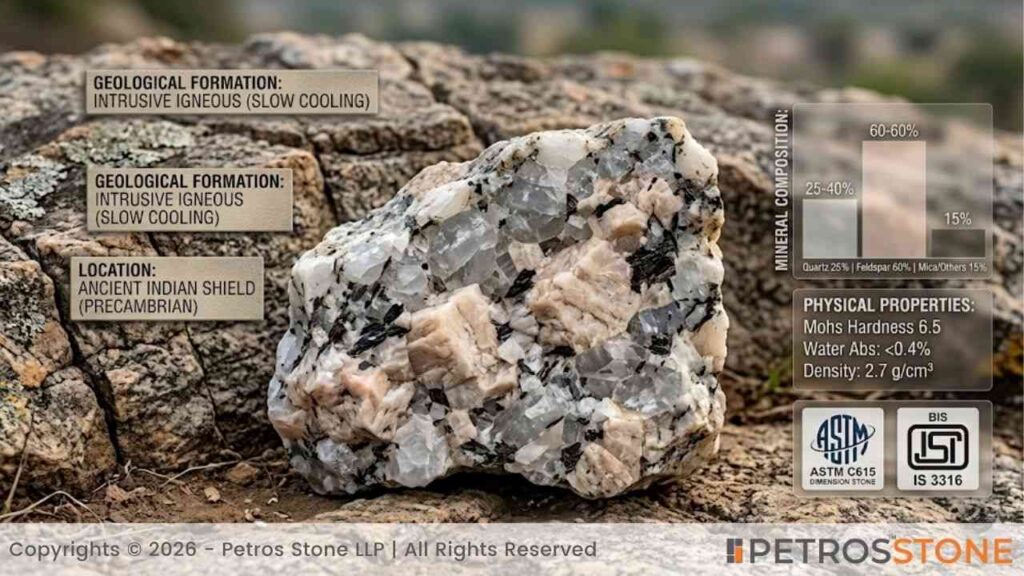
Technically, granite is a light-colored, coarse-grained plutonic rock composed mainly of feldspar and quartz with minor darker minerals. In commercial practice, however, the term is used more broadly for crystalline decorative rocks that can withstand quarrying, cutting, and polishing and that are valued for strength, color, and durability. The Indian Bureau of Mines also notes that India has a wide variety of granite, with over 200 shades identified in resource reporting and trade descriptions.
Manufacturing starts at the quarry, not the factory. This is where the deposit is studied for color consistency, fractures, joints, and recoverable block size. If the stone is badly fractured at quarry level, the factory will never get high-yield slabs out of it.
Older IBM yearbooks note that granite recovery in quarrying can be quite low, roughly 5 to 15 percent in cases of unscientific mining, which is why block planning and crack control matter so much to profitability. Those same reports describe a shift toward more modern block-splitting methods, such as flame-jet cutting and diamond wire saws, as well as mechanized lifting of large blocks.
Typical Granite Technical Properties
| Property | Typical Range | Relevant ASTM Standard |
|---|---|---|
| Density | 2.63 – 2.75 g/cm³ | ASTM C97 |
| Water Absorption | 0.1% – 0.4% | ASTM C97 |
| Compressive Strength | 100 – 250 MPa | ASTM C170 |
| Flexural Strength | 7 – 25 MPa | ASTM C99 / C880 |
These values align with testing methods defined by ASTM International and are widely used by exporters and consultants to evaluate granite suitability for structural and architectural applications.
Quarrying and Block Extraction
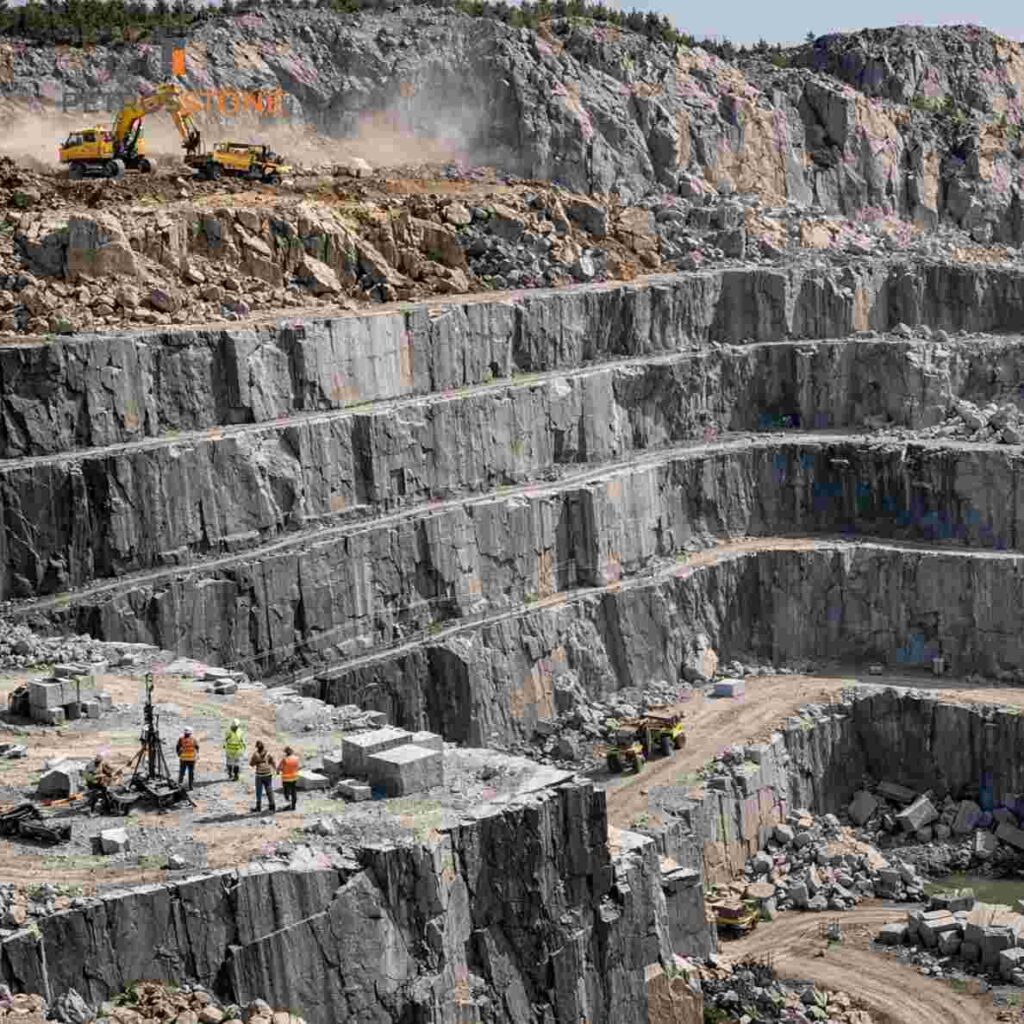
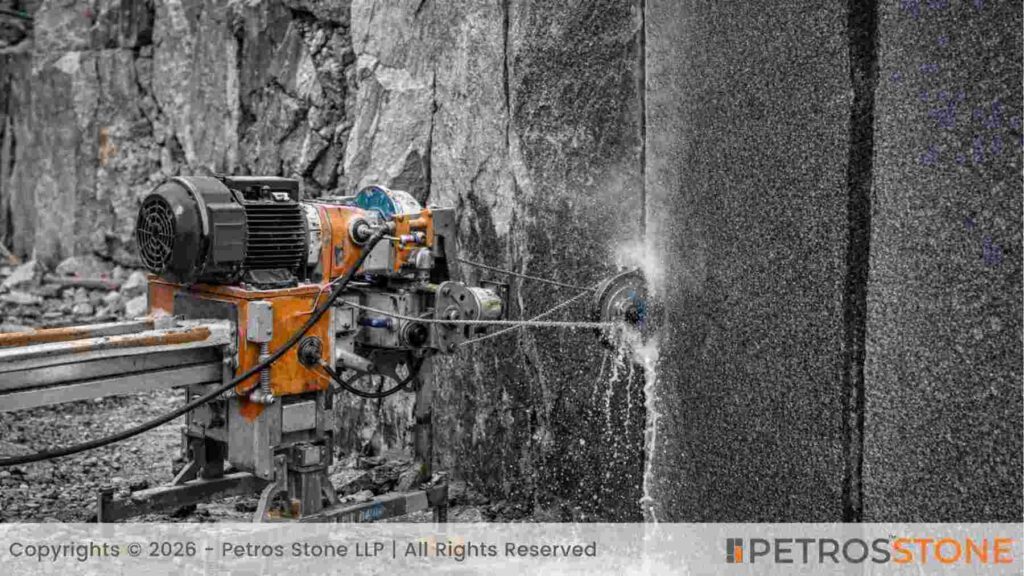
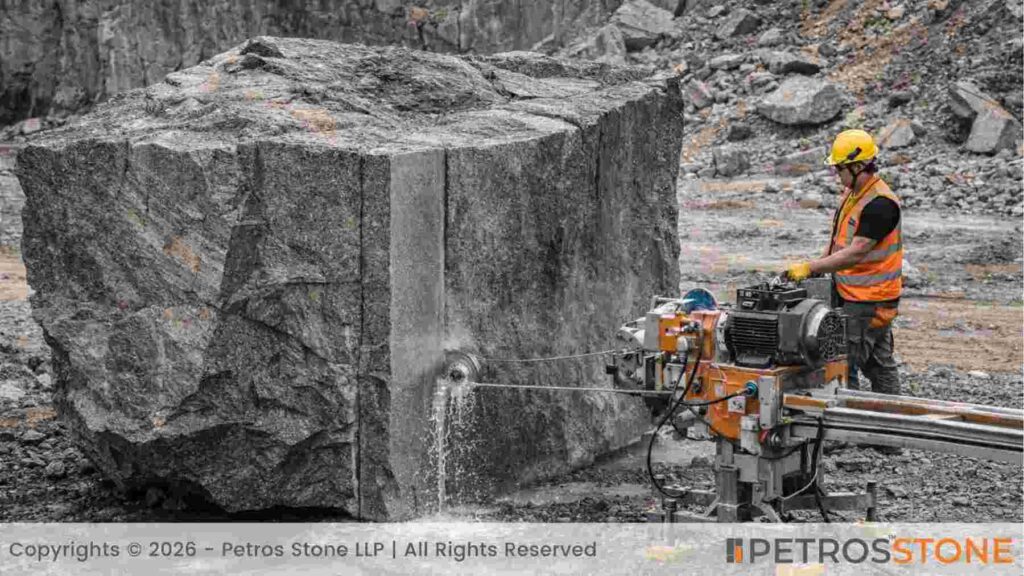
In a typical granite quarry, extraction happens in stages. The overburden is removed first, then benches are formed so the stone can be cut in controlled sections. Older manual or semi-mechanized splitting is still seen in some quarries, but more advanced extraction methods use drilling, controlled splitting, flame channeling in some cases, and diamond wire saw cutting. Diamond wire saws are especially important because they help produce cleaner quarry cuts and reduce random damage to the block. NSDC training material for wire-saw operators also points out that wire saws are used both for quarry-front cutting and for squaring blocks before they move to processing plants.
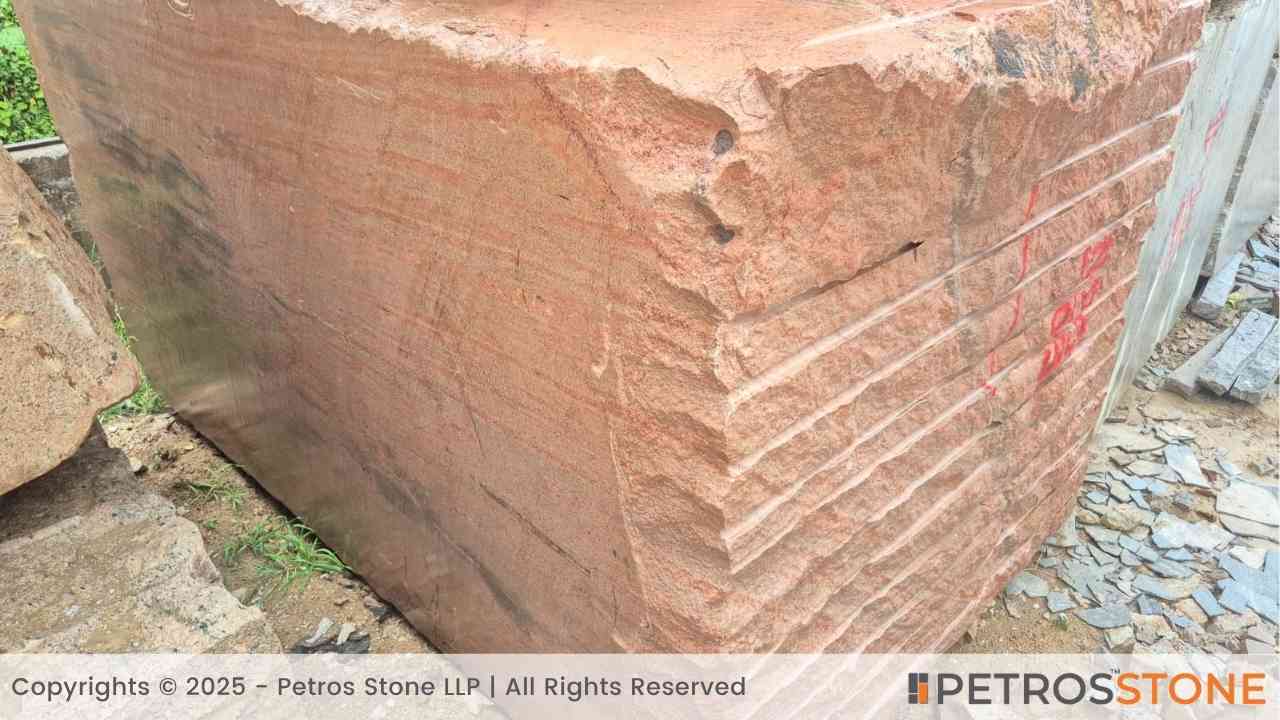
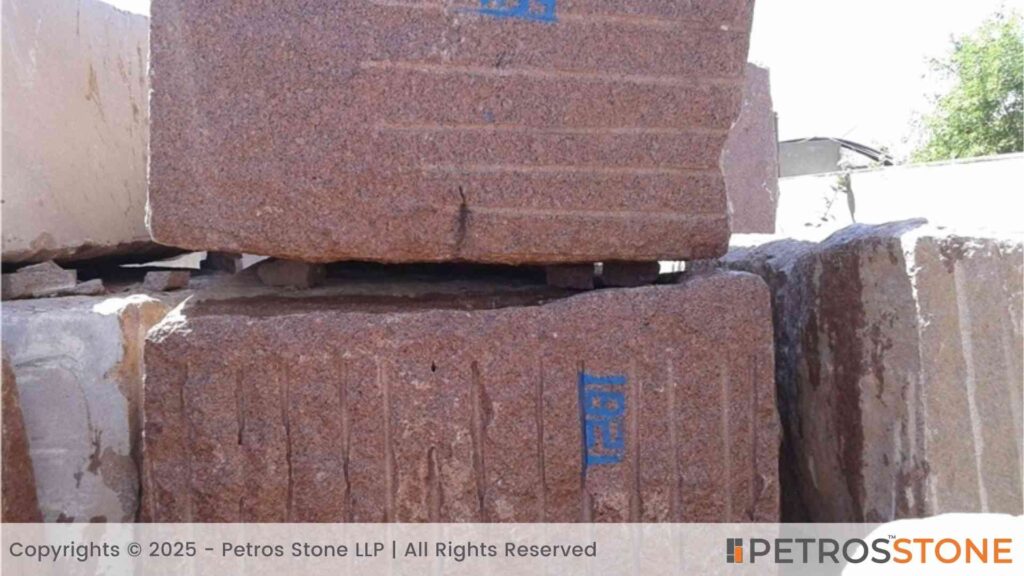
The goal at this stage is not to make a polished product. It is to win a commercial block with enough size, stability, and visual consistency to justify factory processing. Blocks are then dressed and roughly squared. Quarry owners and processors sort them by color range, grain movement, and visible defects. Export-grade blocks generally have tighter appearance control and fewer visible structural issues than lower-grade domestic material, though the exact grading language can vary from one processor to another. ASTM C615 reinforces the principle by requiring granite to be sound, durable, and free of spalls, cracks, open seams, pits, or other defects likely to impair structural integrity in its intended use.
Granite Quarry Extraction Process – A Summarized Table
| Stage | Description |
|---|---|
| Overburden Removal | Overburden is removed first to expose the solid granite deposit. |
| Bench Formation | Benches are formed to allow safe and controlled extraction of stone. |
| Extraction Methods | Extraction is carried out using manual splitting, drilling, flame cutting, or modern diamond wire saw cutting. |
| Role of Diamond Wire Saw | Diamond wire saws ensure cleaner cuts and less damage, as noted by National Skill Development Corporation. |
| Objective of Quarrying | The objective is to extract a large, stable, and visually consistent raw block, not a finished product. |
| Block Dressing | Extracted blocks are dressed and roughly squared for handling and transport. |
| Sorting and Grading | Blocks are sorted based on color, grain pattern, and visible defects. |
| Export vs Commercial Grade | Export-grade blocks have tighter quality control compared to commercial grades. |
| Quality Standards | As per ASTM C615, granite must be durable and free from structural defects. |
Impact on Final Product – The quality of quarry blocks directly impacts the final slab quality and market value.
Transport from the Quarry to the Factory
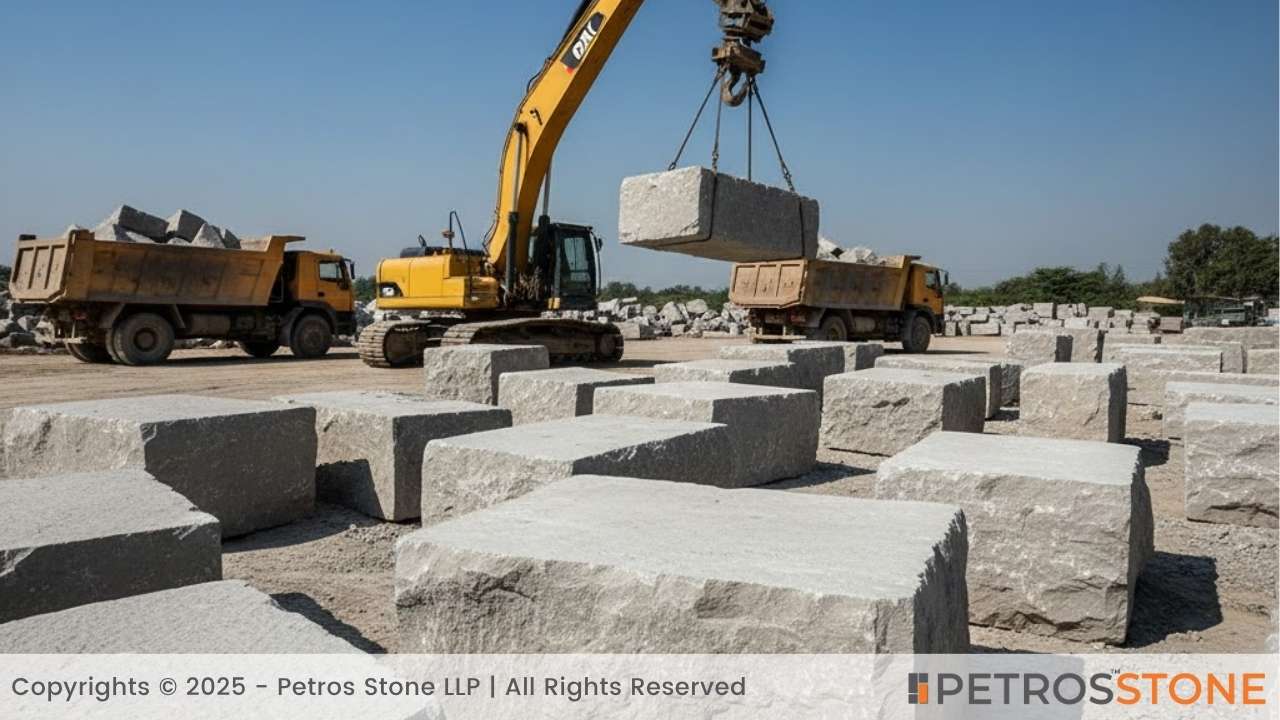
This stage looks simple, but it is where yield can be quietly lost. Granite blocks are extremely heavy, and poor loading or rough transport can create corner damage, edge fractures, or hidden stress. At many Indian plants, blocks are loaded with cranes or heavy-duty lifting systems, moved on trailers, and unloaded again at the factory yard. Every lift is a risk point.
From a buyer’s perspective, transport is part of manufacturing quality. A block that reaches the factory with impact damage may still produce slabs, but those slabs may need more trimming, more resin filling, or more rejection. That is one reason integrated operations with disciplined quarry-to-factory handling tend to perform better than loosely connected supply chains. IBM’s granite review also notes that major production of granite in raw as well as processed form is concentrated in states such as Andhra Pradesh, Telangana, Rajasthan, Karnataka, Tamil Nadu, and Gujarat, which helps explain why many processing clusters sit close to quarry belts or established logistics corridors.
Logistics Advantage – Processing units are often located near quarry belts or transport corridors to reduce handling risks and cost.
Primary Processing from Block to Slab
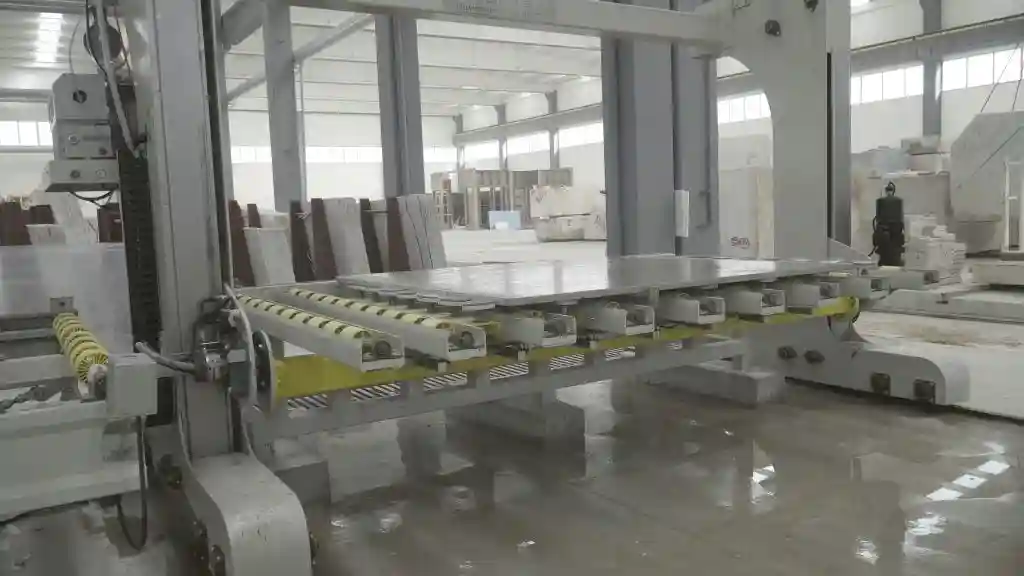
Once the block reaches the factory, the real visible transformation begins. The block is inspected, marked for cutting direction, and then fed to the appropriate sawing system. In India, processors traditionally used gangsaws for larger block processing, while cutter units and circular saw systems handled smaller or different-format work. IBM’s granite industry review for 2016 also refers to steel-shot gangsaws, multi-wire diamond saws, and large-format diamond circular saws in processing practice, reflecting how technology has evolved toward better speed and yield.
The choice of cut depends on the final product. Thick 2 cm or 3 cm slabs for countertops follow one route. Thin tiles for flooring or cladding follow another. The orientation of the cut also matters because grain, rift, and natural movement can affect both appearance and strength. This is one reason experienced factories do not just slice a block mechanically. They study how the block will open visually and structurally. A well-cut slab series gives better bookmatching, fewer weak corners, and more saleable material.
Final Output Quality – Proper cutting improves slab quality, reduces waste, and increases saleable material.
Drying, Resin Treatment, and Reinforcement

After sawing, granite slabs are often dried before further treatment. Many granites are dense enough to perform well without dramatic intervention, but this does not mean resin treatment is irrelevant. Even strong granites can contain pinholes, hairline fissures, or micro-cracks that become obvious after cutting. Factories, therefore, use fillers or resin treatment to stabilize the surface, improve polish quality, and reduce visible imperfections.
This step matters even more on granites with movement, mica-rich zones, or minor structural lines. The Natural Stone Institute’s technical library notes that common repairs and reinforcements are part of mainstream dimension stone practice, not an unusual rescue measure. In the same spirit, ASTM C615 allows granite with lower or variable values to be considered if competent engineering review addresses durability and related properties, which shows that proper evaluation and treatment are part of normal industry judgment.
Some fragile stones need net backing or additional reinforcement. Many granite slabs do not. This is where buyers often confuse manufacturing marks with defects. Resin filling is not automatically a red flag. Poor-quality resin work, however, is. Bad resin treatment can yellow, leave dull patches, or open up later under use.
Quality Risk – Poor resin treatment can cause yellowing, dull patches, or failure over time.
Polishing & Surface Finishes
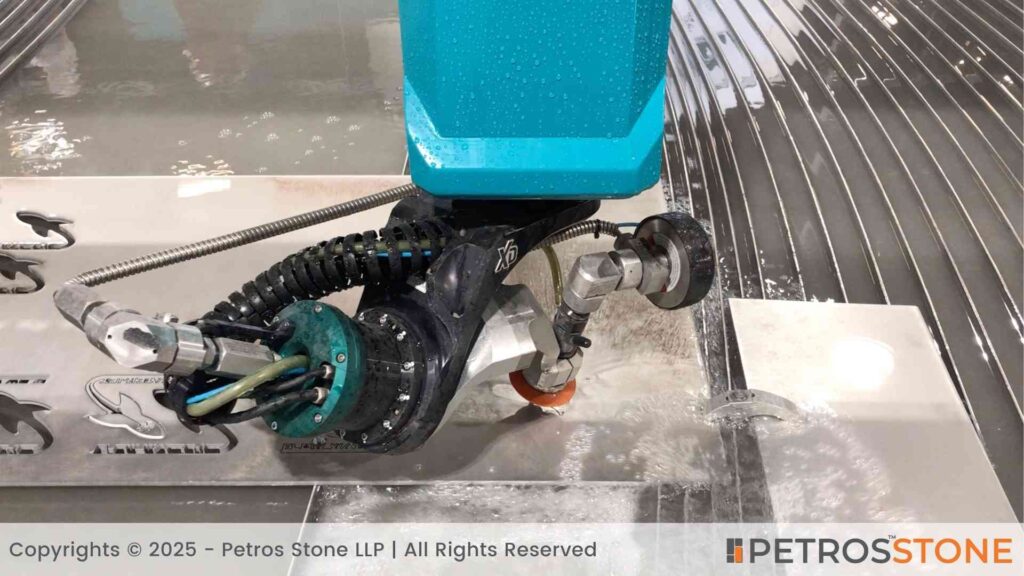
Polishing is the stage where granite begins to look like the stone buyers recognize. Slabs move through automatic polishing lines using progressively finer abrasives until the desired gloss level is reached. IBM highlights granite’s value for its ability to take a mirror-like polish, which remains one of the material’s biggest commercial strengths.
But polished is only one finish. Granite can also be honed, leathered, flamed, bush-hammered, shotblasted, or given other textures depending on the application. The right finish depends on use. A polished slab may suit interiors and countertops. A flamed or textured finish is often more appropriate for outdoor paving or steps. The Natural Stone Institute’s design resources emphasize that finish definitions, application selection, tolerances, and physical properties are all interconnected. In other words, the finish is not a style decision alone. It is part of performance.
Performance Consideration – As per Natural Stone Institute, finish selection affects durability, slip resistance, and overall performance, not just appearance.
Calibration, Trimming, & Cut-to-Size Fabrication
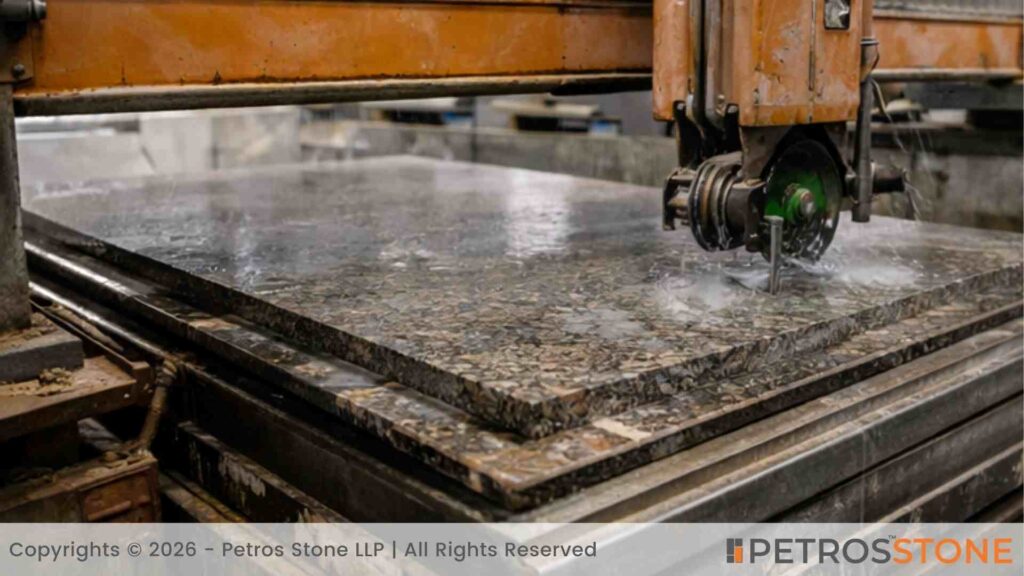
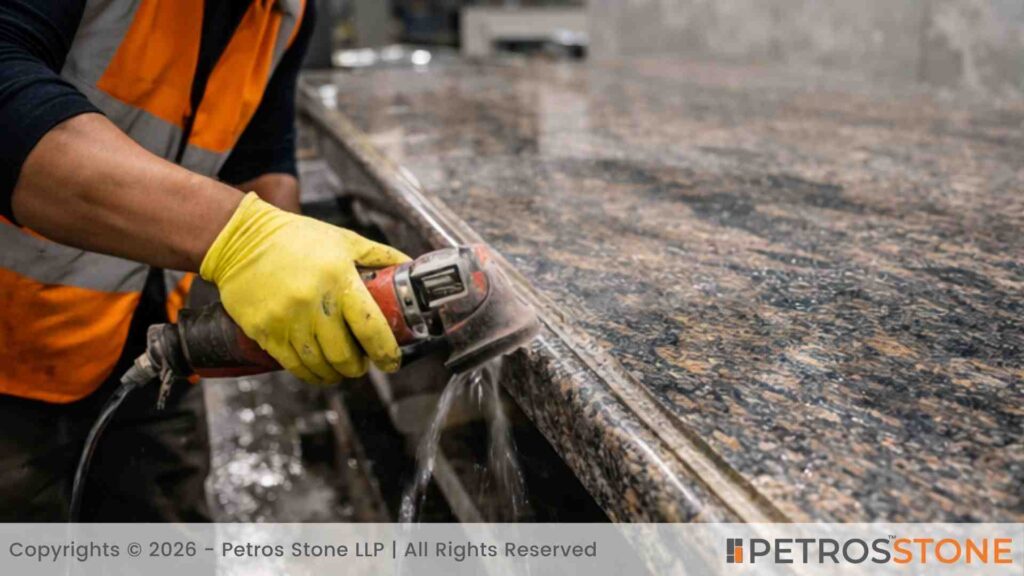
After finishing, slabs are trimmed and processed into saleable formats. This includes edge cutting, calibration to accurate thickness, and conversion into countertops, steps, risers, vanity tops, monuments, window sills, or facade panels. IBM specifically notes that edge cutting, milling, boring, and contouring are ancillary functions that enhance both quality and price realization.
For countertop fabrication, this is where CNC work or skilled manual shop work comes in. Sink cutouts, hob cutouts, drainer grooves, edge profiles, and laminated edges all happen here. This stage is also where the difference between a factory slab and an installed kitchen counter becomes real. A good slab can still be ruined by poor fabrication, especially around corners and cutouts.
Impact on Final Quality – Even a high-quality slab can fail if fabrication is poorly executed.
Quality Control and Technical Testing
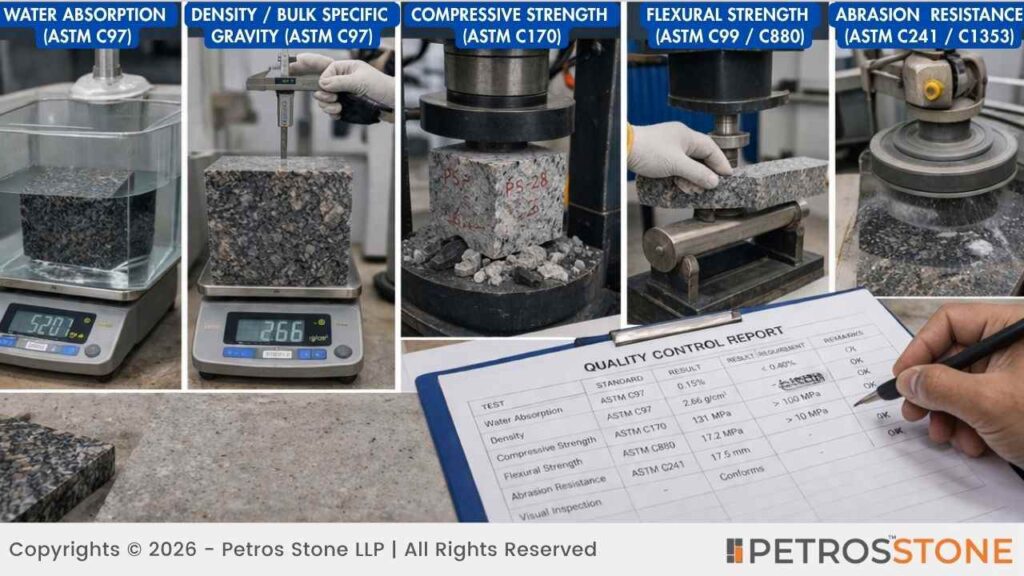
Good factories do not rely on shine alone. They inspect slabs for shade variation, pinholes, resin marks, saw lines, warpage, edge quality, and thickness consistency. They also work against recognized standards.
ASTM C615 sets the specification framework for granite dimension stone, while the related tests referenced in that standard include ASTM C97 for absorption and bulk specific gravity, ASTM C170 for compressive strength, ASTM C99 and C880 for rupture and flexural strength, and ASTM C241 or C1353 for abrasion resistance.
For buyers, the most useful lab values to ask for are usually water absorption, density, compressive strength, flexural strength, and abrasion resistance, where relevant. IBM also lists compressive strength, density, water absorption, porosity, hardness, color, texture, and granularity among the properties that influence both exploitation and marketability.
Table – Quality Control and Technical Testing
| Stage | Description |
|---|---|
| Visual Inspection | Slabs are checked for shade variation, pinholes, resin marks, saw lines, warpage, edge quality, and thickness consistency. |
| Purpose of Quality Control | Ensures slabs meet both visual and structural requirements, not just surface shine. |
| Specification Standard | ASTM International C615 defines requirements for granite dimension stone. |
| Water Absorption & Density Test | ASTM C97 measures water absorption and bulk specific gravity of granite. |
| Compressive Strength Test | ASTM C170 determines the load-bearing strength of granite. |
| Flexural / Rupture Strength | ASTM C99 and C880 evaluate bending and breaking resistance. |
| Abrasion Resistance | ASTM C241 or C1353 tests wear resistance for flooring applications. |
| Key Buyer Parameters | Important values include water absorption, density, compressive strength, flexural strength, and abrasion resistance. |
| Material Properties (IBM) | As noted by Indian Bureau of Mines, key properties include density, strength, porosity, hardness, color, and texture. |
Impact on Marketability – Better technical performance improves durability, usability, and commercial value of granite.
Waste, Water, & Worker Safety
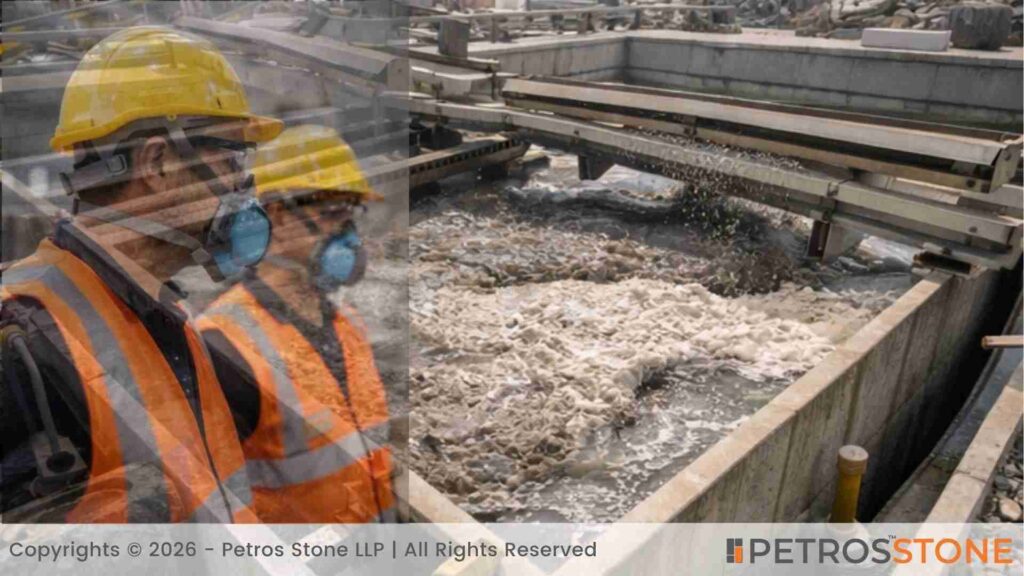
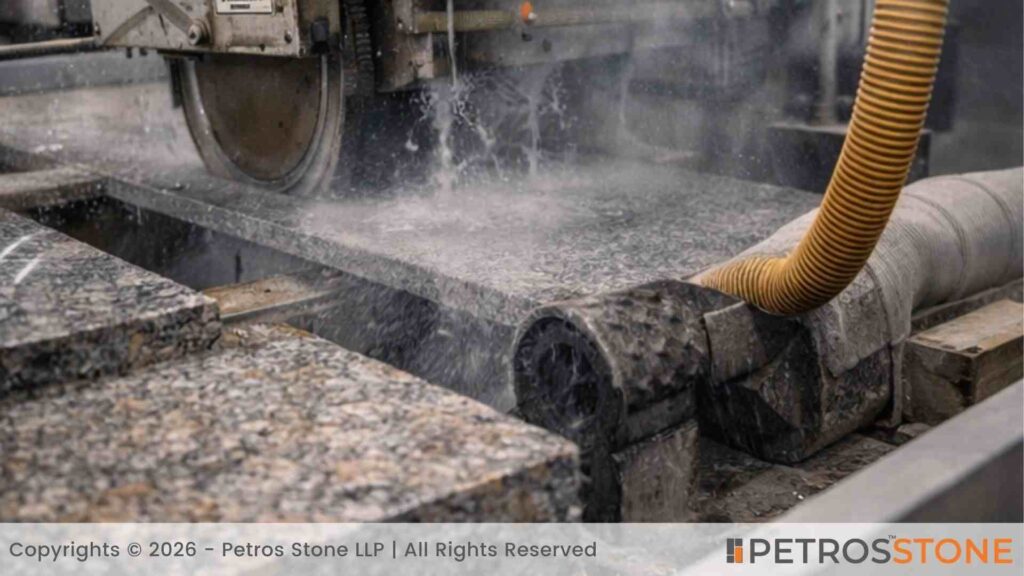
Granite manufacturing generates slurry, broken offcuts, rejected slabs, and water-borne stone fines. Better factories try to reuse at least part of this stream by converting waste into cobbles, kerbstones, memorial articles, landscaping products, or aggregates. Water recycling is also common because wet cutting and polishing use substantial water.
Worker safety has become a much more serious issue in stone manufacturing, especially around respirable crystalline silica. OSHA’s guidance on countertop manufacturing specifically recommends wet cutting, proper water flow, pretreatment of recycled water used on remotely operated machines, pre-washing slabs, and HEPA-filtered vacuum cleaning to keep dust under control. Even though the OSHA document is US based, the logic is relevant anywhere stone is cut and polished.
Safety Practices – As recommended by Occupational Safety and Health Administration, proper water flow, pre-washing slabs, and controlled processes reduce dust exposure.
Packing, Container Loading, and Export Readiness
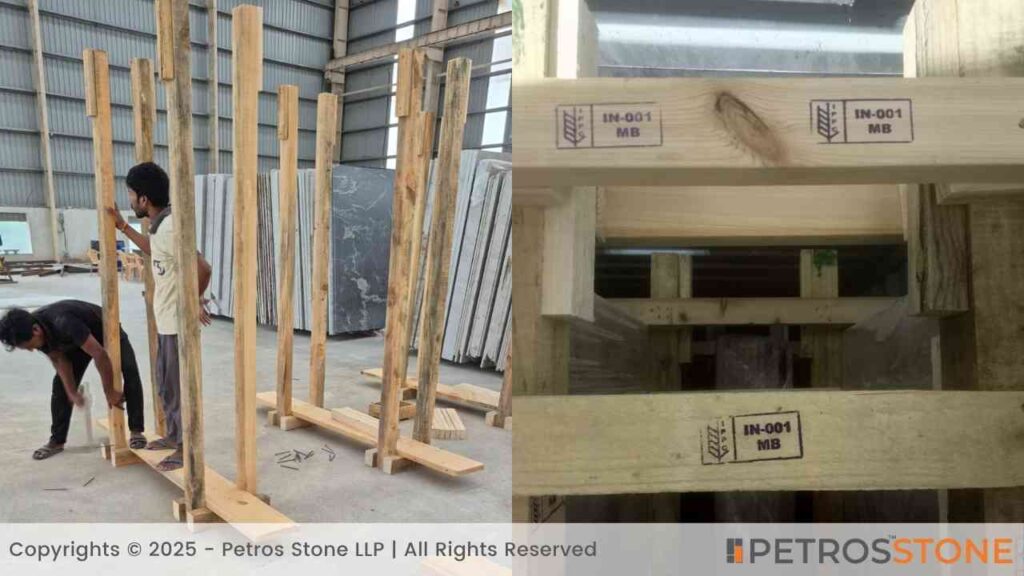
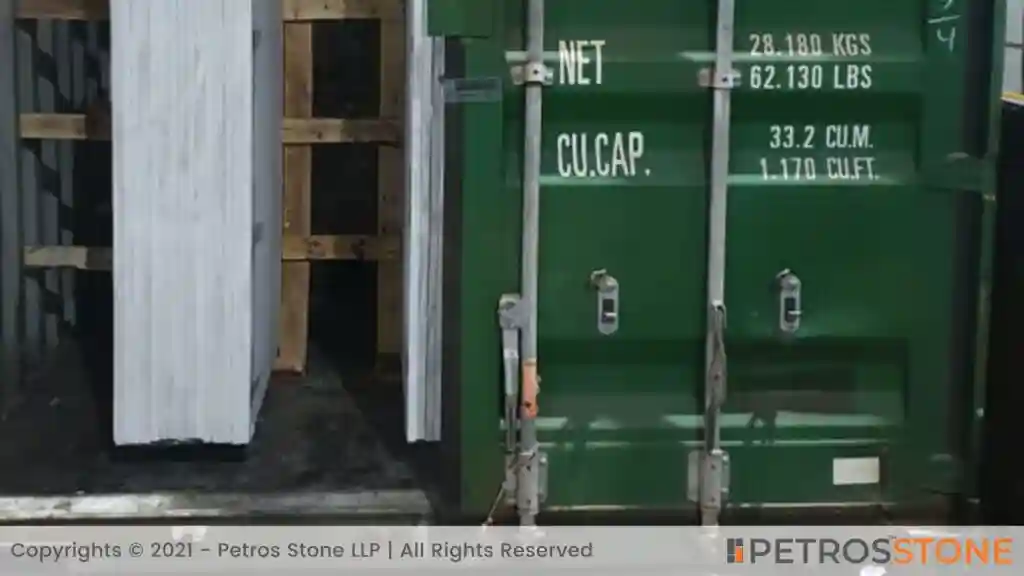

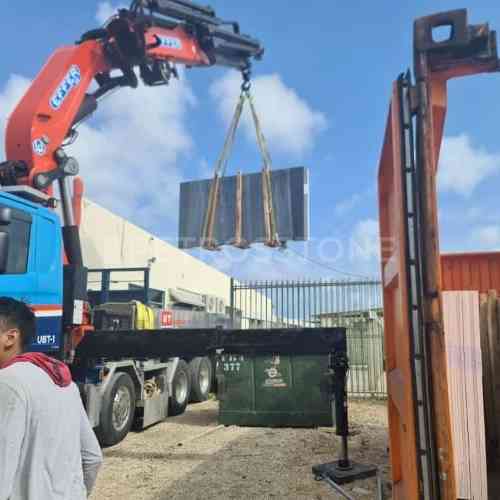
Once slabs or cut-to-size pieces pass inspection, they are packed into bundles, crates, or A-frames with separators and edge protection. This stage is easy to underestimate. In export work, packing quality can decide whether a finished polished slab arrives saleable or broken. Freight shocks, poor crate design, weak blocking, and moisture exposure can all damage stone after perfect processing.
India remains highly relevant in granite exports because it combines quarry resources, processing skills, and machinery capabilities.
CAPEXIL notes that India has a broad spectrum of dimension stones, a developed natural stone sector, and indigenous machinery and tool manufacturers serving the industry. The panel performance sheet for April to October 2024 recorded US$1,035.34 million for “Granite, Natural Stones and Products,” which shows the sector remains commercially meaningful even in a mixed export environment.
Table – Packing, Container Loading & Export Readiness
| Stage | Description |
|---|---|
| Final Inspection Clearance | Slabs or cut-to-size pieces are approved after quality checks before packing. |
| Packing Methods | Materials are packed in bundles, wooden crates, or A-frames with separators and edge protection. |
| Protection Measures | Use of padding, plastic sheets, and edge guards prevents scratches, chipping, and moisture damage. |
| Loading into Containers | Packed materials are carefully loaded into containers with proper blocking and support. |
| Transport Risks | Freight shocks, weak crates, poor loading, or moisture exposure can damage finished stone. |
| Importance of Packing Quality | Good packing ensures slabs reach the destination without breakage or loss of finish quality. |
| Export Strength of India | As noted by CAPEXIL, India has strong quarry resources, processing capabilities, and machinery support. |
| Industry Capability | India benefits from a developed natural stone sector and indigenous tool and machinery manufacturing. |
| Export Performance (2024) | CAPEXIL reports approx. US$1,035.34 million exports (Apr–Oct 2024) under granite and natural stone products. |
Commercial Significance – Granite exports remain a key contributor to India’s natural stone industry despite market fluctuations.

To ensure consistency and export-grade reliability, Petros® Stone focuses on reinforced packing systems, calibrated slab stacking, and strict container loading protocols, minimizing transit damage and rejection rates. This integrated approach, from factory inspection to final dispatch, helps maintain quality standards expected in international markets.
Granite Price Range (approx.)
| Category | Price Range (USD/sq.ft.) | Basis |
|---|---|---|
| India Factory Price (Rough Slabs) | ₹70 – ₹250 per sq. ft. | $0.85 – $3 per sq ft (FOB India, unpolished slabs) |
| Processed & Polished Slabs (Export Grade) | $3 – $10 per sq. ft. | FOB India, depends on finish, thickness (2 cm / 3 cm), and quality |
| Delivered Pricing (International Markets) | $5 – $15 per sq. ft. | CIF pricing, includes freight, insurance, and destination costs |
As highlighted by CAPEXIL, value addition through processing, polishing, and packaging significantly increases export realization compared to raw blocks.
Why Processing Directly Impacts Granite Price

The final price of granite is not driven by color alone. It reflects block quality, quarry recovery, cutting yield, resin cost, finish type, thickness, fabrication complexity, rejection rate, packing standard, and logistics. A slab from a sound block with minimal waste and smooth polishing costs less to produce than one from a fractured block that needs heavy repair and trimming.
This is why two slabs that look similar online may be priced very differently in the market. One may come from a better block, tighter process control, and a lower-waste production route. The other may be carrying the hidden cost of poor recovery and more factory intervention.
- Block Recovery Drives Cost – Cleaner quarrying and precise gang saw cutting increase slab yield, reducing cost per usable square foot.
- Defects Increase Processing Expense – Cracks, pinholes, and veins require resin treatment, trimming, or rejection, raising overall production cost.
- Factory Technology Improves Value – Multi-wire saws, automated polishing, and calibration lines produce consistent slabs with higher market acceptance.
- Finish Type Changes Pricing – Polished, leathered, or flamed finishes involve different abrasives, labor, and time, directly affecting price.
- Thickness & Calibration Matter – Accurate 20 mm or 30 mm slabs reduce installation issues and command better pricing in export markets.
- Fabrication Adds Significant Value – CNC cutouts, edge profiles, and finishing convert raw slabs into ready-to-use products, increasing price per unit.
- Handling Losses Affect Real Cost – Damage during transport or loading reduces saleable output, increasing effective cost of remaining material.
- Grading Determines Market Position – Uniform, defect-free export-grade slabs are priced significantly higher than commercial-grade material.
- Standards Influence Buyer Confidence – Compliance with ASTM International (C97, C170, C99) ensures performance, allowing premium pricing.
- Export Processing Multiplies Value – As highlighted by CAPEXIL, processed granite (cut, polished, packed) earns far higher value than raw blocks.
Common Buyer Risks in Granite

- Judging by polish only – Shine can hide cracks, fillers, or weak zones—always verify with ASTM International test data (C97, C170, C99).
- Ignoring thickness & calibration – Uneven slabs (18–20 mm / 30 mm variation) lead to installation issues and breakage risk.
- Poor resin quality – Low-grade resin can yellow, dull the polish, or fail over time.
- Not checking block origin & grade – Export-grade slabs are more consistent; commercial-grade may have more defects (quarry variation noted by Geological Survey of India).
- Transport & handling damage – Improper lifting or loading can cause edge cracks and hidden stress.
- Weak packing standards – Poor crates or loading can lead to breakage during transit (critical in exports per CAPEXIL insights).
- Skipping technical test reports – Key values like density, absorption, and strength directly affect durability.
- Assuming all factories are equal – Cutting, polishing, and fabrication quality vary significantly across suppliers.
Key Takeaways
- Granite quality starts at the source and is shaped by processing — quarry selection, cutting direction, and factory control directly influence strength, appearance, and yield.
- Surface finish does not define performance — proper resin treatment, calibration, and polishing quality matter more than shine alone.
- Testing and standards are essential — verified values (as per ASTM International C97, C170, C99) ensure durability and suitability for application.
- Handling, fabrication, and packing complete the quality chain — even good slabs can fail due to poor cutting, edge work, or transport damage.
Feel free to get in touch for a free consultation, quote, and get a detailed understanding from our experts here at Petros®. Visit www.petrosstone.com or call +91-8446360361 or WhatsApp

Hi, I’m Shivangi,
With years of experience in the architecture and design space, I write to bridge the gap between material knowledge and practical application. At Petros® Stone, I create content that highlights the beauty, function, and impact of natural stones, helping homeowners and professionals make confident design decisions.
Explore my LinkedIn profile to learn more about my work!

Brown Granite

White Galaxy Granite

Blue Bahia Granite

Silver Cloud Granite

Black Pearl Granite

Dallas White Granite