Granite is a reliable choice for pathways due to its high compressive strength, abrasion resistance, and outdoor durability. However, buyers often prioritize color over thickness, when thickness should come first. It directly affects breakage risk, installation, and long-term performance.
Guidance from the Indian Bureau of Mines and ASTM International treats thickness as a structural factor, not cosmetic. While 20 mm slabs suit indoor flooring, outdoor pathways face moisture, temperature changes, and load stress. The right approach is to select thickness based on usage, load, and base conditions, not a fixed standard.
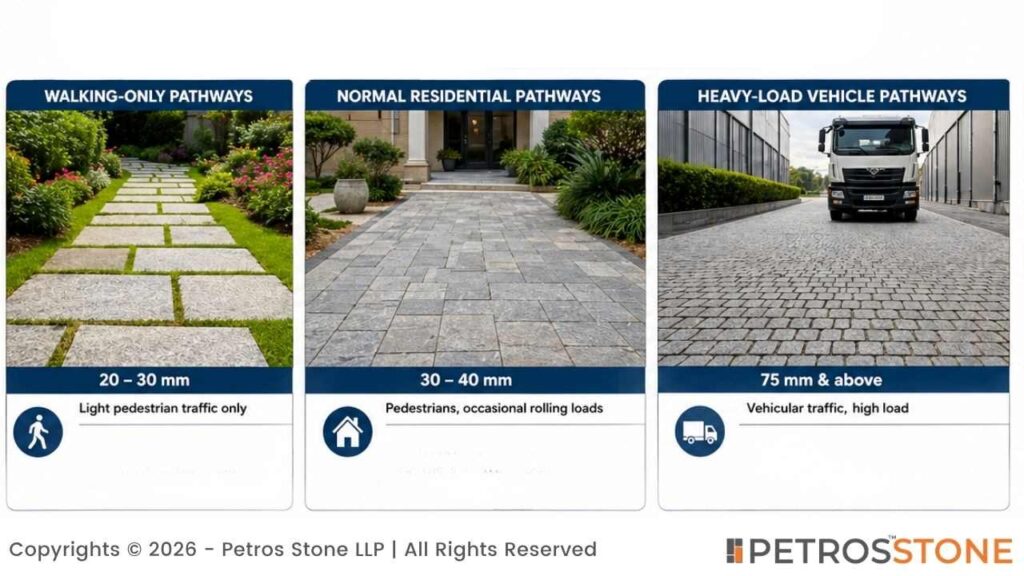
Granite Thickness Guide for Different Pathways – A Quick Summary Table
| Pathway Type | Recommended Thickness | Typical Use Cases | Best Format | Key Risk if Underspecified |
|---|---|---|---|---|
| Walking-only (Light Foot Traffic) | 20–30 mm (20 mm only in controlled conditions) | Garden paths, stepping stones, lawn walkways, side yards | Small slabs / stepping stones / small pavers | Edge cracks, rocking due to minor base gaps |
| Normal Residential Pathways | 30–40 mm (30 mm standard, 40 mm safer) | Entry paths, patios, courtyards, daily-use walkways, bins & bicycles | Medium slabs or pavers | Corner breakage, long-term loosening, surface fatigue |
| Heavy-load / Vehicle Pathways | 75 mm and above (engineering-based) | Driveways, service lanes, parking zones, truck access areas | Granite pavers / cubes / setts | Structural failure, slab cracking, base deformation |
| Decorative / Low-use Paths (Premium Install) | 20–25 mm (only with rigid base) | Feature walkways, landscaped zones with minimal traffic | Large slabs (bonded system) | Sudden cracking if support is inconsistent |
| Large-format Slabs (Any Use) | +10 mm over base recommendation | Modern designs with big slab sizes (600×900 mm and above) | Slabs (requires strong base) | Bending failure due to increased span |
In this article, we break down how granite thickness actually performs in real outdoor conditions, not just in theory. We compare pedestrian, residential, and heavy-load pathways using practical site logic, ASTM-based guidance, and installation realities. You’ll also understand how thickness works together with base preparation, unit size, and stone quality, so you don’t over-specify or under-design your pathway.
- Why Granite Thickness Matters
- Pathway Types
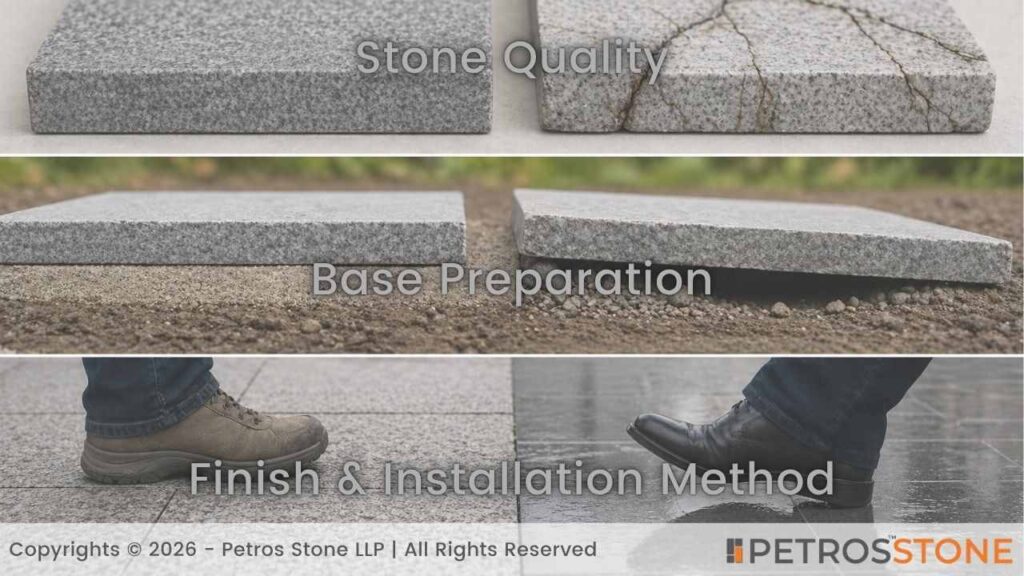
- What Affects Granite Thickness Besides Load
- Best Thickness for Walking Pathways
- Best Thickness for Normal Residential Pathways
- Best Thickness for Heavy-Load Vehicle Pathways
- Slabs vs Pavers for Different Uses
- Common Mistakes in Choosing Granite Thickness
- Cost and Practical Considerations
- Frequently Asked Questions
- Key Takeaways
Why Granite Thickness Matters
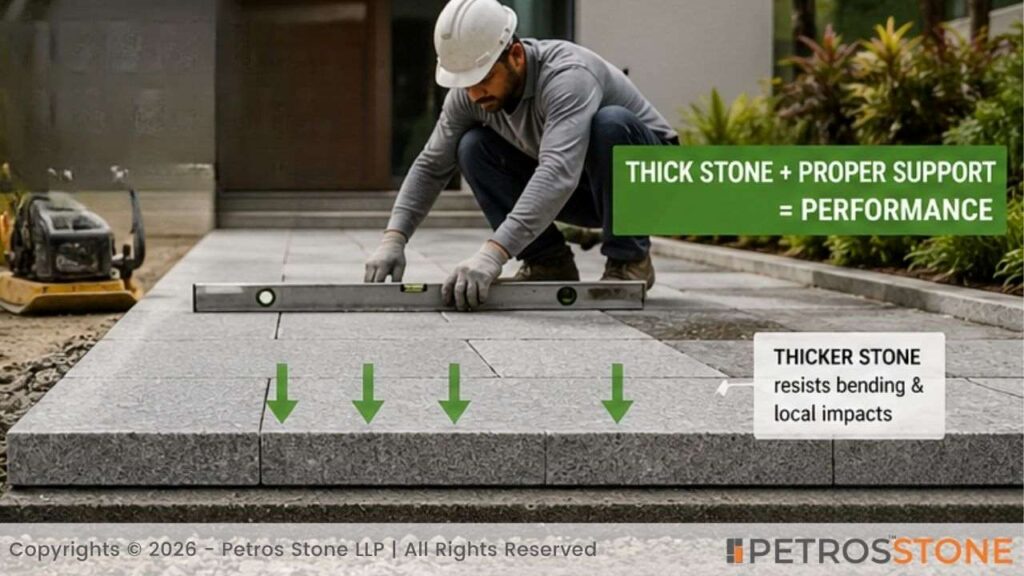
Thickness matters because stone fails by bending and by loss of support much more often than people expect. Most pathway failures are not dramatic or crushing. They are cracked corners, rocking pieces, broken edges, or slabs that snap because one part of the underside is unsupported. The thicker the granite, the better its ability to resist small support errors, local impacts, and bending stress. At the same time, thickness alone cannot rescue poor design. Natural Stone Institute’s paving guidance makes this very clear by pairing thickness with base preparation, jointing, movement accommodation, and setting-system design.
This is also why thicker is not always ‘better’ in a simplistic way. A 75 mm paver over a weak, pumping base can still fail. A 20 mm slab on a rigid, well-bonded, properly drained base may perform better than expected in a light-use decorative path. The load, the span, the support, and the unit size all work together. ASTM C1950 is specifically written as a guide for the selection, design, and installation of exterior dimension stone paving systems because these variables cannot be separated in practice.
Pathway Types
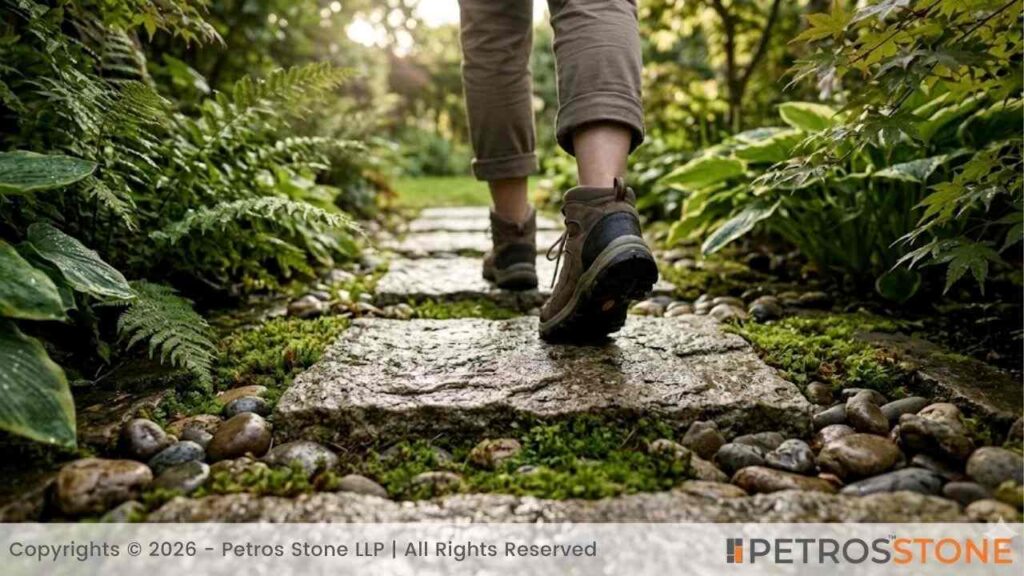
Walking-only Pathways
These are the lightest-use paths. Think garden stepping routes, side-yard paths, lawn crossings, and low-frequency pedestrian trails where the users are mainly people on foot. No scooters, no cars, no service carts, and ideally no concentrated wheel loads. This category gives the most flexibility in thickness, especially if the pieces are small and well supported.
Normal Residential Pathways
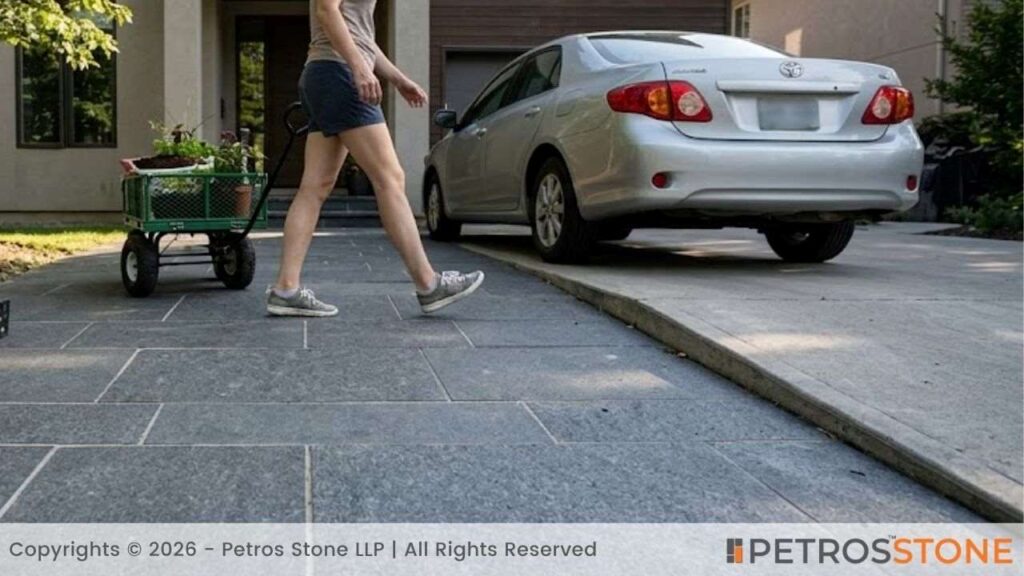
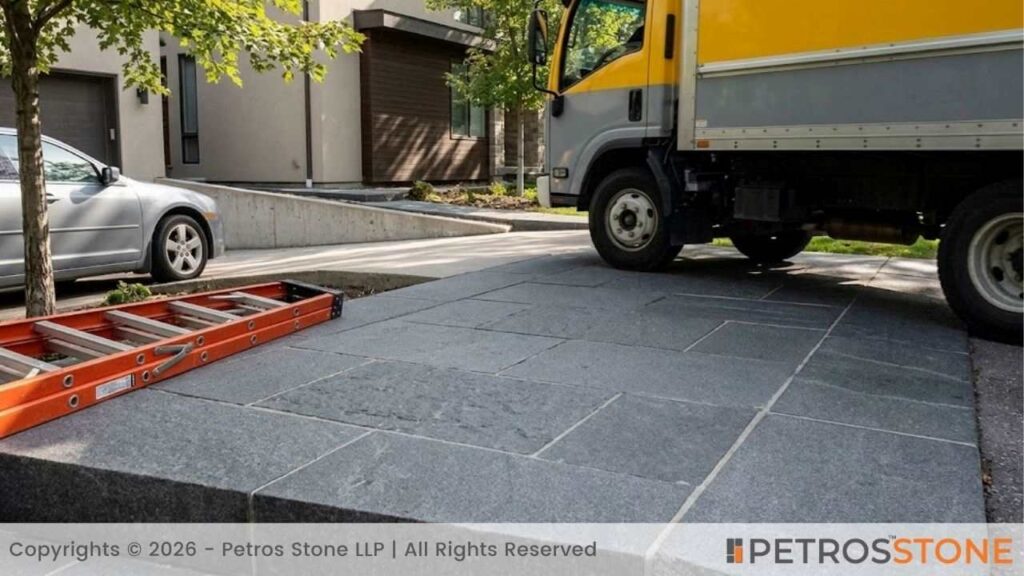
This is the category most homeowners underestimate. A normal residential path is not just ‘people walking.’ It includes front-entry routes, courtyard circulation, side passages, patio connectors, and places that may occasionally see bicycles, ladders, wheeled bins, garden equipment, or a misplaced car tyre at the edge. This is where outdoor residential paving becomes more demanding than decorative stepping.
Heavy-load Vehicle Pathways
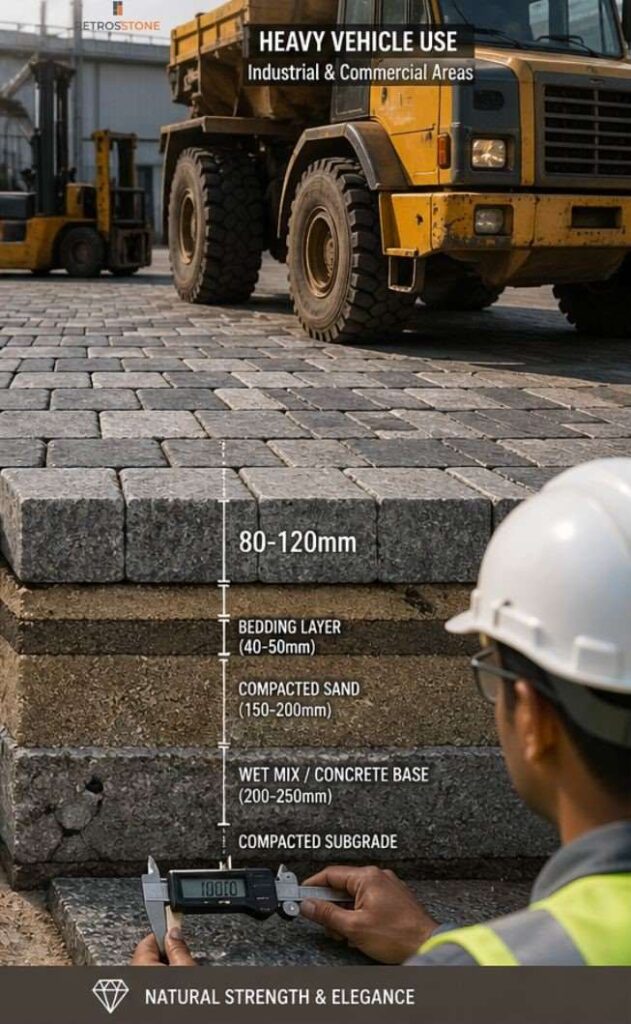
This category covers service lanes, commercial or institutional approach roads, truck-bearing paths, loading-area paving, and any route where repeated vehicular loads are real and not hypothetical. Here, granite should be treated more like a structural paving element than a decorative surfacing material. NSI guidance states that vehicular exterior stone pavers are generally 75 mm or thicker, with final thickness best determined by engineering analysis.
What Affects Granite Thickness Besides Load
Stone quality
Not all granite behaves the same. Even though granite is generally durable, actual field performance still depends on soundness, grain structure, mineral composition, and whether the stone contains flaws, injurious veins, or weak zones. IS 3316 requires structural granite to be free from flaws, cavities, and injurious veins that would impair integrity, and sets a minimum compressive strength requirement for structural use. So a weaker, more fissured granite may need more conservative thickness or a different format than a denser, sounder material.
Base preparation
If there is one thing buyers get wrong most often, it is blaming stone thickness for a base problem. Uneven compaction, trapped water, settlement, voids under corners, and weak edge restraint will break even good granite. ASTM C1950 and NSI’s design manual both treat paving as a system. That means bedding, drainage, mortar or sand support, and movement accommodation are just as important as the stone itself.
Finish and installation method
Finish changes, grip, and sometimes use cases. Polished granite is generally a poor outdoor choice because it becomes more slippery and visually exposes wear faster. Flamed, shot-blasted, bush-hammered, or other textured finishes are usually more appropriate for pathways. The installation method also matters. Stone over a rigid mortar bed performs differently from stone over sand, and both behave differently from pedestal-supported systems. NSI’s horizontal-surfaces manual specifically distinguishes between these paving assemblies because thickness recommendations and support conditions are not identical across systems.
Best Thickness for Walking Pathways
For walking-only paths, 20 mm granite can work, but only under controlled conditions. It should ideally be a smaller-format unit, properly supported, and installed on a stable, well-prepared base. If the path is decorative, lightly used, and set over a bonded mortar bed or another reliably supported system, 20 mm may be adequate. IBM’s note that 20 mm granite is commonly used for flooring helps explain why some suppliers carry this thickness readily, but that should not be read as blanket approval for every outdoor path.
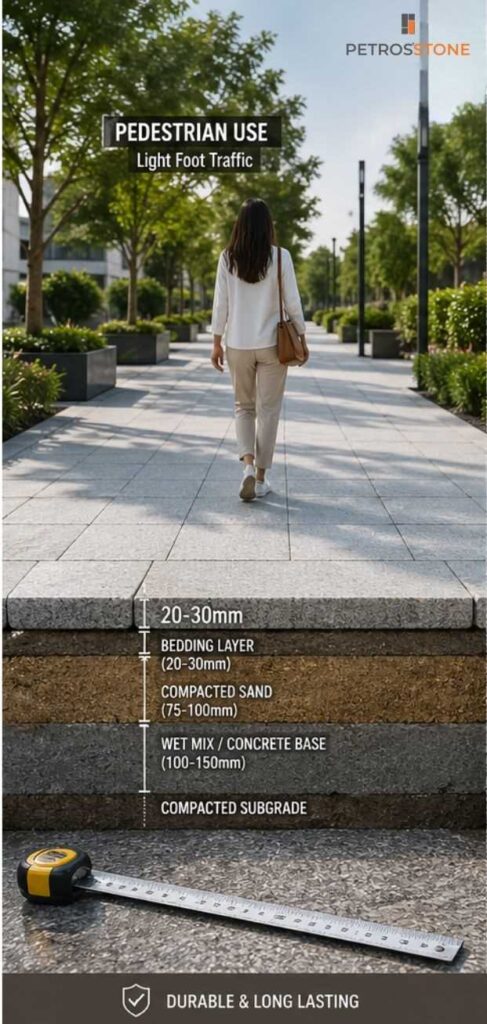
For most homeowners, 25 to 30 mm is the more forgiving choice for walking paths. It gives more tolerance against small support errors and feels less fragile during installation. NSI’s suggested minimum for exterior stone pavers under pedestrian traffic is 30 mm, a useful benchmark for outdoor paths expected to remain serviceable over time.
A practical rule works well here. If you want the absolute minimum and everything else is tightly controlled, 20 mm is acceptable. If you want something that installers can handle with less drama and that will better tolerate ordinary outdoor life, 30 mm is the safer recommendation.
Best Thickness for Normal Residential Pathways
For ordinary residential outdoor pathways, 30 mm should usually be the starting point. It aligns with NSI’s pedestrian exterior-paver guidance and gives a better safety margin for real home use than 20 mm. This is especially true where the path is a main entry route, a courtyard connector, or an everyday circulation strip where people carry groceries, move furniture, wheel bins, or drag planters and ladders across the surface.
If the path uses larger slab units, spans over variable fill, or may occasionally take bicycle, trolley, or garden-equipment loads, moving up toward 40 mm can make sense. This is not because 30 mm suddenly becomes “wrong,” but because unit size and support conditions matter. NSI’s manual expressly notes that larger unit sizes and specific traffic requirements may dictate greater thicknesses than the general minimums listed.
In simple terms, most normal residential granite paths fall into a comfortable working range of 30 to 40 mm, with 30 mm being the standard-safe answer and 40 mm being the more conservative one when the design is less forgiving.
Best Thickness for Heavy-Load Vehicle Pathways
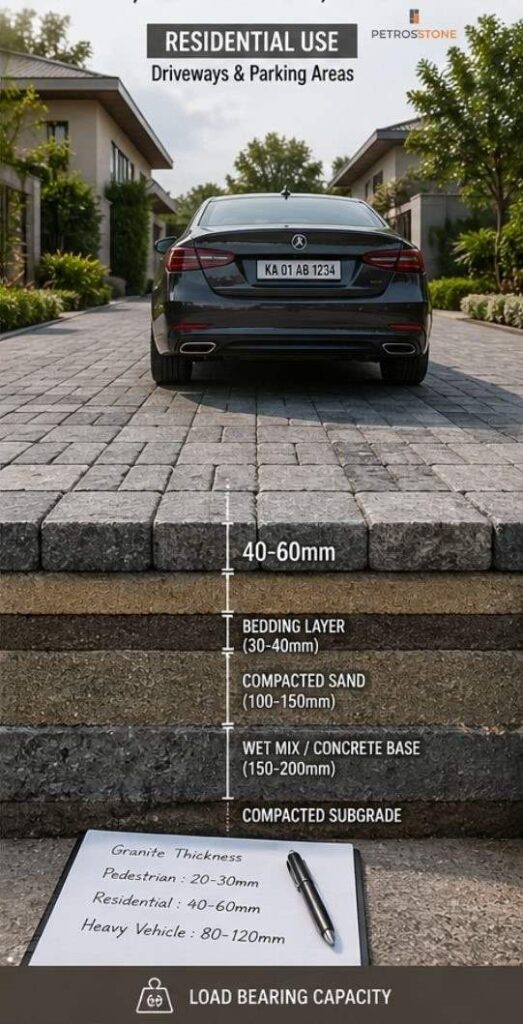
For heavy-load vehicle pathways, thin granite slabs are the wrong starting point. Natural Stone Institute guidance says exterior stone pavers under vehicular traffic are generally 75 mm or thicker, and the final thickness should be determined by engineering analysis. That guidance exists for a reason. Vehicle loads do not just add weight. They introduce repeated wheel pressure, turning stress, braking stress, and edge loading that can damage thin or poorly supported stone very quickly.
This does not mean every vehicle zone must use the same thickness. Light passenger vehicles, occasional service access, and heavy commercial traffic are not identical cases. But once you are in serious vehicular territory, 75 mm is the meaningful benchmark, not 20 mm or 30 mm. In many cases, smaller-format pavers or cubes will outperform larger slabs because they reduce bending span and distribute loads more effectively across the pavement system.
So if the pathway truly carries heavy vehicles, the answer is not “use thicker slabs.” The answer is “use a properly engineered stone paving system,” and that usually means 75 mm or more, an appropriate base design, and often a paver format rather than broad slab pieces.
Slabs vs Pavers for Different Uses
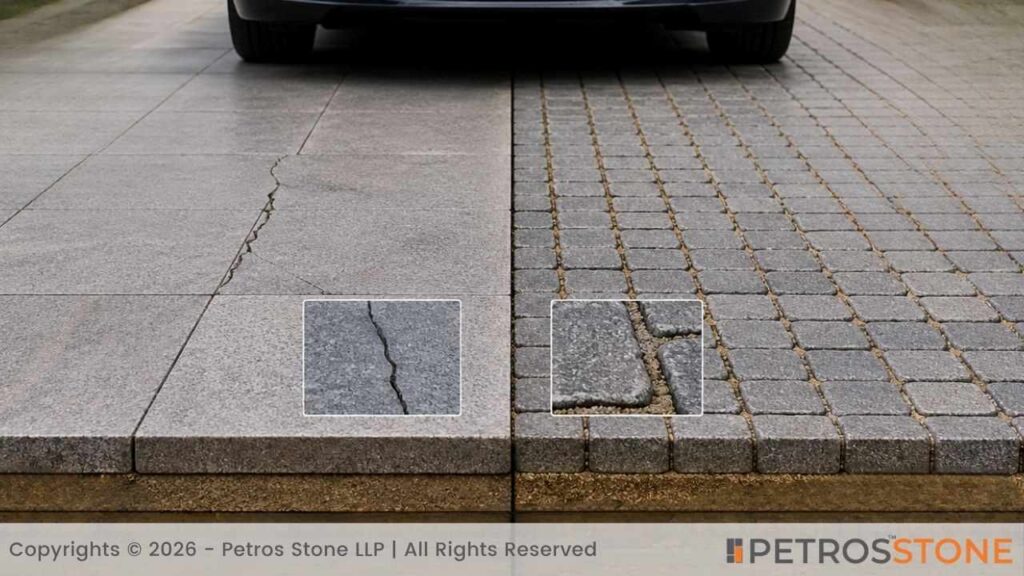
This distinction is more important than many people realize. A slab is usually a larger-format unit. It looks sleek, modern, and clean, but it also has a larger bending area and can be less forgiving if support is inconsistent. A paver is smaller. It may look more modular, but structurally it often performs better because the load is broken into smaller units and local damage is easier to replace.
For walking-only and normal residential paths, both slabs and pavers can work. The choice depends on design language, thickness, and base quality. For heavy-load pathways, pavers are generally the safer route because they control bending better and fit established exterior paving logic more naturally. This is one reason many successful granite vehicle-bearing surfaces use setts, cubes, or heavy pavers rather than broad decorative slabs.
Common Mistakes in Choosing Granite Thickness
- The first mistake is copying the indoor flooring thickness directly into an outdoor path. IBM’s 20 mm flooring reference is useful, but it applies to flooring preference in the building sector, not automatically to all external paving conditions. Outdoor paths need more caution.
- The second mistake is assuming load alone decides thickness. In reality, base condition, unit size, and support continuity often matter just as much. A thin unit on a perfect base may outperform a thicker unit on a poor one.
- The third mistake is choosing polished granite for exterior pathways simply because it looks finished in the yard. For most outdoor routes, a textured finish is the better practical choice. The fourth mistake is expecting thickness to fix weak stone quality. If the granite contains flaws, weak veins, or structural defects, adding a few millimeters is not always the solution. IS 3316 makes that point indirectly by insisting on soundness and freedom from impairing defects.
Cost and Practical Considerations

Thicker granite costs more for obvious and not-so-obvious reasons. The stone itself weighs more, quarry yield can drop, cutting takes longer, transport costs rise, and installation becomes more labor-intensive. Once you move from 20 mm to 30 mm, and especially into 40 mm or 75 mm territory, you are not just paying for “extra stone.” You are paying for heavier logistics and lower ease of handling.
That said, under-specifying thickness is often a false economy. Replacing broken path units, redoing bases, or dealing with cracked corners is far more expensive than choosing the right section in the first place. The most cost-effective pathway is not the one with the cheapest slab rate. It is the one where thickness, format, finish, and base are matched correctly to the use.
Frequently Asked Questions
Is 20 mm granite enough for pathways?
It can be enough for light-use pedestrian paths if the units are well supported and the installation is controlled. For most exterior pedestrian paving, 30 mm is the safer benchmark.
Is 30 mm granite good for residential outdoor use?
Yes. For most normal residential pathways, 30 mm is the most practical default recommendation.
What thickness of granite is needed for heavy vehicle areas?
For vehicular exterior paving, NSI guidance says thickness is best determined by engineering analysis, but is generally 75 mm or thicker.
Can large granite slabs be used for vehicle pathways?
They can in some engineered systems, but paver formats are usually safer and more forgiving because they reduce bending span and local failure risk.
Does thicker granite mean lower maintenance?
Not automatically. Thickness improves structural tolerance, but maintenance also depends on finish, drainage, installation quality, and how the path is used.
Key Takeaways
- 20 mm is a controlled-use thickness, suitable only for light pedestrian paths with strong base support and smaller unit sizes.
- 30 mm is the practical outdoor standard for most pedestrian and residential pathways, offering better tolerance against real-world site variation.
- 30–40 mm works best for normal residential use, especially where occasional loads (bins, bicycles, ladders) are expected.
- 75 mm and above is the true vehicular category, typically used in pavers/cubes with engineered base systems—not large slabs.
- Thickness alone does not prevent failure, base quality, drainage, jointing, and installation method are equally critical.
- Paver formats outperform slabs in heavy-load areas because they reduce bending span and distribute loads more effectively.
Feel free to get in touch for a free consultation, quote, and get a detailed understanding from our experts here at Petros®. Visit www.petrosstone.com or call +91-8446360361 or WhatsApp

Hi, I’m Shivangi,
With years of experience in the architecture and design space, I write to bridge the gap between material knowledge and practical application. At Petros® Stone, I create content that highlights the beauty, function, and impact of natural stones, helping homeowners and professionals make confident design decisions.
Explore my LinkedIn profile to learn more about my work!

Brown Granite

White Galaxy Granite

Blue Bahia Granite

Silver Cloud Granite

Black Pearl Granite

Dallas White Granite