Carrara and Calacatta marble both come from Italy’s Apuan Alps, but their appearance differs. Carrara has a soft white-to-grey background with fine, subtle veining, while Calacatta marble features a brighter white background and bold, dramatic veins. Choose Carrara marble for large floors, bathrooms, and budget-conscious projects; choose Calacatta for statement countertops, feature walls, and luxury interiors.
Carrara marble starts at around USD 40/m² (USD 3.72/sq. ft.), while Calacatta starts at around USD 133/m² (USD 12.36/sq. ft.). These prices are indicative for 2 cm-thick slabs at the source. Actual prices vary by grade, finish, veining, and slab selection.
Neither is inherently more durable. Both are calcite-rich marbles that can etch when exposed to acidic substances and require proper sealing, cleaning, and maintenance.
Calacatta vs Carrara Marble
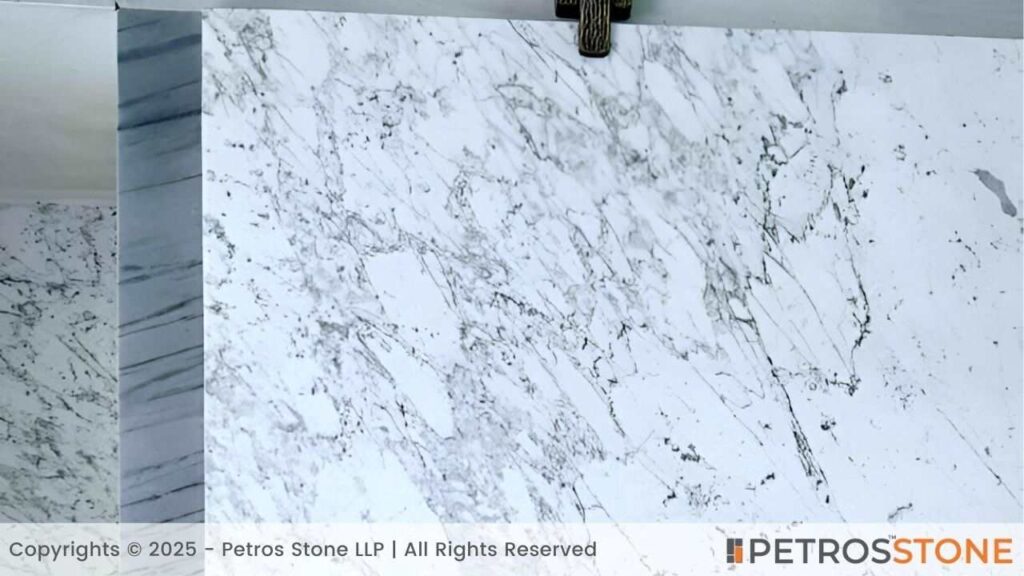
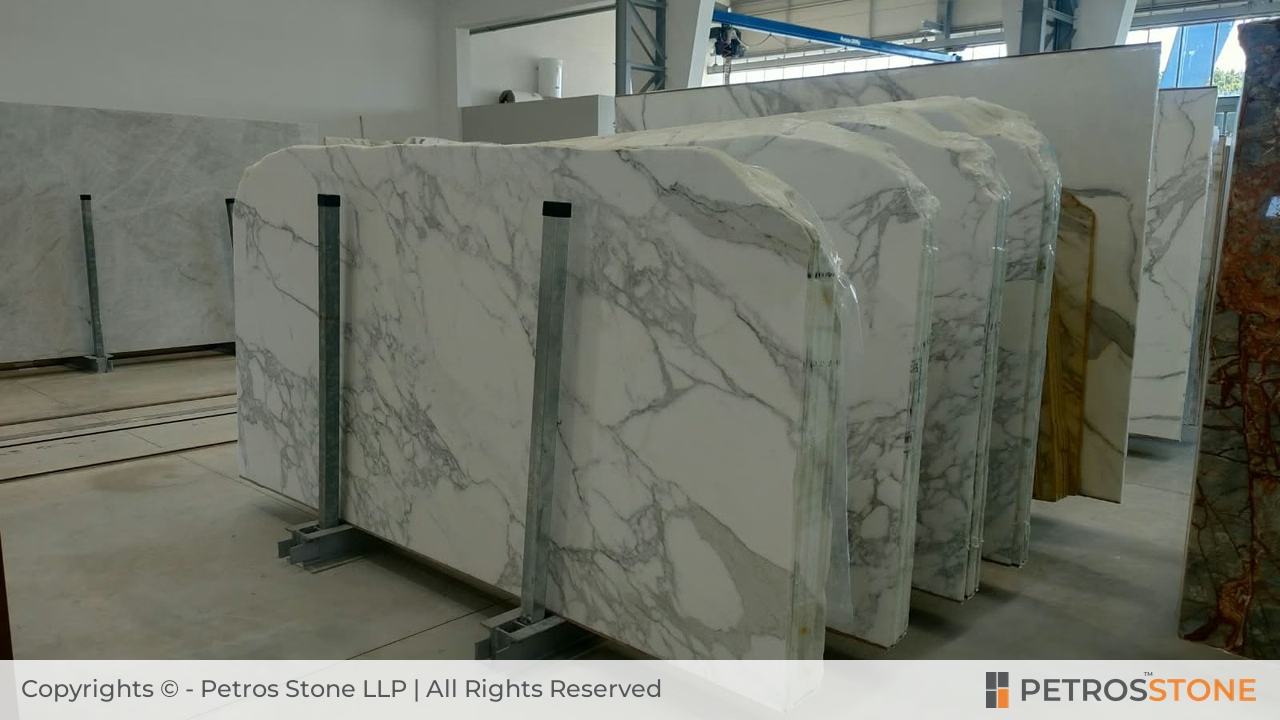
Quick Comparison Table – Calacatta vs Carrara Marble
| Feature | Carrara Marble | Calacatta Marble |
|---|---|---|
| Quarried in | Apuan Alps, Tuscany, from hundreds of quarry sites | Apuan Alps, Tuscany, from fewer quarries and deposits |
| Ground colour | White to grey or blue-grey | Whiter and crisper; some varieties creamy |
| Veining | Fine, soft, feathery, mostly grey | Thick and bold; grey, gold, brown or violet, depending on variety |
| Typical starting price at source (2 cm slab) | About $40/m² ($3.72/sq. ft.) | About $133/m² ($12.36/sq. ft.) |
| Hardness (Mohs) | About 3 | About 3 |
| Water absorption (published sheets) | Around 0.1–0.16% | Around 0.2–0.35% |
| Availability | Widely available; large matched lots possible | More limited; depends on quarry and block |
| Best suited to | Large areas, floors, wall cladding, and tighter budgets | Focal surfaces such as islands, feature walls, and vanities |
In this article, we cover where each stone comes from, how to tell them apart, why Calacatta costs so much more, and how both behave in kitchens, bathrooms and on floors. It ends with a way to decide. The technical figures come from published data sheets and the prices from supplier and fabricator lists. Treat the prices as budgeting guides, not quotes.
Where Do Carrara and Calacatta Marble Come From?
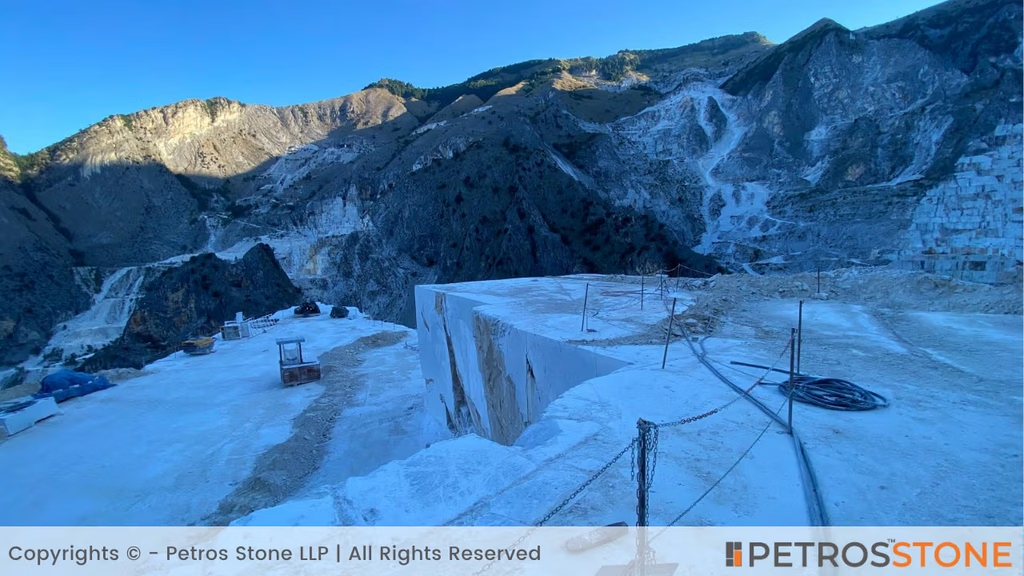
Are they really from the same place?
Broadly yes. Both come from the Apuan Alps in Italy’s Carrara region, but from different mountains and quarries. That is what causes the differences in colour and veining.
‘Carrara’ is partly shorthand. Some Calacatta marble, such as Calacatta Oro, comes from the Vagli basin in Lucca province, not Carrara itself. Marble names carry centuries of trade habit and don’t always match geography.
Which quarries produce each stone?
- Carrara Marble: a broad family. Over 600 quarry sites exist in the Apuan Alps, though far fewer are working. The common commercial grades are Bianco Carrara C and CD (CD has more veining and a greyer ground).
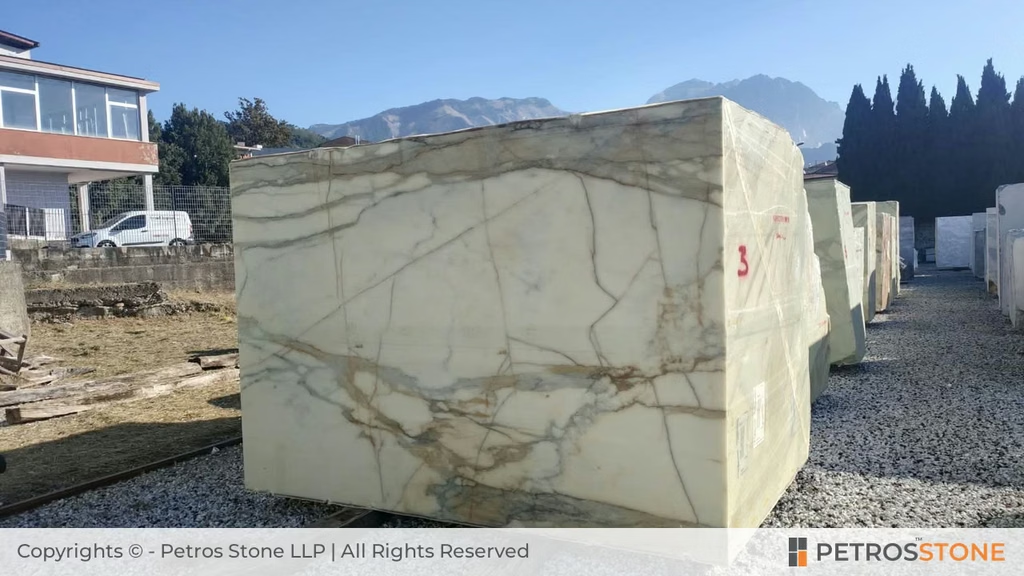
- Calacatta Marble: not one quarry. Each variety comes from a specific deposit. The best known is Calacatta Borghini, from a quarry near Torano owned by Paolo Borghini since 1979. Bettogli and Vagli are named after places.
- Sources disagree on the map. Some place the Calacatta zone around Monte Altissimo and Fantiscritti; others around Torano and Vagli. ‘Calacatta’ is not a quality grade, so ask for the quarry and block.
Why does the source affect availability?
- Calacatta marble comes from limited zones higher in the mountains, which are harder to extract from.
- Output is small. Borghini produces roughly 300 m³ a month, and the top “Extra” Bettogli selection is under 10% of that quarry’s output.
- Most quarries shut for part of winter because of snow and ice.
For buyers: Carrara marble is usually available in volume with many matched slabs from one block. With Calacatta, you reserve what the quarry has, and large projects may mean choosing the block early.
How Can You Tell Carrara and Calacatta Marble Apart Visually?
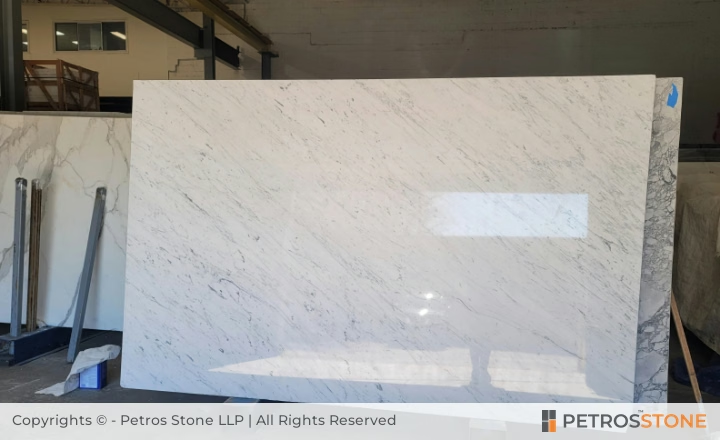
What does Carrara marble look like?
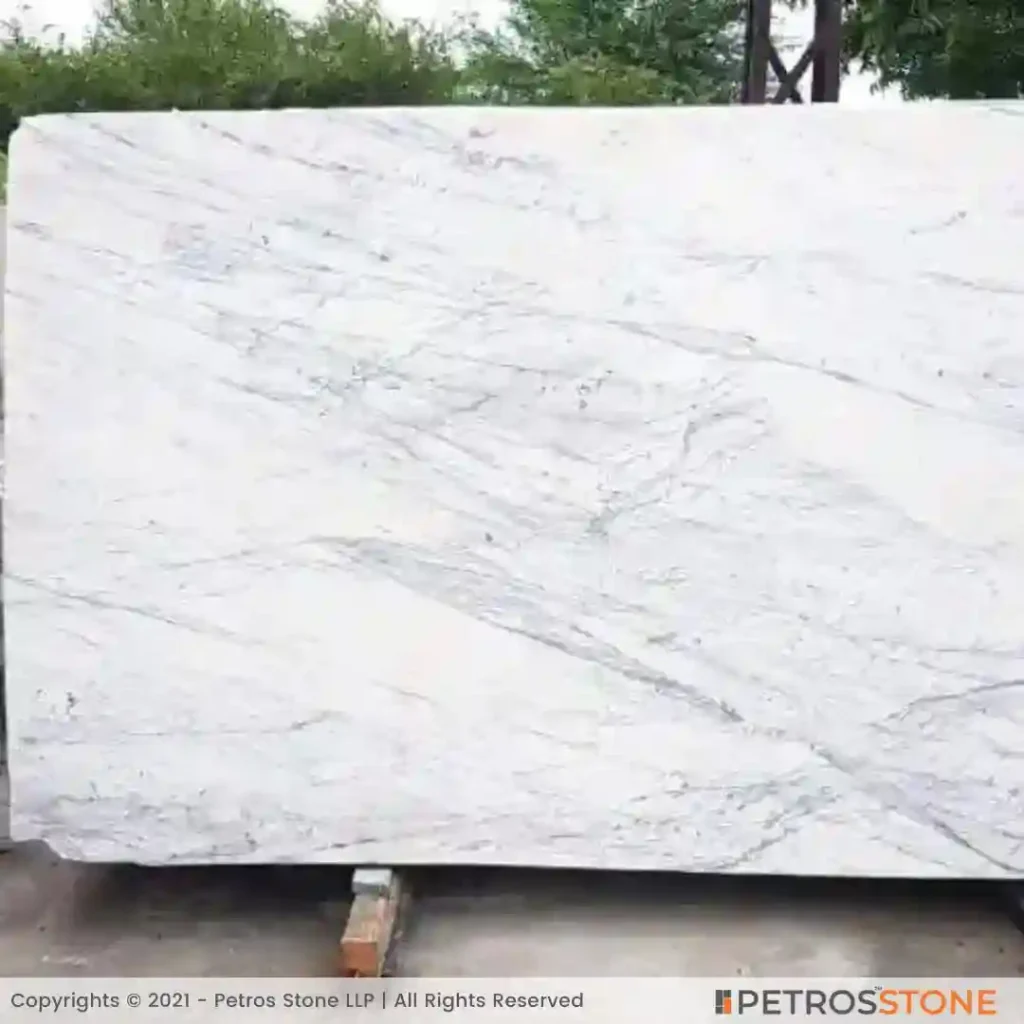
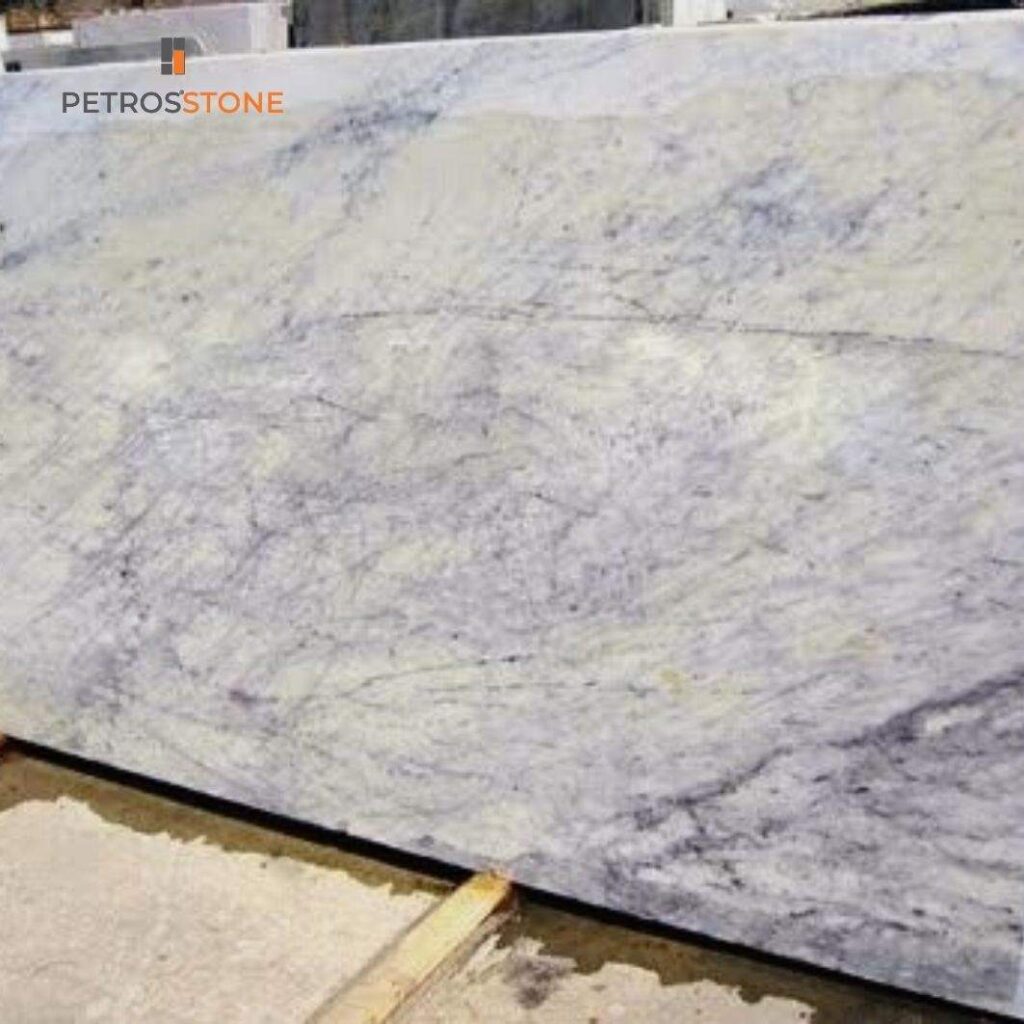
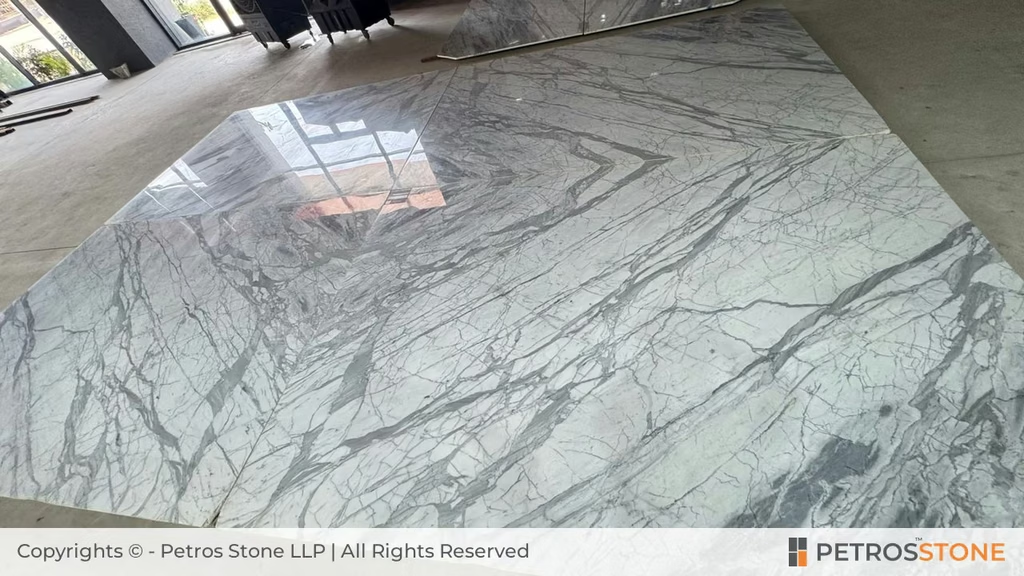
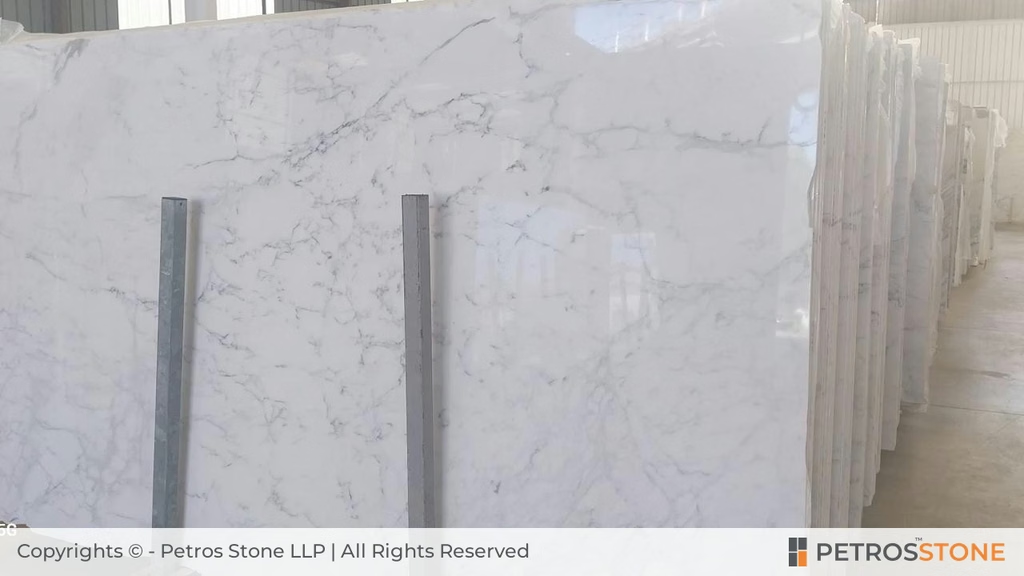
Soft, fine, feathery veining on a white to grey ground, often with a blue-grey cast, especially under cool light. It is rarely pure white. Lower grades (Carrara C) are creamier with fainter veining.
What does Calacatta marble look like?
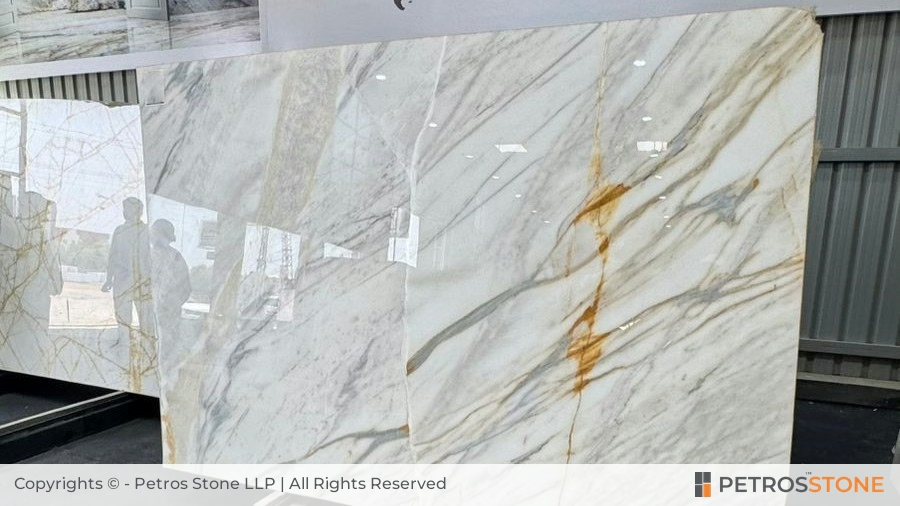
Thick, dramatic veins in grey, gold, or brown on a crisp, bright ground. Veins can run as wide ribbons across a whole slab. Not all Calacatta marble is stark white: Calacatta Lincoln has grey-brown veining on a creamy ground and looks quieter
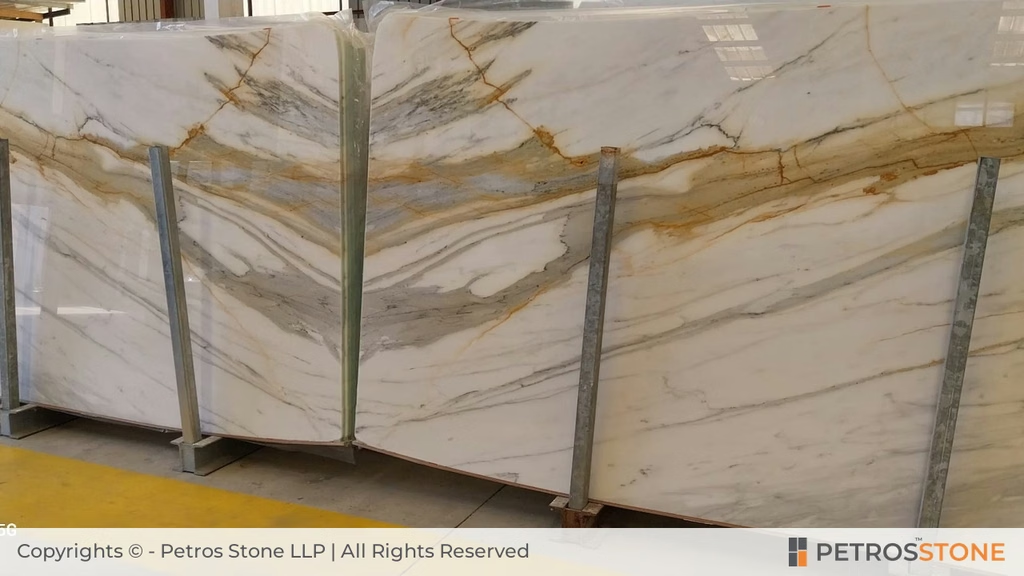
Calacatta Vs Carrara Marble – Side-by-side
| Carrara Marble | Calacatta Marble | |
|---|---|---|
| Ground | White to blue-grey | Brighter white; some creamy |
| Veins | Fine, soft, diffuse | Thick, defined, dramatic |
| Vein colour | Mostly grey | Grey, gold, amber, brown, violet |
| Slab impact | Blends into the room | Becomes the focal point |
| Slab consistency | Higher within a grade | Varies; match slabs from one block |
What are the main varieties of each?
Carrara Marble
- Bianco Carrara C / CD: everyday commercial grades.
- Carrara Extra: cleaner, with a delicate pattern.
- Bianco Venatino: another white marble from the same region.
- Arabescato: more heavily veined; often priced separately.


Calacatta Marble
- Oro / Gold: warm gold veining on white. Sources disagree on whether the names are identical.
- Borghini: wide, sweeping grey-gold veins from a single Torano quarry.
- Vagli: grey-green veining.
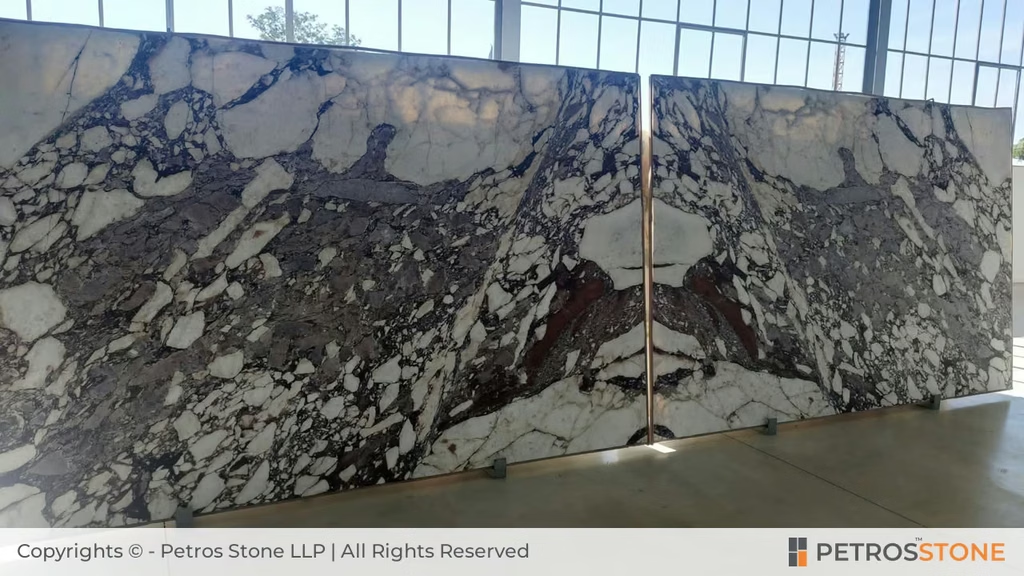
- Viola: veining shifting toward violet and mauve.
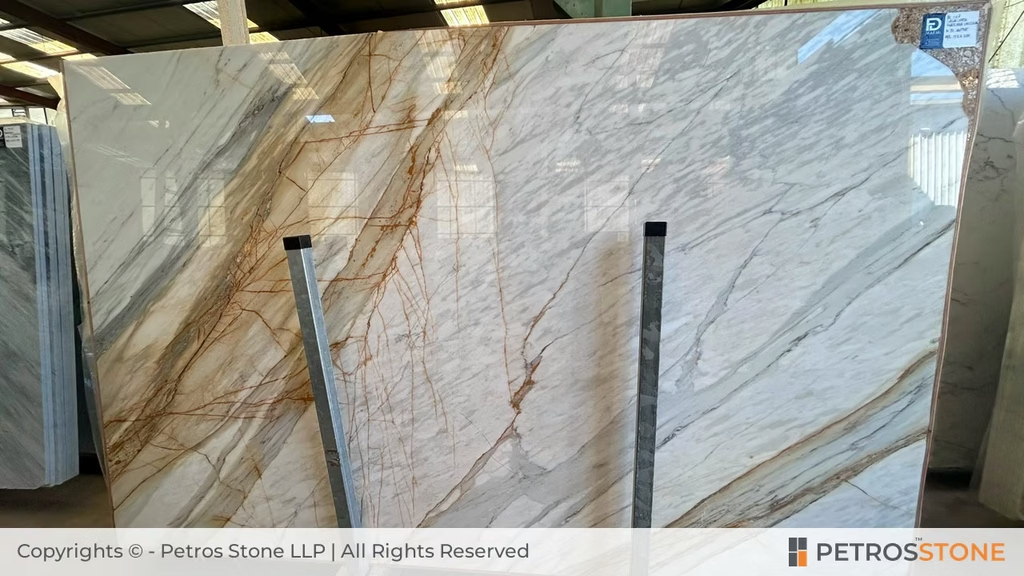
- Macchia Vecchia: gold, amber, and rust veining on white.
- Bettogli: light grey veining with thin gold veins and pyrite flecks on a creamy ground.
Why Is Calacatta Marble So Much More Expensive?

What drives the price gap?
Scarcity comes first. On top of it, price rises with ground whiteness, vein balance, slab size, quarry origin, structural integrity, matching slabs, and block yield. Large, clean, well-veined slabs are far rarer than fractured material.
Carrara marble follows the same logic on a smaller scale: a cleaner, larger slab costs more than a darker, busier one. Calacatta marble also costs more to fabricate, since natural fissures are often resin-filled and need rodding or mesh backing before cutting.
Carrara vs Calacatta – Price Comparison
| Marble Type | Starting Price (USD/m²) | Starting Price (USD/sq. ft.) |
|---|---|---|
| Carrara Marble | $40 | $3.72 |
| Calacatta Marble | $133 | $12.36 |
Installed ranges vary widely because labor, region, and grade shift the number. Quarry prices exclude freight, duty, and fabrication.
Beware of bargains. One directory lists the same “Calacatta Oro Extra Vagli” at $299/m² from one seller and $1,300/m² from another. A big gap usually means a different grade, thickness, or origin. Check the block and quarry.
What other costs should you budget for?
- Fabrication: ~$500-900 (Carrara marble) or ~$600-1,000 (Calacatta marble) for countertops, plus 8-12 hours of labour at ~$800-1,200.
- Layout and waste: matching veins across seams needs careful planning. Bookmatched Calacatta walls waste more slab.
- Templating: errors are the leading cause of remakes.
- Freight and duties: added on top of ex-factory pricing.
- Upkeep: periodic resealing and, eventually, professional re-honing.
Which Marble is Better for Kitchen Countertops?
Is Carrara Marble Good for Kitchens?
Carrara marble is a workable choice for kitchens if you are comfortable with regular sealing, prompt spill cleanup, and some ongoing care to help prevent staining. A honed finish makes etching less noticeable, while its grey veining helps disguise everyday marks. With proper maintenance, it can develop a soft patina over time while retaining its natural character.

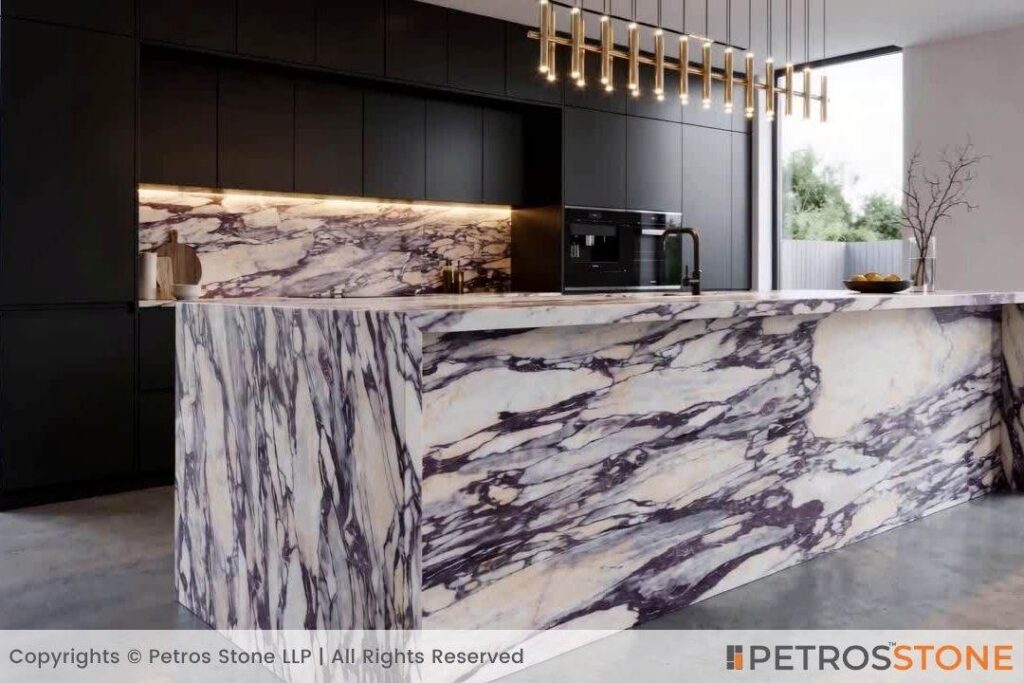
Is Calacatta Marble worth it for a Kitchen Island?
Yes, when the island is the focal point. You see it from every angle, and the premium buys veining scale and a large, clean slab.
Risks:
- Resin-filled fissures need reinforcement. Inspect both faces before cutting.
- Veins can form weak planes. Keep seams and cutouts away from them.
- Pale ground shows etching and stains more easily.
Skip it if you cook heavily and every etch mark will bother you.
What about the hybrid approach?
Use Calacatta marble on the island or backsplash and Carrara marble on the perimeter. The costly stone covers a few square metres; the cheaper one does the bulk.
Carrara marble runs cooler and greyer, so warm gold-veined Calacatta marble can clash. Cooler-veined varieties pair better. View both samples together in your own lighting.
Which is Best for Bathrooms, Floors, Walls, and Fireplaces?
| Surface | Carrara Marble | Calacatta Marble |
|---|---|---|
| Vanities, bathroom walls | Good, budget-friendly | Good spend: low abuse, high visibility |
| Shower walls | Good when sealed | Good when sealed |
| Shower floors | Honed mosaic only | Not recommended |
| Floors | Good, honed preferred | Costly for large areas |
| Wall cladding | Strong cost choice | Best as bookmatched feature wall |
| Fireplace surrounds | Common | Common |
- Floors: choose honed (less slippery). Grit is harder than marble, so entrances wear first.
- Walls: ideal for bookmatched Calacatta, since nothing walks on it. Use a white, non-staining adhesive to avoid show-through.
- Fireplaces: surrounds and hearths only, not the firebox. Check clearances with your fabricator.
Is Calacatta Marble More Durable Than Carrara?
No. Not in any way that should drive your decision.
Do they have the same hardness?
Yes. Both are calcite, about 3 on the Mohs scale.
| Stone (published sheet) | Water absorption | Compressive strength |
|---|---|---|
| Bianco Carrara C/CD (MIA) | 0.1% | ~75 MPa |
| Bianco Carrara (Stone World) | 0.16% | ~119 MPa |
| Calacatta Oro | 0.35% | ~137 MPa |
| Calacatta Vagli Rosato | 0.28% | ~125 MPa |
| Calacatta Cremo | 0.23% | ~121 MPa |
Two Carrara marble sheets differ as much as Carrara and Calacatta do, and all absorb very little water. Each figure is one lot, so request test reports for your project.
Where does ‘Calacatta marble is harder’ come from?
Likely from the Borghini quarry, whose stone is reported to have recrystallised naturally and become stronger. That is one quarry, not the family, and it still etches. Price also leads people to assume the costlier stone is tougher.
Is whiter marble softer?
No published support. Hardness comes from the mineral, not the colour. Pale stone shows marks more.
“Soft” is also muddled: scratching is about hardness, etching is about chemistry.
Key point: finish, sealing, and use matter more than the name.
How Hard Is It to Maintain Carrara and Calacatta Marble?
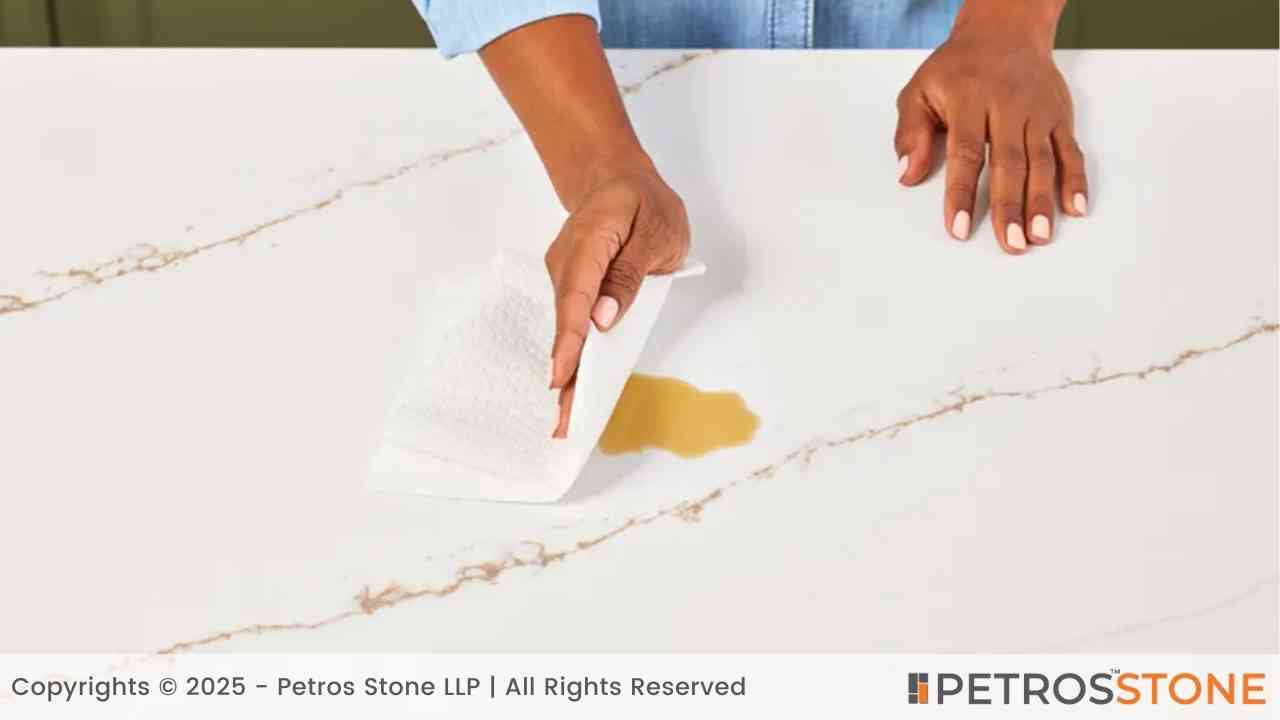
Do both stain and etch?
Yes, and they are different problems.
- Etching: a chemical reaction between calcite and acids, ammonia, or alcohol.
- Staining: liquid soaking into pores. Sealing slows it but never makes marble stain-proof.
How often should you seal them?
- Use a penetrating sealer, not a topical coating. Test on a hidden area first.
- Reseal every 6-12 months (honed kitchen surfaces may need it at the short end).
- Water-bead test: if water soaks in within minutes, reseal.
- Sealer reduces staining, not etching. Excess leaves a haze.
Honed or Polished?
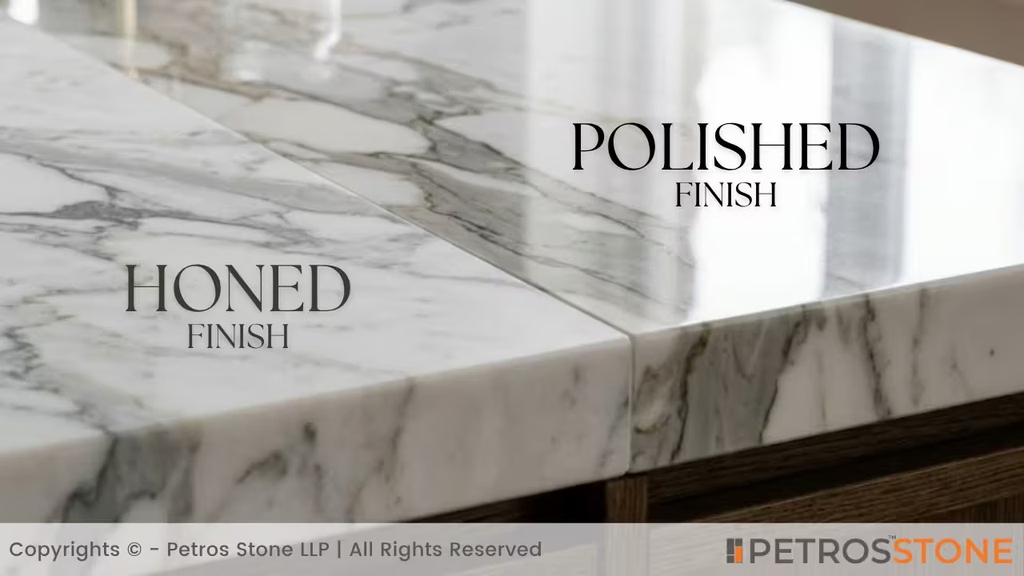
Calacatta Marble – Honed and Polished Finish
| Honed | Polished | |
|---|---|---|
| Etching and scratches | Better hidden | More visible |
| Staining | More porous, seal more often | Pores slightly closed, more resistant |
| Slip | Less slippery | More slippery |
Neither is low-maintenance. Honed is more forgiving for most kitchens and floors.
Daily care
- Wipe spills fast, especially wine, citrus, vinegar, and tomato.
- Use a pH-neutral stone cleaner. Avoid ammonia and acidic cleaners.
- Skip baking soda; it dulls the finish.
- Use coasters and boards.
- Re-hone professionally if etching spreads.
White marble is a poor fit for heavy-use areas without steady upkeep.
Which One Should You Choose?

| Choose Carrara Marble if | Choose Calacatta Marble if |
|---|---|
| The area is large, or budget is tight | The marble should be the star |
| You like a soft, timeless look | The surface is small and focal (island, feature wall, vanity) |
| You accept some patina | Budget covers stone and careful fabrication |
Quick checklist:
- Size: large areas favour Carrara, small focal ones Calacatta.
- Budget: include fabrication, templating, and waste.
- Role: statement (Calacatta) or backdrop (Carrara)?
- Tolerance: if etch marks will bother you, choose honed or another material.
- Slab: approve the actual block or slab, not a catalogue photo.
FAQs
Is Calacatta marble the same as Carrara marble?
No. They share a mountain range and chemistry but differ in quarry zone, ground colour, veining, scarcity, and price.
Is Carrara marble cheaper than Calacatta marble?
Almost always. Carrara runs ~€150-350/m² ex-factory versus ~€750-1,650/m² for Calacatta. The gap narrows after fabrication and installation.
Can you use Calacatta and Carrara marble together?
Yes, it’s a common way to control cost. Compare tones side by side, since Carrara runs cooler and greyer than gold-veined Calacatta.
Which one is whiter?
Usually Calacatta marble, with a brighter, crisper ground. Exceptions: some Calacatta is creamy, and the cleanest Carrara selections are quite white.
Does Calacatta marble stain more easily than Carrara marble?
Not meaningfully. Absorption is low for both, but Calacatta’s whiter ground makes stains more visible. Finish and sealing matter more.
Is Calacatta Gold the same as Calacatta Borghini?
Not necessarily. Borghini comes from one quarry above Torano, while ‘Gold’ is a looser commercial label. Ask for the quarry and block number.
Can I use Carrara or Calacatta marble outdoors?
Carrara has the better record. It is listed for exterior cladding, and for exterior floors only when honed. One Carrara lot held its strength after 20 freeze-thaw cycles. Use a breathable silane-siloxane sealer. Little published exterior data exists for Calacatta, and its slabs are usually resin-filled and mesh-backed for interior use, so request test reports first.
Key Takeaways
- Carrara marble features soft grey veining and subtle tones, while Calacatta marble offers a brighter background with bold, dramatic veins.
- Calacatta marble is generally more expensive due to its rarity, distinctive appearance, and lower quarry yield.
- Both marble types are relatively soft and susceptible to etching and staining, making proper care and maintenance essential.
- Carrara suits large flooring areas, wall cladding, and budget-conscious projects, while Calacatta marble is ideal for statement islands, feature walls, and luxury interiors.
- Always inspect the actual slab for colour, veining, fissures, and repairs, and consider fabrication costs, wastage, and maintenance before purchasing.

Tapas Koul leads editorial direction and content strategy at Petros® Stone, bringing over 15 years of combined experience in e-commerce, publishing, and digital communication. His work spans research, strategy, and communication, with a focus on natural stone, its technical properties, processing, and architectural applications. Collaborating with Petros® Stone’s production team, laboratory experts, and specialists, he translates industry knowledge into clear, engaging content and communication for diverse audiences.
Feel free to get in touch for a free consultation, quote, and get a detailed understanding from our experts here at Petros®. Visit www.petrosstone.com or call +91-8446360361 or WhatsApp

Brown Granite

White Galaxy Granite

Blue Bahia Granite

Silver Cloud Granite

Black Pearl Granite

Dallas White Granite