When you are picking a natural stone, you want something that looks good today and still looks good years from now. Isn’t it? Well, Blue Dunes Granite is one of those stones that quietly does both. It is available in various forms.
Price Table – Blue Dunes Granite
| Product Type | Thickness | Price (USD per sq ft approx.) | Price (USD per sq m approx.) |
|---|---|---|---|
| Cutter Slab | 2 cm | $2.20 – $2.80 | $23.70 – $30.15 |
| Gangsaw Slab | 2 cm | $2.80 – $3.25 | $30.15 – $34.98 |
| Gangsaw Slab | 3 cm | $3.25 – $3.90 | $34.98 – $41.98 |
| Tiles | 10–20 mm | $1.70 – $2.50 | $18.30 – $26.91 |
| Steps & Risers | 2–3 cm | $2.80 – $4.20 | $30.15 – $45.21 |
In this article, we provide detailed information about Blue Dunes Granite, including available sizes, pricing factors, features, common applications, and simple care tips, so you can decide if it is the right choice for your project.
- Price Table – Blue Dunes Granite
- What is Blue Dunes Granite?
- Available Sizes and Forms
- Blue Dunes Granite Price Guide
- Price Table – Blue Dunes Granite
- Factors That Affect Blue Dunes Granite Price
- Blue Dunes Granite Properties
- Key Properties – Blue Dunes Granite
- Lab-Tested Technical Properties
- Applications
- Why Blue Dunes Granite is Good for Countertops
- Blue Dunes Granite Façade Applications
- How to Choose the Right Blue Dunes Granite
- Buyer Risk Warning
- Installation Guidelines
- Maintenance and Cleaning Guide
- Where to Buy Blue Dunes Granite?
- FAQs
- Key Takeaways
What is Blue Dunes Granite?
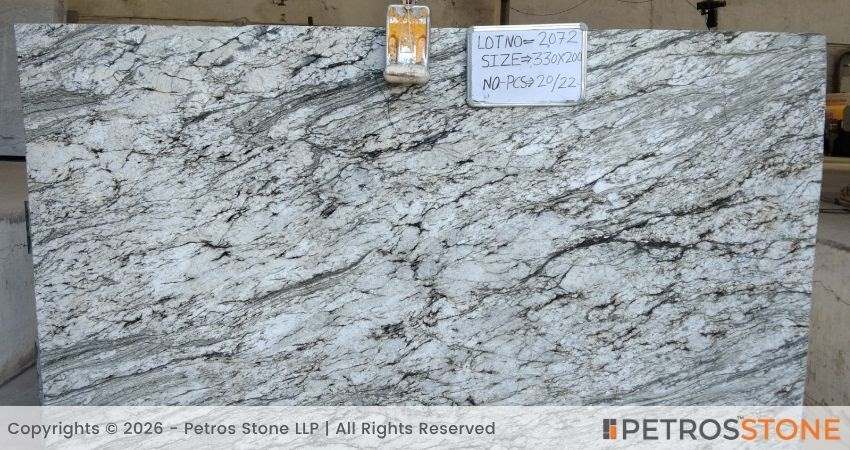
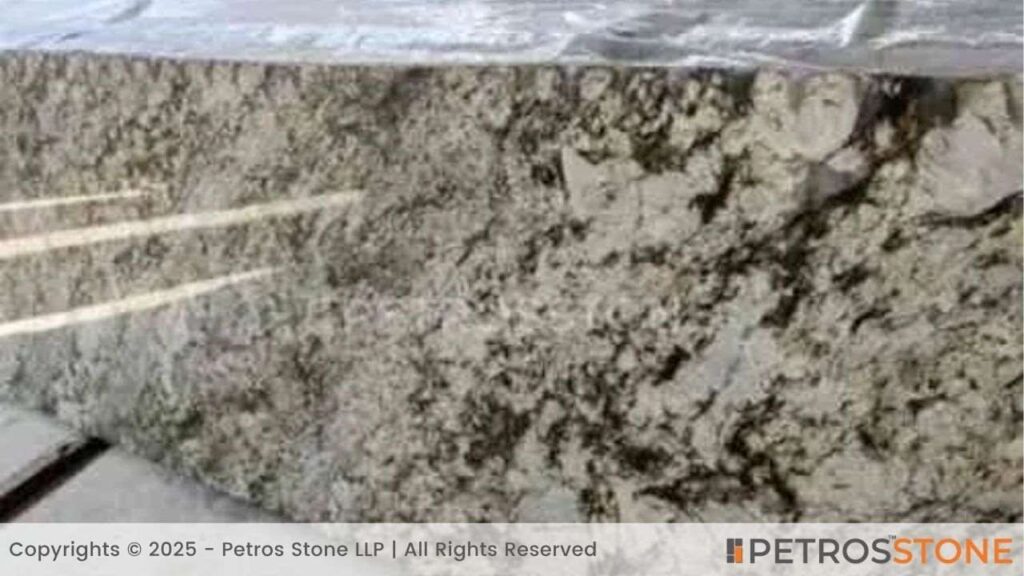
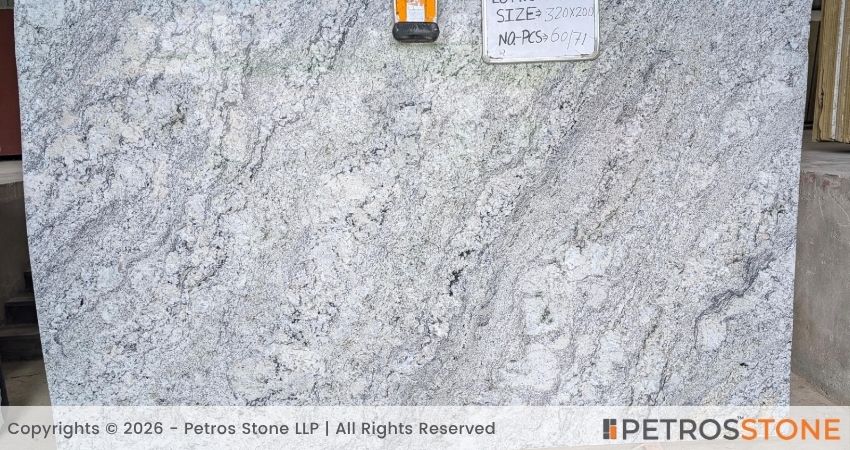
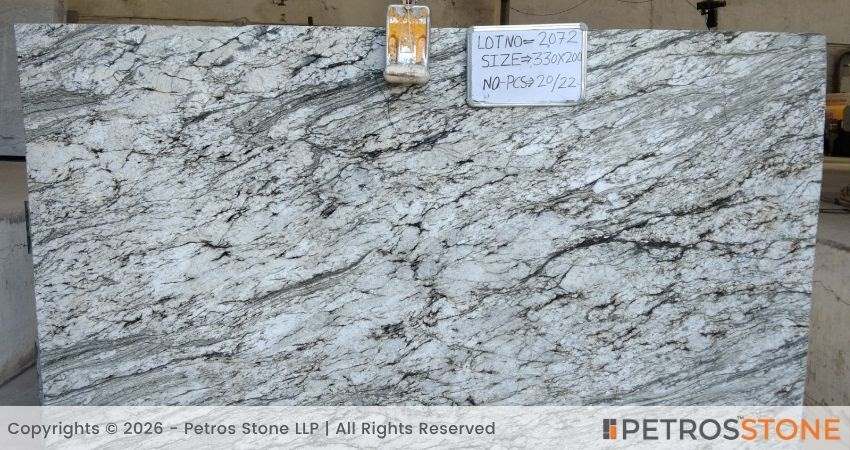
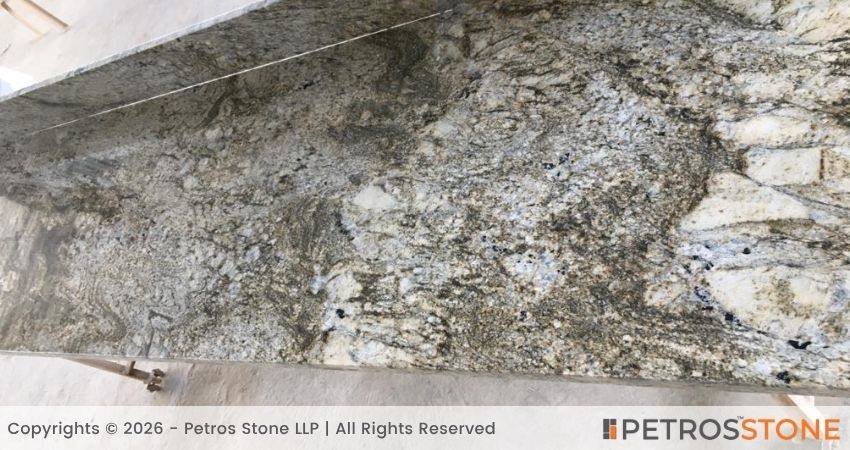
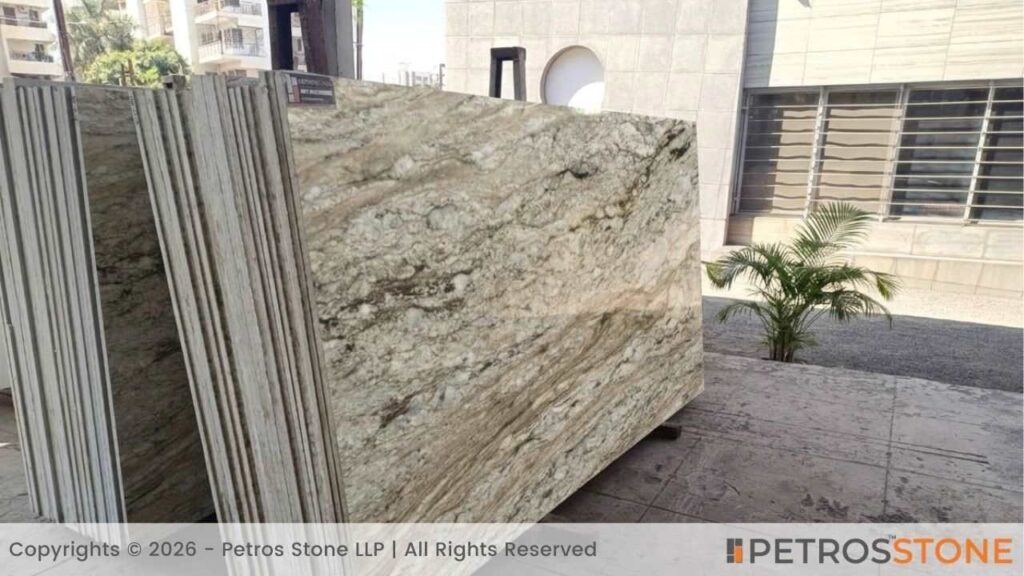
This is a high quality natural granite that is mined in Southern India. The other name of the stone is Azul Celeste Granite. It is also characterized by its flowing dune-like patterns that resemble desert waves.
There is a swish of blue and grey rippling over its surface, mingled with warm brown and little yellow speckles. The pattern is indeed very natural and almost look like sand shaped by the wind. And, this is how it gets its name.
But this stone isn’t just about appearance. It is reputed to be powerful, thick, and reliable. That is why people apply it to the countertops in the kitchen, the flooring, exterior walls, stairs, and even the exterior of the large villas. It can easily handle daily activities, fluctuating weather and busy pedestrian traffic without losing its nature.
Blue Dunes Granite is part of the Southern Indian granite belt, with formations documented by Geological Survey of India. These deposits are known for their mineral stability and consistent block extraction, which supports large-scale commercial quarrying.
Available Sizes and Forms
Blue Dunes Granite is available in multiple forms to suit different project requirements.
Blue Dunes Granite Slabs
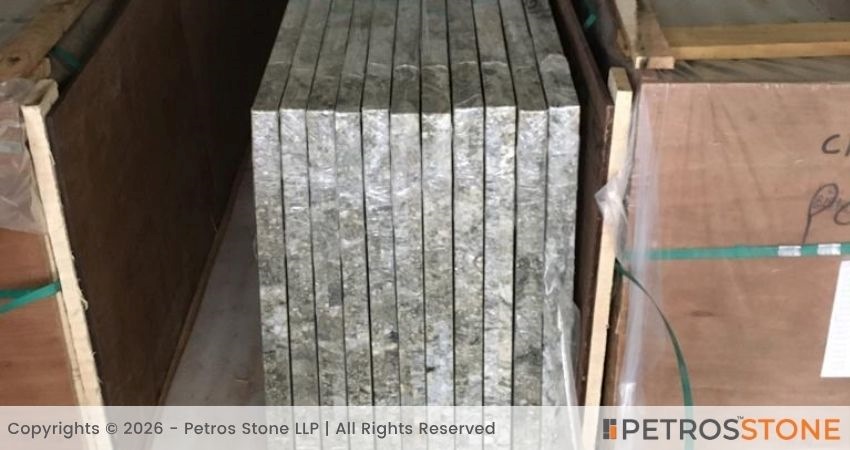
Slabs are the most popular form of Blue Dunes, especially for countertops and large wall applications. Standard slab thickness is 18 mm, but 20 mm and 30 mm are also commonly supplied for export projects.
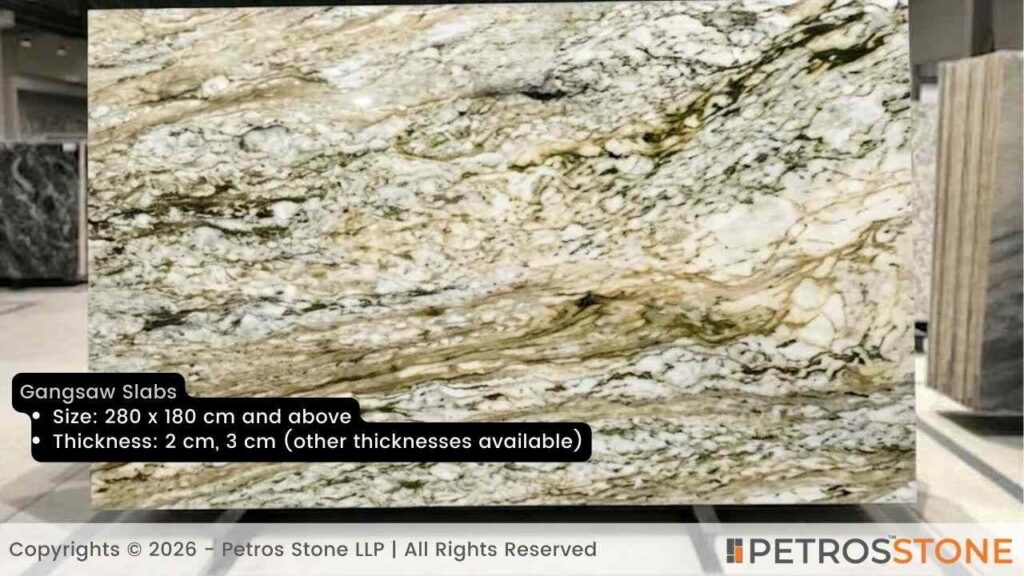
Gangsaw Slabs:
- Size: 280 x 180 cm and above
- Thickness: 2 cm, 3 cm (other thicknesses available)
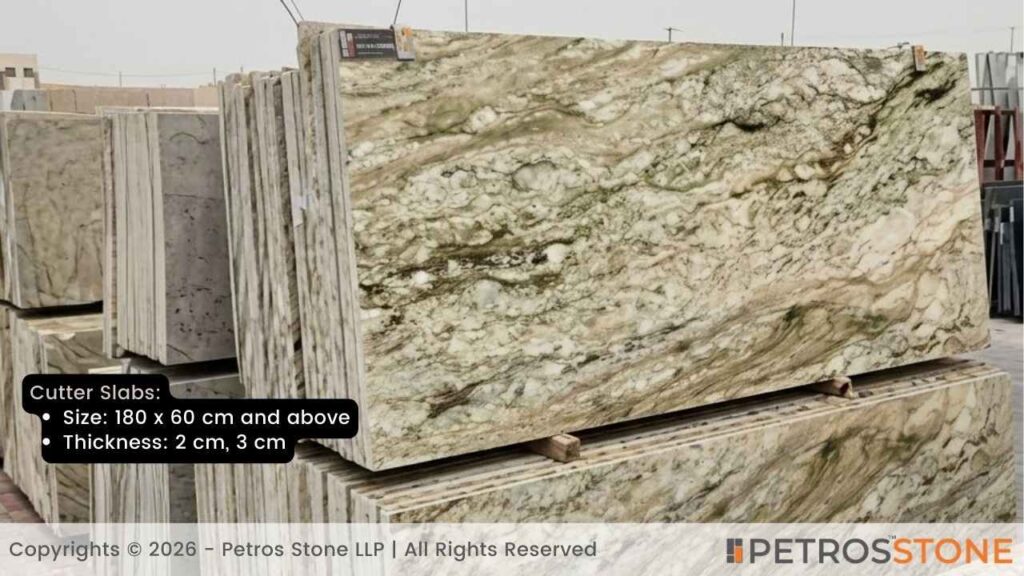
Cutter Slabs:
- Size: 180 x 60 cm and above
- Thickness: 2 cm, 3 cm
Blue Dunes Slabs are ideal for:
- Kitchen countertops
- Island tops
- Large flooring areas
- Wall cladding
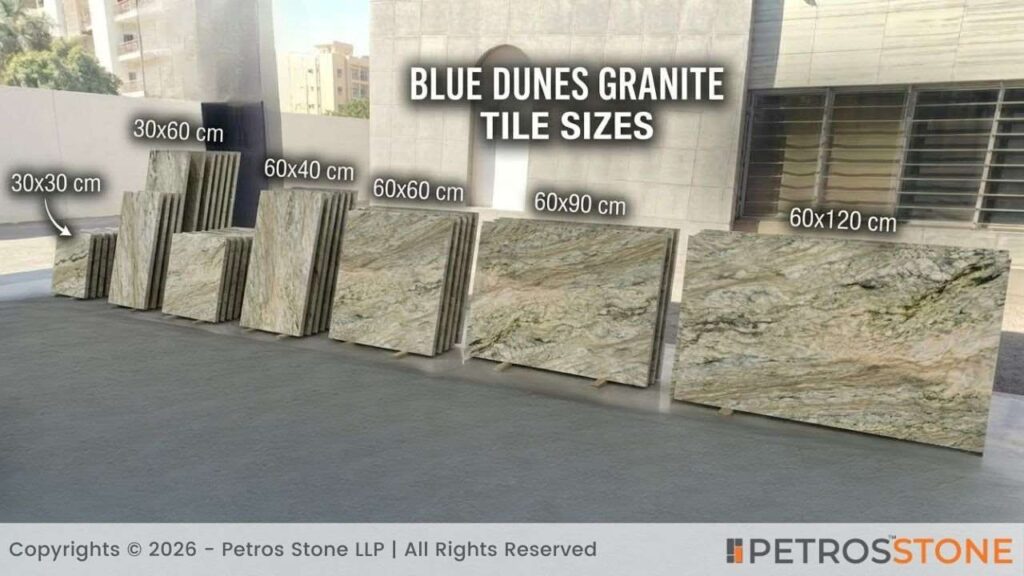
Blue Dunes Granite Tiles
Tiles are used for flooring and wall applications.
Common tile sizes:
- 30×30 cm
- 30×60 cm
- 40×40 cm
- 60×40 cm
- 60×60 cm
- 60×90 cm
- 60×120 cm
Note: Custom sizes are also available depending on project requirements.
Tiles are easy to install and are often chosen for:
- Residential flooring
- Bathroom walls
- Commercial spaces
- Outdoor pathways
Blue Dunes Granite Blocks
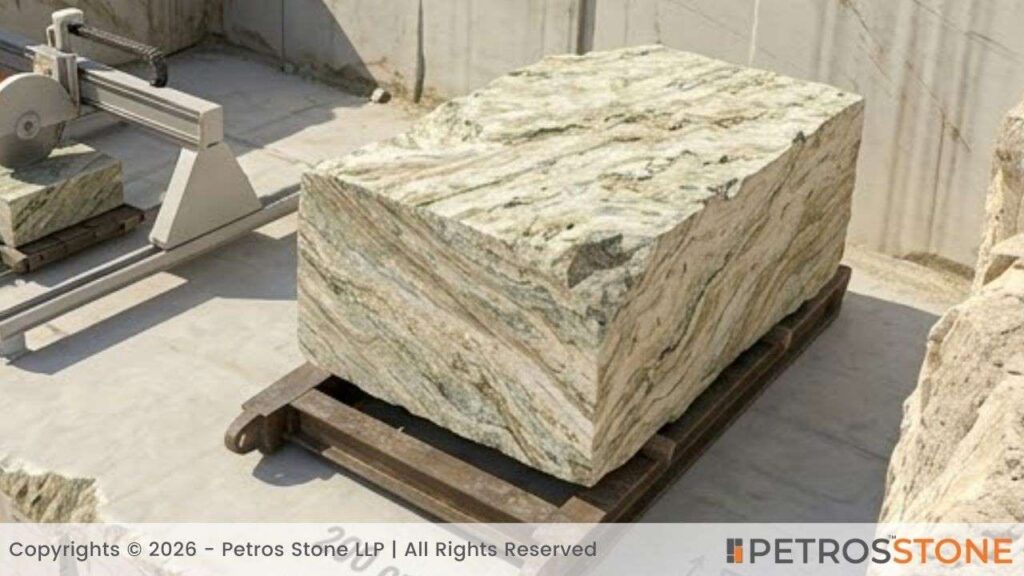
Rough Blue Dunes Granite blocks are extracted directly from quarries. These blocks are mainly purchased by large factories for slab production and international supply. Block Sizes are:
- Gangsaw Blocks: 280–330 x 160–220 x 100–150 cm
- Cutter Blocks: 160–300 x 60–100 x 60–100 cm
Blue Dunes Granite Steps and Risers
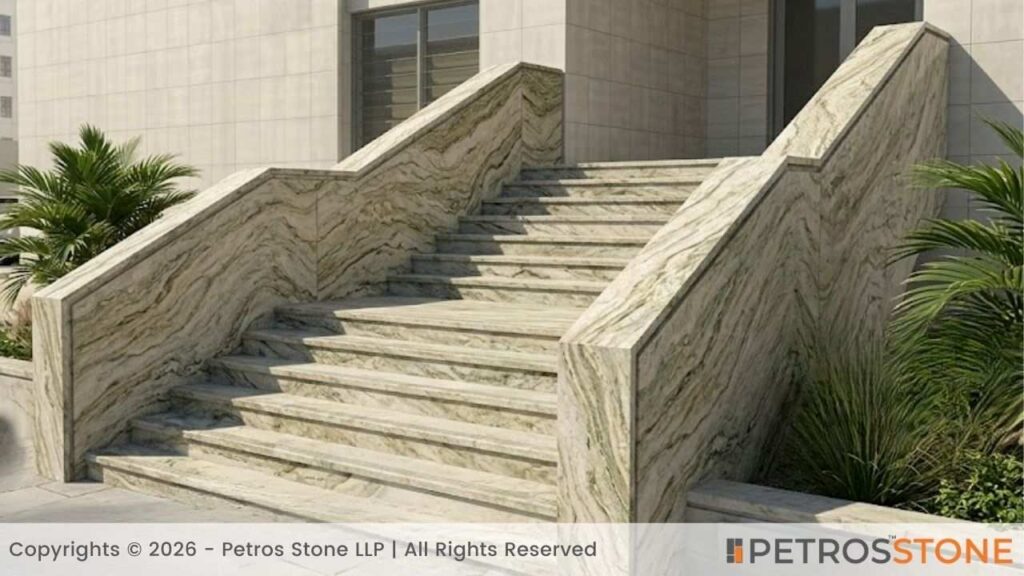
Blue Dunes Granite is widely used for staircases because of its strength and wear resistance. Finishes like flamed or bush-hammered are often used for outdoor steps to prevent slipping. It is available as:
- Pre-cut stair treads
- Risers
- Custom staircase panels
- Anti-slip finishes available
Blue Dunes Granite Countertop Cut-to-Size
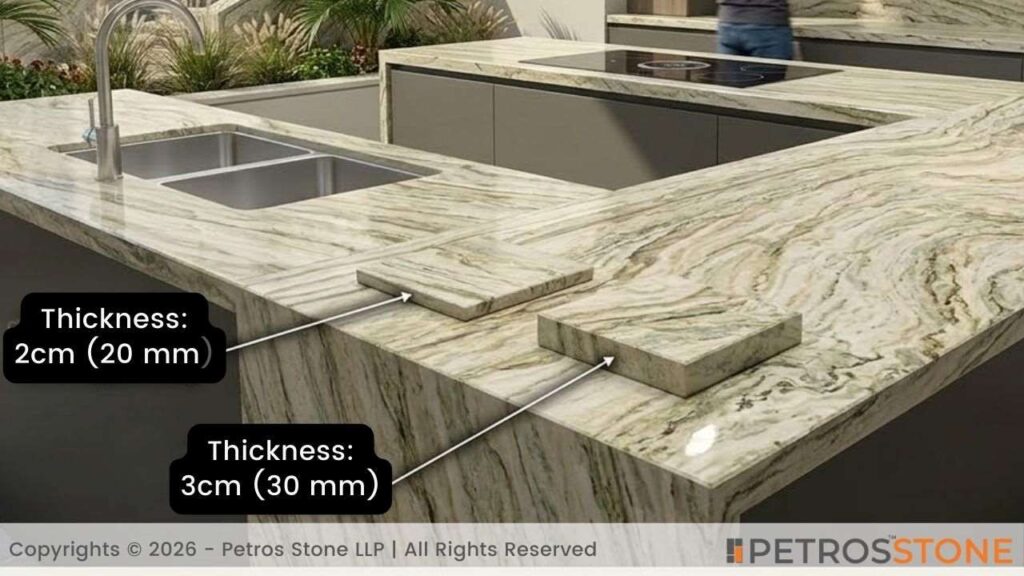
Countertops are available in custom sizes.
Popular thickness:
- 2 cm (20 mm)
- 3 cm (30 mm)
Edge profiles:
- Straight edge
- Bullnose
- Beveled
- Ogee
Countertops can include:
- Sink cutouts
- Hob cutouts
- Polished edges
- Backsplash pieces
Blue Dunes Granite Custom Sizes
Apart from slabs and tiles, Blue Dunes Granite is available in:
- Window sills
- Thresholds
- Monuments
- Wall coping
- Prefabricated vanity tops
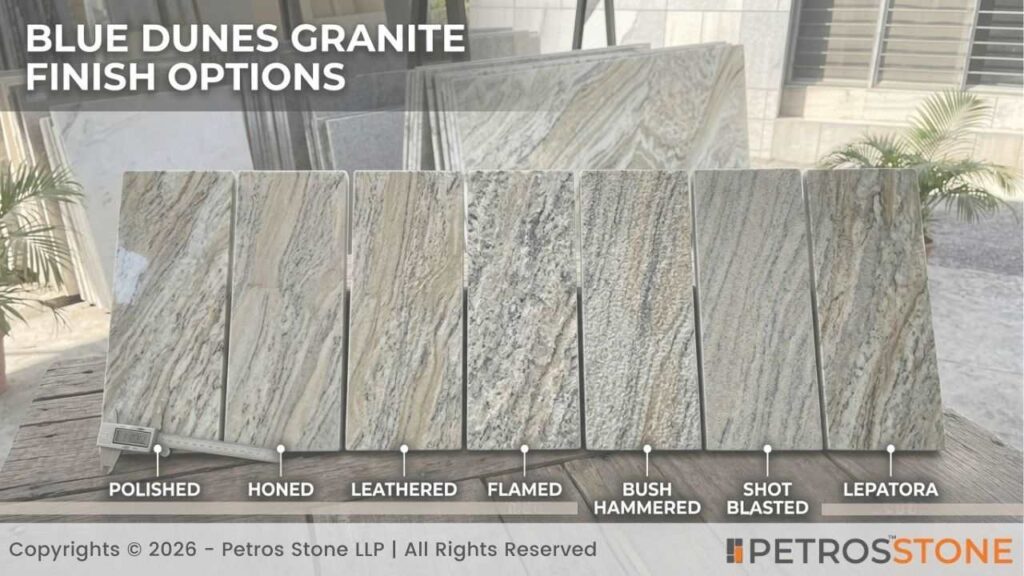
Finish options include:
- Polished
- Honed
- Leathered
- Flamed
- Bush hammered
- Shot blasted
- Lepatora
Factory Insight
In production, Blue Dunes Granite is processed using gangsaw cutting for large slabs, followed by epoxy resin treatment to stabilize natural fissures. After curing, slabs pass through calibration and multi-head polishing lines to achieve uniform thickness (±1 mm), which is critical for export quality and proper on-site installation.
Blue Dunes Granite Price Guide
The price of Blue Dunes Granite depends on size, thickness, finish, and order quantity.
Starting price for small cutter slabs:
- USD 2.20 per sq. ft. (approx.)
Price Table – Blue Dunes Granite
| Product Type | Thickness | Price (USD per sq ft approx.) |
|---|---|---|
| Cutter Slab | 2 cm | $2.20 – $2.80 |
| Gangsaw Slab | 2 cm | $2.80 – $3.25 |
| Gangsaw Slab | 3 cm | $3.25 – $3.90 |
| Tiles | 10–20 mm | $1.70 – $2.50 |
| Steps & Risers | 2–3 cm | $2.80 – $4.20 |
Note: Prices vary depending on finish and quality grade. So, for exact project pricing, it is best to request a custom quotation.
Factors That Affect Blue Dunes Granite Price
When someone asks, “Why does the price change?” The answer is simple; granite is a natural material, and many small decisions during selection and processing influence the final cost.. Some of the influencing factors are:
Thickness
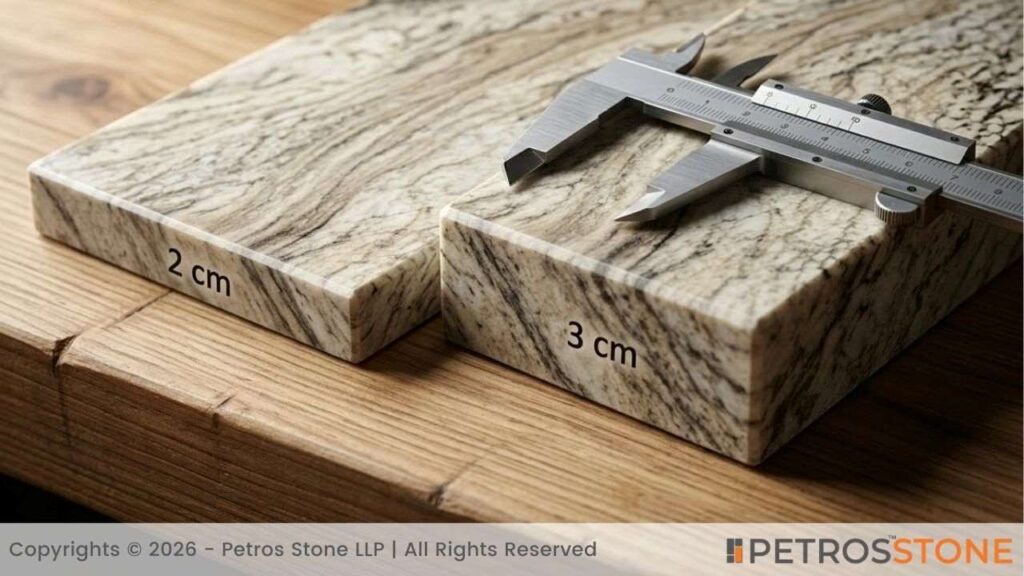
Thickness plays a big role in pricing. A 3 cm slab costs more than a 2 cm slab because:
- It uses more raw material from the block
- It weighs more, which increases transportation cost
- It requires stronger handling and packing
- It is generally preferred for premium kitchen countertops
Thicker slabs also feel more solid and luxurious, which is why many homeowners choose 3 cm for kitchens and islands. However, for wall cladding or vertical use, 2 cm is usually enough and more economical.
Quality Grade
Not all slabs are identical, even if they come from the same quarry.
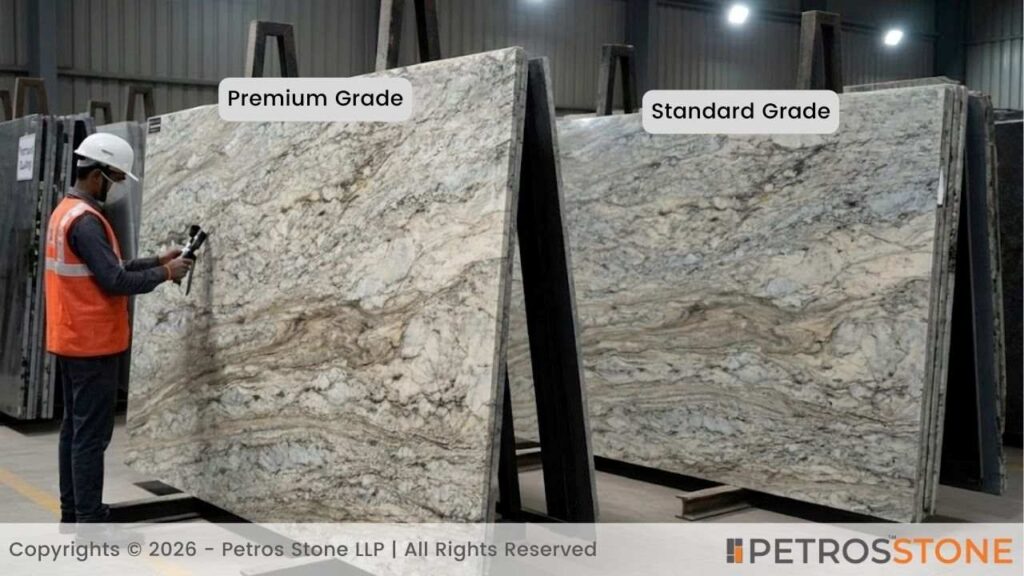
Premium quality slabs have better color balance, fewer visible cracks, minimal resin filling, and cleaner surface movement. On the other hand, lower-grade material may have more natural lines, shade variation, or repaired spots. Yes, these are natural characteristics, but they affect appearance and therefore price.
If the project is for luxury interiors or export markets, higher-grade material is usually selected, which increases the cost.
Block Selection
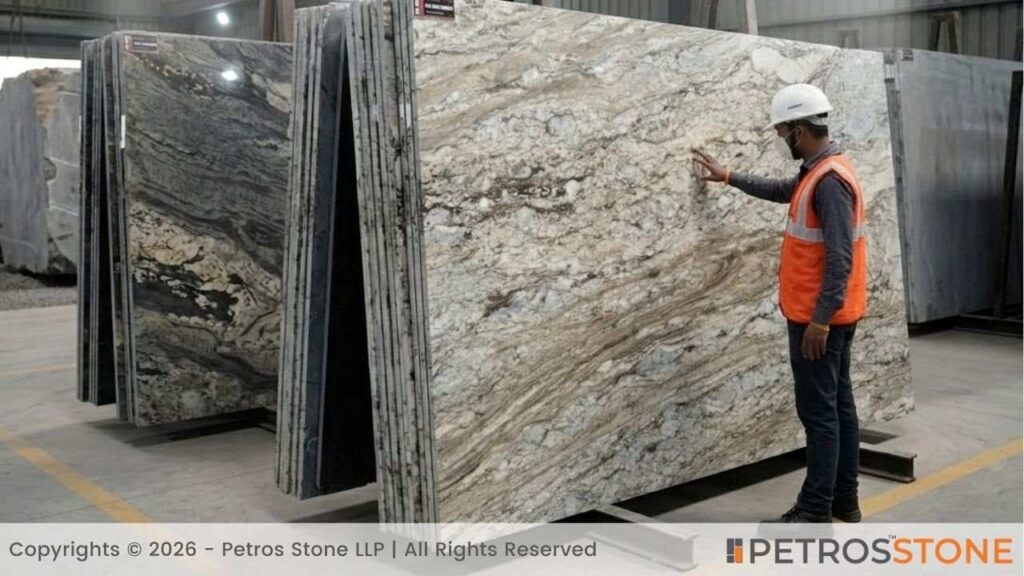
Granite is cut from large quarry blocks. So, each block has its own natural pattern. Some blocks show strong blue and gray movement, attractive golden speckles, and balanced dune-like waves, while other blocks may look darker or less uniform.
When a buyer selects slabs from a visually striking or rare block, the price increases. In short, the more visually consistent and attractive the block, the higher the price.
Finish Type
The finish changes both the look and the cost of the stone.
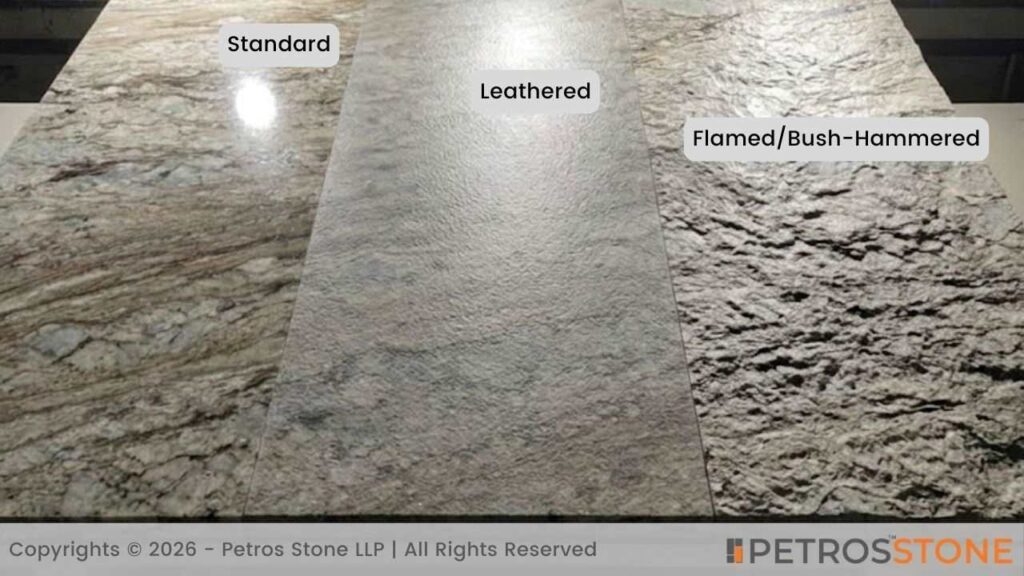
Polished finish is standard and most affordable because it is the most common process. Whereas other finishes require additional processing:
- Leathered (Gives a textured matte surface)
- Flamed (Creates a rough anti-slip texture)
- Bush-hammered (Adds a hammered & rugged look)
These finishes take extra time, labor, and machine work. That additional processing increases the overall cost.
Order Quantity
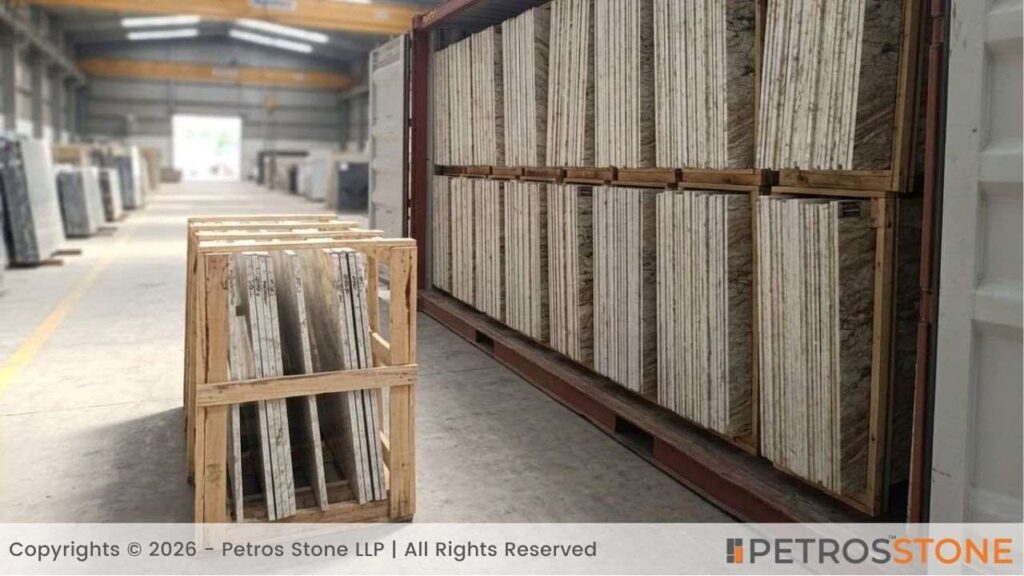
Yes, quantity directly impacts pricing. Small orders cost more per square meter because production setup cost is spread over fewer slabs and hipping is less optimized. On the other hand, bulk orders reduce the per-unit price.
For example, a 20-foot container can hold approximately:
- 450 sqm in 2 cm thickness
- 300 sqm in 3 cm thickness
When the container is fully loaded, shipping becomes more efficient, and suppliers often offer better rates.
Edge Finishing
For countertops and steps, edge design affects fabrication cost.
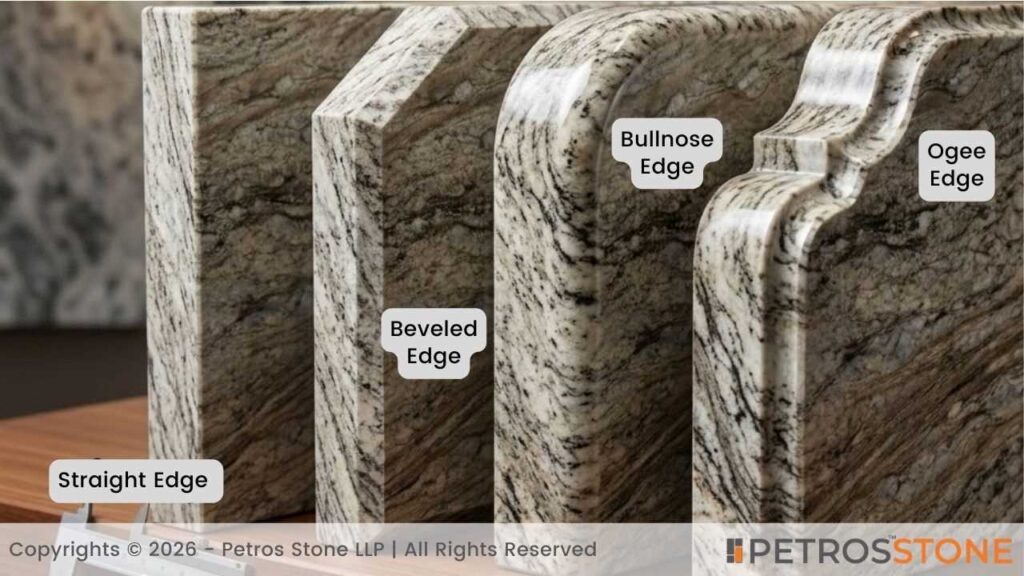
Simple straight edges are standard and economical. And, custom edges such as, Bullnose, Ogee, Beveled, and Laminated edges require additional cutting, polishing, and manual work. So, the more detailed the edge, the higher the fabrication cost.
Transportation Cost
Transportation is often underestimated by people, but it can impact the total price heavily. The final transportation cost include:
- Local transport from factory to port
- Export packing and wooden crates
- Ocean freight charges
- Insurance
- Import duties and taxes in the destination country
Because granite is heavy, freight plays a major role in pricing. Thicker slabs increase weight, which increases shipping cost. Additionally, distance also matters. Shipping to nearby countries is naturally cheaper than long-distance exports.
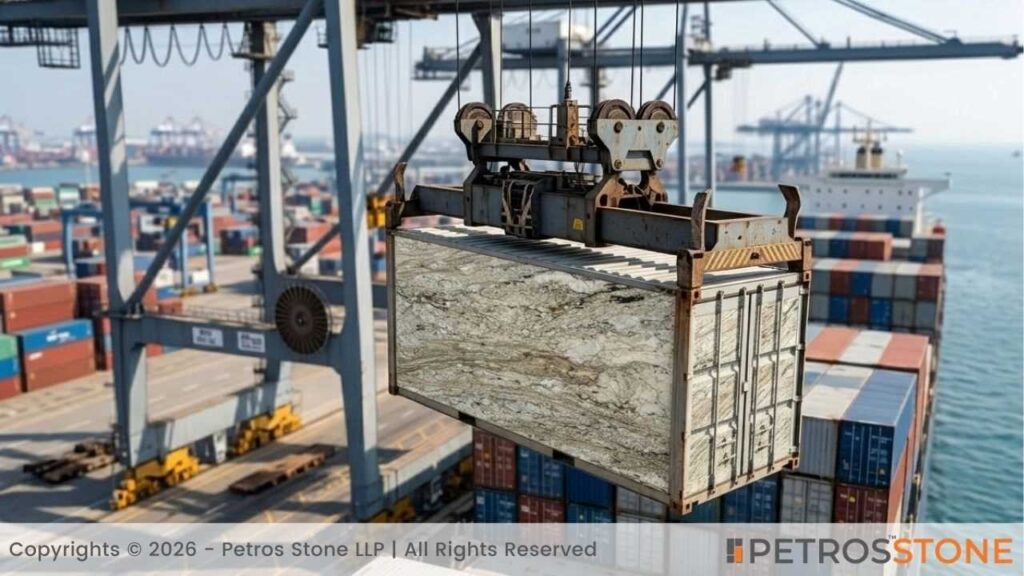
Note: While the starting price is approximately $24/m², this refers to the FOB price at the port. Factors like ocean freight and import duties in the destination country (e.g., USA or Canada) will adjust the final quote.
Blue Dunes Granite Properties
Now, let’s have a sneak peek at the top-notch properties of the Blue Dunes Granite due to which it is the favorite choice of the people nowadays.
Key Properties – Blue Dunes Granite
| Property | Description |
| Water Absorption | Doesn’t soak up water easily, so it’s great for kitchens, bathrooms, and even outdoor areas. |
| Hardness | Very hard stone that can handle daily use without getting damaged. |
| Porosity | Naturally tight grain, so it doesn’t stain easily when sealed. |
| Durability & Strength | Strong and long-lasting, keeping its look for many years. |
| Heat Resistance | Can take hot pots, pans, and sunlight without getting harmed. |
| Scratch Resistance | Tough surface that resists scratches, perfect for busy kitchens and floors. |
| Stain Resistance | A little annual sealing keeps it looking clean and fresh, with hardly any stains. |
Lab-Tested Technical Properties
| Property | Typical Value | Standard |
|---|---|---|
| Density | 2.63 – 2.75 g/cm³ | ASTM C97 |
| Water Absorption | 0.15% – 0.35% | ASTM C97 |
| Compressive Strength | 160 – 220 MPa | ASTM C170 |
| Flexural Strength | 10 – 18 MPa | ASTM C99 |
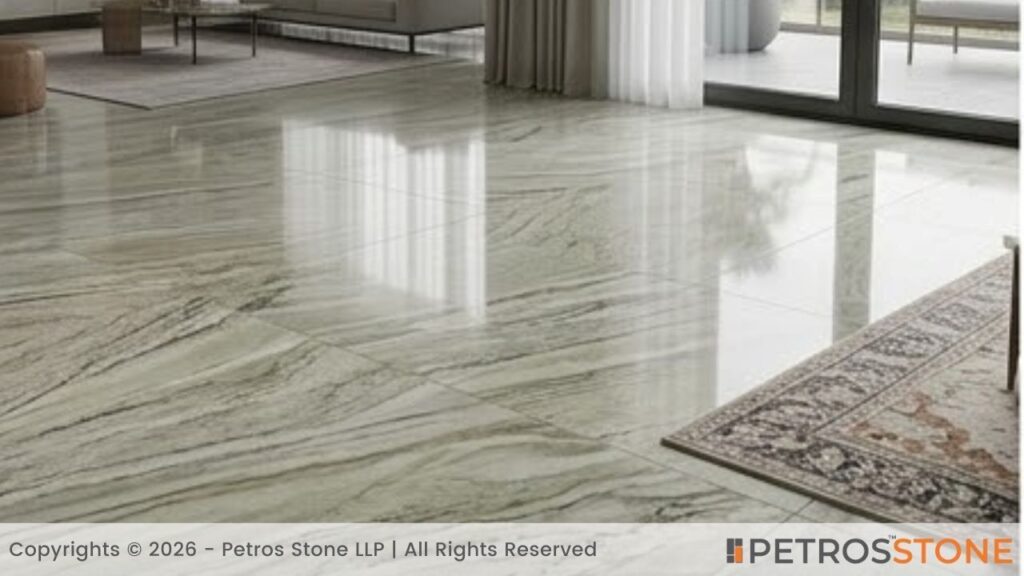
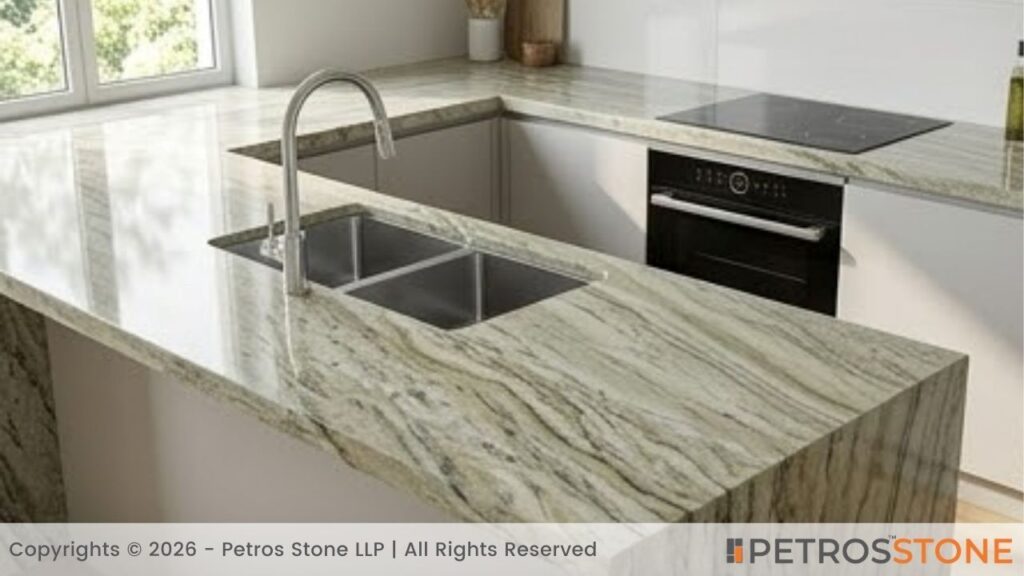
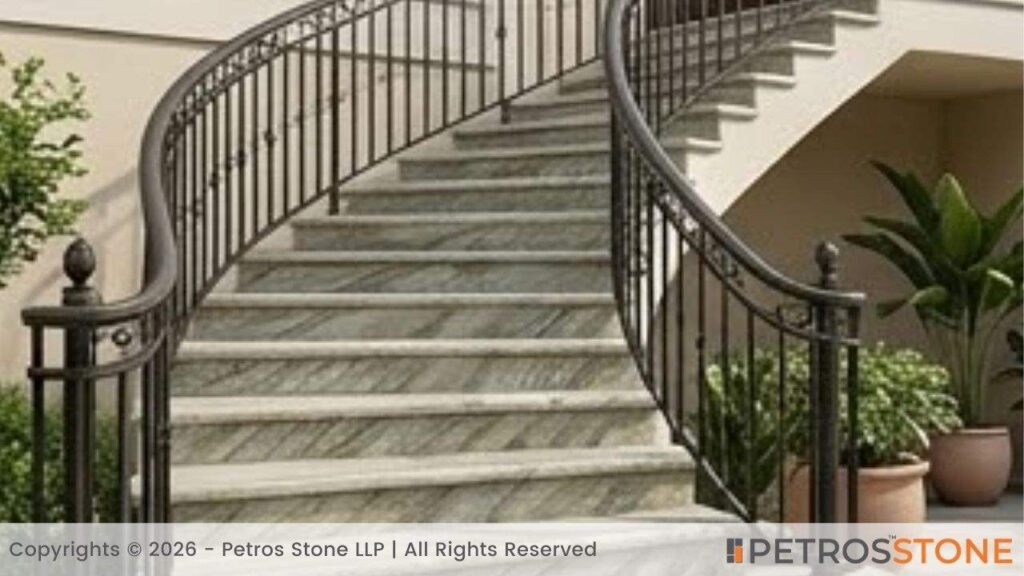
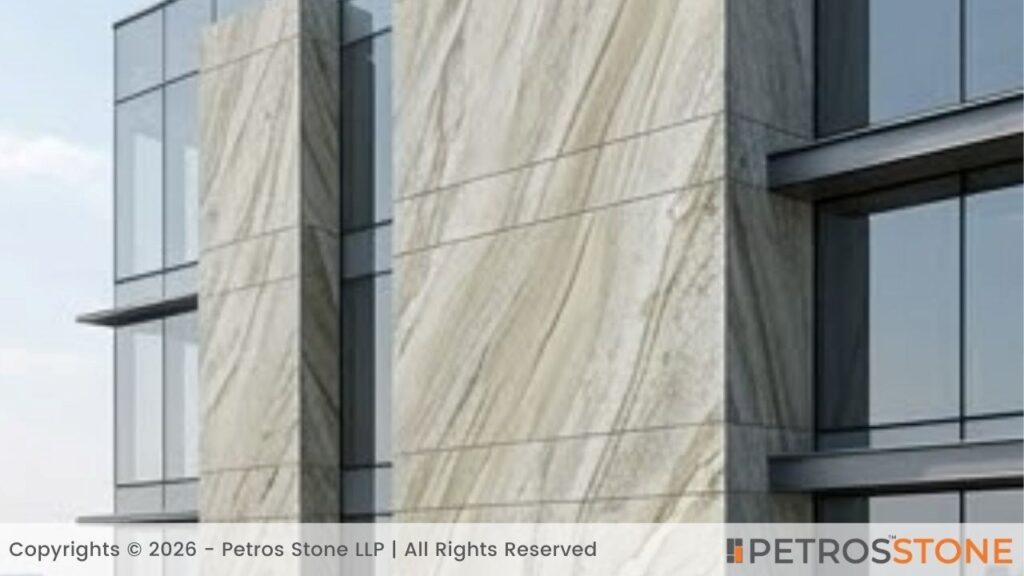
Applications
Blue Dunes Granite is widely used in:
- Kitchen Countertops
- Flooring
- Bathroom Vanities
- Wall Cladding
- Outdoor Landscaping
- Fireplace Surrounds
- Staircases
- Building Facades
Site Observation
In large flooring layouts, installers often face challenges in pattern alignment due to the directional flow of Blue Dunes. Careful dry-laying before installation helps maintain visual continuity.
Why Blue Dunes Granite is Good for Countertops
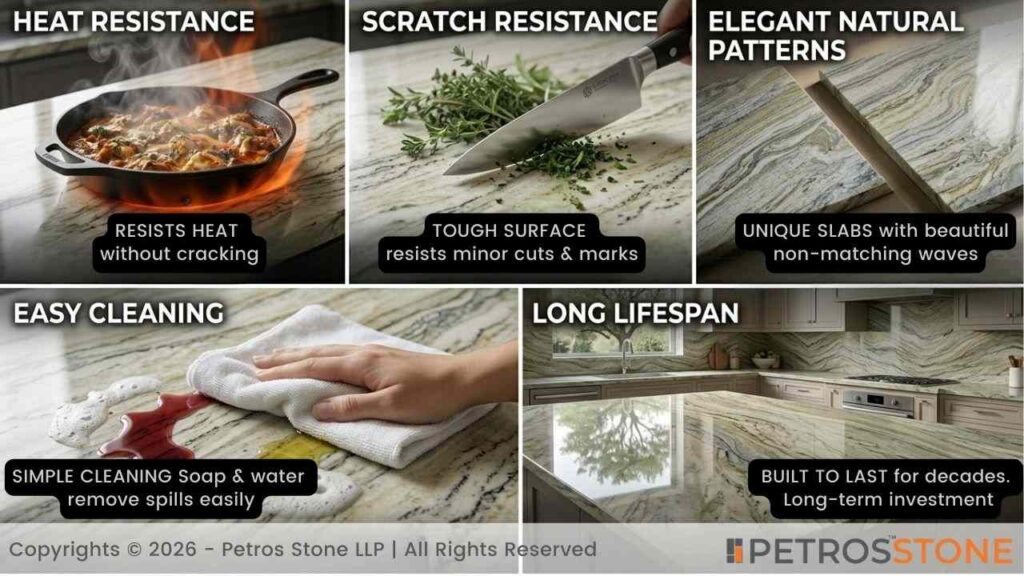
Kitchen countertops require durability and easy maintenance. Its mixed color pattern also hides minor stains and crumbs better than plain stones. The following features depicts why it is best choice for countertops:
Heat Resistance
You don’t have to worry about placing a hot pot or pan directly on the surface. Blue Dunes Granite can handle everyday kitchen heat without cracking or losing its color. It’s perfect for busy cooking spaces.
Scratch Resistance
This stone is tough. You can chop, cut, or move heavy utensils around without leaving marks. It stays looking fresh and neat even after years of use.
Elegant Natural Patterns
The slabs are unique, with beautiful waves of blue, gray, green, and touches of gold. Such natural designs give your countertop a unique look and create the cozy, luxurious ambience in your kitchen. There are no two slabs that match exactly and thus your counter top is a one-of-a-kind.
Easy Cleaning
Cleaning is simple. All one need to do is take a bit of soap and water. Because it doesn’t absorb much liquid, spills wipe away easily, and it resists stains when sealed. Therefore, daily upkeep is hassle-free.
Long Lifespan
Blue Dunes Granite is built to last. With basic care, your countertop can stay strong and beautiful for decades, making it a smart long-term investment for your home.
Blue Dunes Granite Façade Applications
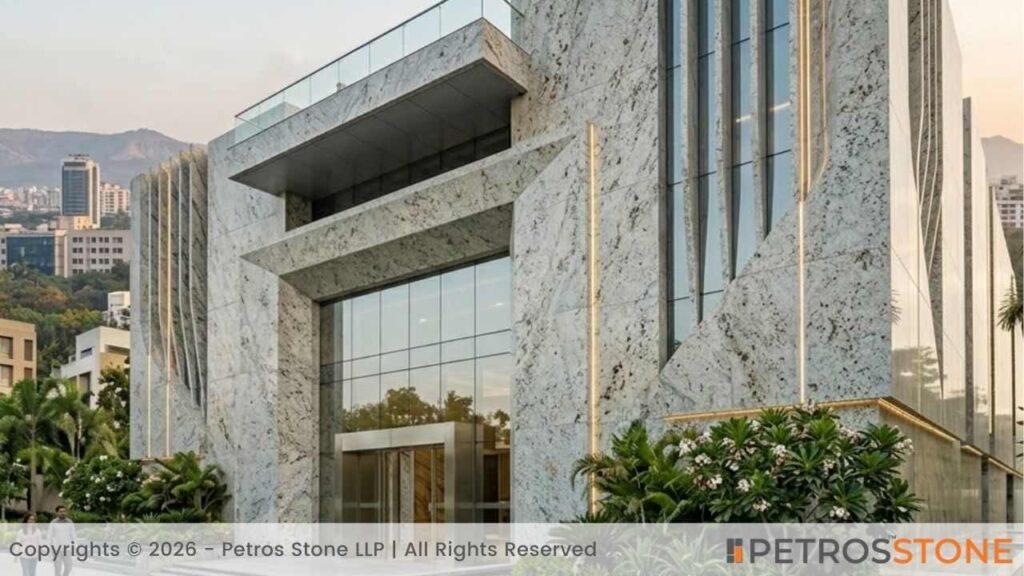
For exterior facades, this granite performs very well because:
- It withstands weather changes
- It resists moisture
- It does not fade easily
- It provides a premium architectural look
Usually, people prefer Flamed or leather finishes for exterior cladding.
How to Choose the Right Blue Dunes Granite
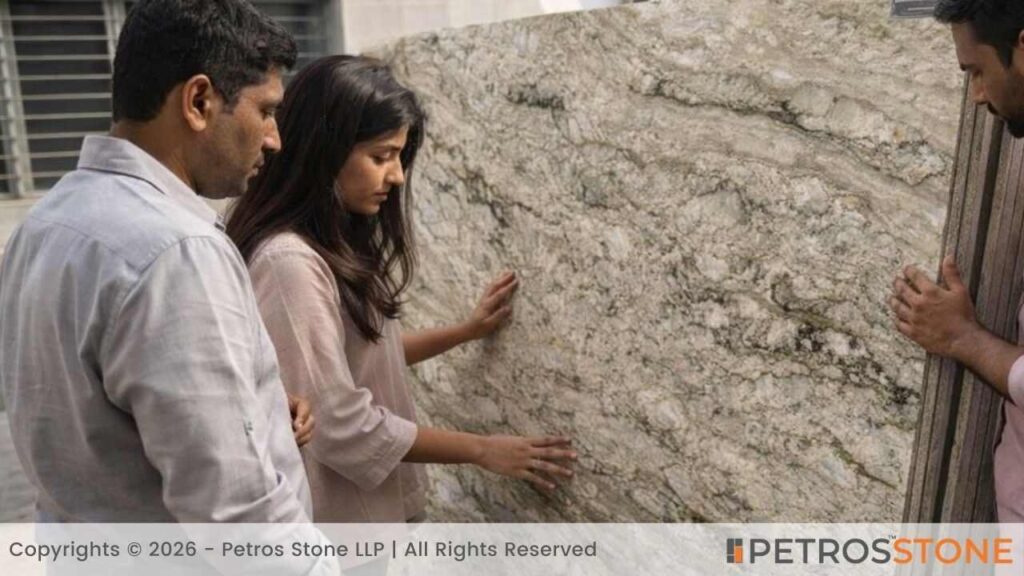
Picking the perfect slab of Blue Dunes Granite doesn’t have to be confusing. Here’s a simple way to make sure you get the best stone for your project:
1. Check the Thickness
Run your hand along the slab or ask the supplier to measure it. You want it to be even everywhere. A slab that’s thicker in some spots and thinner in others can cause problems later when it’s installed.
2. Look for Cracks or Repairs
Some slabs have tiny cracks filled with resin. That’s normal, but too many of them can make the stone weak or look patchy. So, always pick slabs that are mostly clean.
3. Match the Colors
When you require more than one slab in the project, place them side by side. The colors and patterns you want should not be clashing. This is particularly vital about countertops and large walls.
4. Pick the Right Finish
You must consider where you will be using the stone. Flooring and polished slabs are ideal in the interior walls and counters. If it is for outdoor steps or an area that gets wet, consider leathered or flamed finishes as they are safer and more practical.
5. Double-Check the Size
The worst thing is to order slabs which are either too small or too big. So, measure your space carefully and make sure the slabs you choose will fit without too much cutting.
6. See the Slabs in Person
If you can, visit the yard or at least look at real photos. Seeing the stone up close makes a huge difference. You’ll get a better idea of the pattern, color, and texture, so there are no surprises later.
Note: When inspecting a slab, ask the supplier to wet a small section or use a flashlight to check for ‘dry seams.’ Because Blue Dunes is a natural material, ensure any resin fillings used to smooth the surface are high-quality and color-matched to the stone’s grey and blue ripples.
Buyer Risk Warning
- Always inspect slabs for resin-filled fissures and color consistency
- Avoid mixing slabs from different lots without approval
- Check calibration accuracy to prevent uneven flooring
- For exports, confirm fumigated wooden crate packaging and edge protection
Installation Guidelines
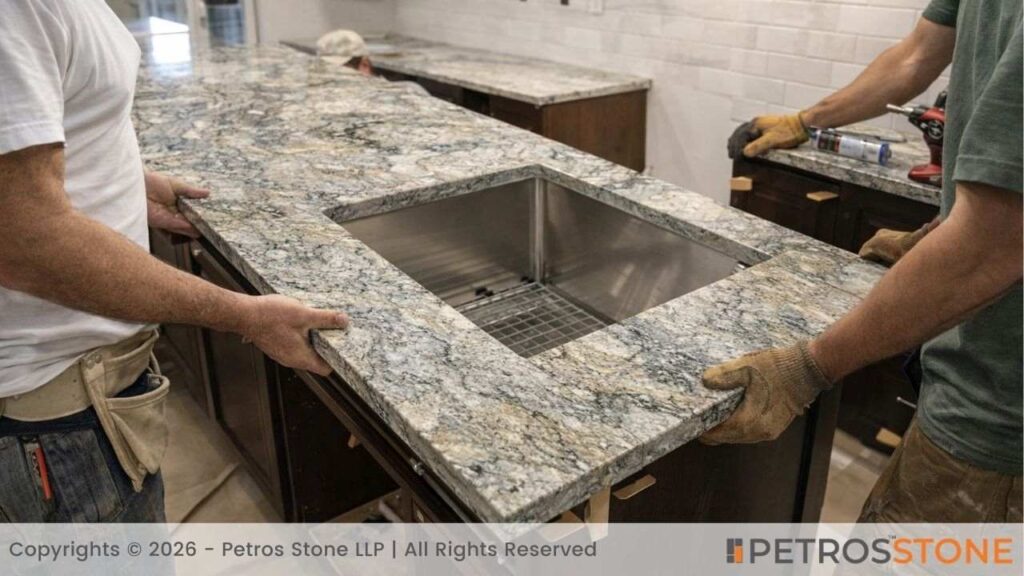
Installing Blue Dunes Granite might sound tricky, but if you follow a few simple steps, it goes smoothly and lasts for years. Here’s what to keep in mind:
1. Make Sure the Base is Level
Before placing the slabs, ensure that there is a flat area beneath because a wavy or unequal base can cause cracks or uneven wear over time.
2. Use Good Adhesive
The granite is placed by a powerful and good-quality adhesive to ensure that it does not move when it is placed on a floor, wall, or a counter. So, don’t skimp on glue.
3. Leave a Little Space for Expansion
Since you know granite expands or contracts a little with the changes in the temperature, and hence, the little space between the slabs does not permit cracks to appear and help the stone stay intact longer.
4. Seal the Surface
Once the granite is installed properly, don’t forget to apply a sealant. This prevents the occurrence of stains and simplifies the cleaning process.
5. Hire Experienced Fabricators
Granite installation takes skill. So, make sure your installers know what they are doing. Experienced hands ensure straight cuts, proper alignment, and smooth edges.
5. Support Overhangs
In case of countertops, any overhanging part needs extra support. Without it, the slab may crack or sink in the long run. Proper brackets or corbels make a big difference.
Climate Consideration
- In hot climates (India, Middle East), use UV-resistant adhesives to prevent discoloration.
- In cold regions (USA, Europe), ensure proper sealing to avoid freeze-thaw damage.
- Exterior cladding should use mechanical anchors + adhesive system for safety.
Maintenance and Cleaning Guide
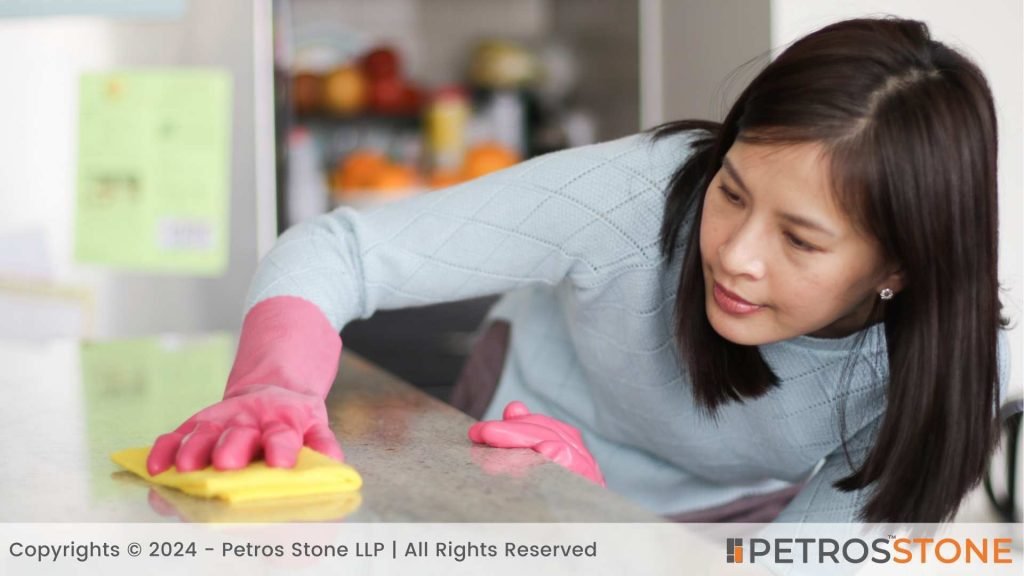
With proper care, the surface remains beautiful for decades. And, Blue Dunes Granite is not difficult to maintain. All you need to do is:
- Clean daily with mild soap and water
- Avoid acidic cleaners like vinegar or bleach
- Apply a sealant once a year
- Clean spills quickly to prevent staining
Note – “Perform the ‘Water Drop Test’ to check your sealant: place a few drops of water on the surface; if it hasn’t beaded after 10 minutes, it’s time to re-seal. Always use pH-neutral cleaners specifically formulated for natural stone to avoid dulling the polished finish.”
Professional Insight
From field experience, improper sealing is the most common reason for staining complaints. Using a penetrating sealer instead of surface coating significantly improves long-term performance.
Where to Buy Blue Dunes Granite?
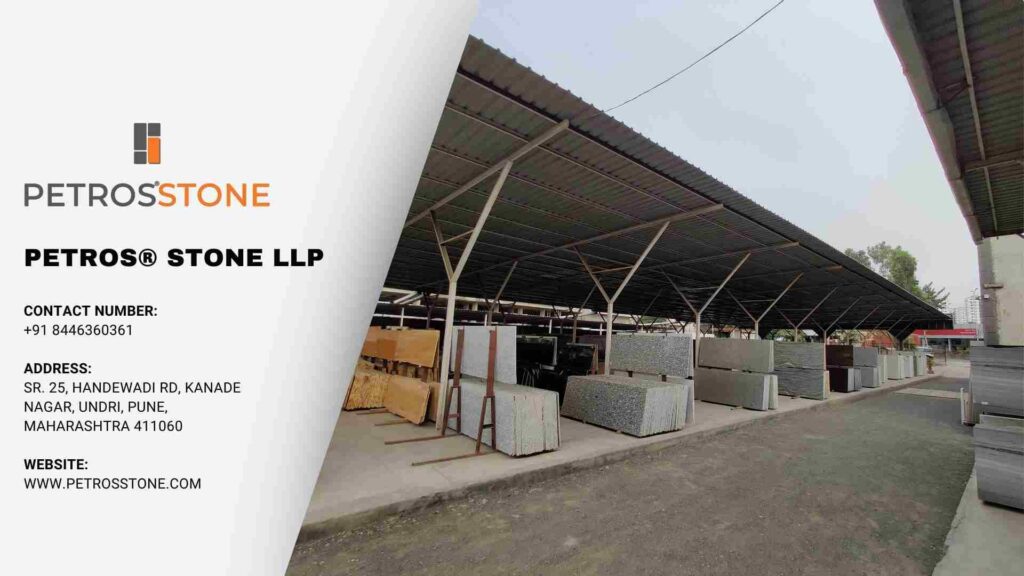
When it comes to buying Blue Dunes Granite, you have a few choices. It is possible to order it online, visit local stone shops in your neighborhood, or refer directly to a manufacturer.
If you have time, it is always best to visit a store in person to see it. Online photos can be tricky; sometimes the original colors or patterns look different, and not every slab is top quality. A close view of the stone will allow you to select the most suitable stone and avoid trouble.
Petros® Stone LLP has been supplying granite in India and the USA for years and offers:
- Gangsaw slabs
- Cutter slabs
- Tiles
- Prefabricated countertops
- Cut-to-size projects
You can contact their customer service agents directly and clear all your doubts.
FAQs
1. What is the standard thickness of Blue Dunes Granite?
18 mm, 20 mm, and 30 mm are the most common thicknesses of Blue Dunes Granite used in slabs for countertops, flooring, and staircases.
2. Is Blue Dunes Granite good for outdoor use?
Yes. Blue Dunes Granite performs well in exterior environments because granite is a dense natural stone with low water absorption and high compressive strength. It can withstand rain, sunlight, and temperature changes, making it suitable for outdoor flooring, steps, and wall cladding.
3. Does Blue Dunes Granite require sealing?
Yes. Although granite has low porosity, sealing once a year is recommended to prevent staining and maintain surface durability, especially in kitchens and outdoor areas.
4. What is the starting price of Blue Dunes Granite?
The starting price is approximately $2.10–$2.30 per sq ft for cutter slabs (around 18–20 mm thickness), depending on slab quality and quarry grade.
5. Is Blue Dunes a granite stone?
Yes. Blue Dunes Granite is a natural granite quarried in India and widely used for countertops, flooring, wall cladding, and staircases.
6. How much does Blue Dunes Granite cost?
The average cost of Blue Dunes Granite typically ranges between $2.80 and $3.80 per sq ft depending on slab thickness, finish (polished, flamed, leathered), and slab size. Premium export-grade gangsaw slabs can cost slightly higher.
7. What is another name for Blue Dunes Granite?
Blue Dunes Granite is also sometimes referred to in the market as Azul Celeste Granite, although naming can vary between exporters and regional distributors.
Key Takeaways
- Blue Dunes Granite is a natural stone with wavy and unique patterns.
- It is available in different forms: slabs, tiles, and blocks.
- You can purchase it from from various manufacturers, including Petros Stone LLP.
- It is strong and durable, which makes it suitable for kitchens, floors, and stairs.
- This stone is easy to maintain with simple cleaning and yearly sealing.
- The prices vary by thickness, finish, and size.
Feel free to get in touch for a free consultation, quote, and get a detailed understanding from our experts here at Petros®. Visit www.petrosstone.com or call +91-8446360361 or WhatsApp

Hello!
I’m Varsha, with a deep interest in architecture and years of content writing experience, I explore how natural stones like granite and marble shape beautiful, functional spaces. At Petros® Stone, I share insights that help readers appreciate the design potential and timeless appeal of stone.

Brown Granite

White Galaxy Granite

Blue Bahia Granite

Silver Cloud Granite

Black Pearl Granite

Dallas White Granite